JOURNALISTS’ protection must be a national priority in Syria, demands the International Federation of Journalists (IFJ).
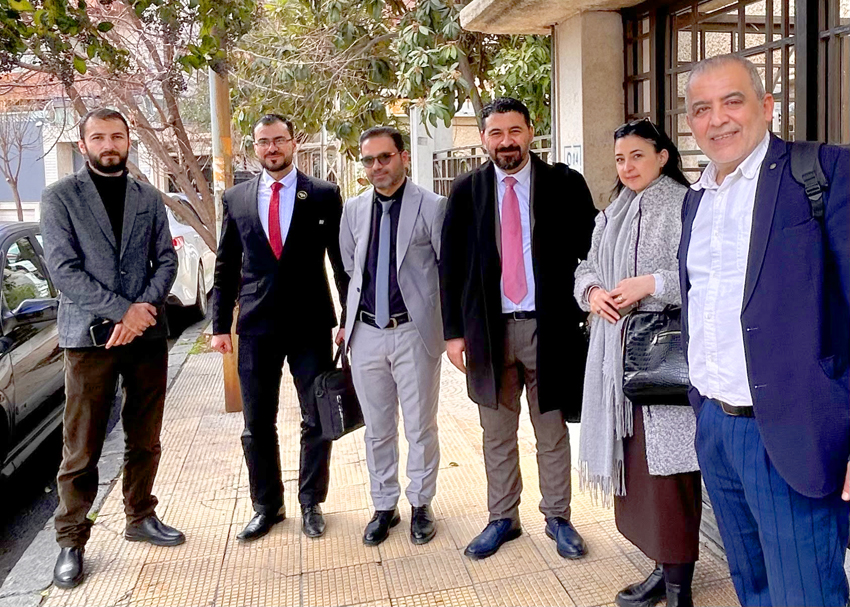
The IFJ, in coordination with one of its affiliates in the country, the Syrian Journalists’ Association (SJA), organised a conference on 12 February in Damascus to promote a safe working environment for journalists and media workers.
Representatives of the IFJ and media institutions attended the conference, where discussions focused on the challenges of rebuilding professional journalism in Syria, after the fall of Bashar Al Assad’s regime in December 2024.
The event addressed the growing risks that journalists face in the workplace and when reporting on the ground.
The concept of ‘institutional duty of care’ was introduced, setting out the legal and ethical obligation of media organisations to protect their staff from physical, psychological, digital and professional risks, whether they are permanent employees, contributors or freelance journalists.
Participants emphasised that protecting journalists is a shared commitment requiring clear occupational health and safety policies, regular physical and digital safety training, psychological and legal support, insurance coverage and social protection, rather than an individual responsibility.
Additionally, IFJ representatives highlighted the importance of establishing safe and confidential complaint mechanisms at the national level to safeguard whistleblowers and ensure that journalists can carry out their duties without fear of retaliation.
Discussions also reviewed relevant international frameworks for prevention, protection and accountability. These included the International Labour Organisation (ILO) Convention 190, which tackles violence and harassment in the world of work, and the UN Plan of Action on the Safety of Journalists.
During the meeting, the SJA launched its annual report, ‘Press Freedom in Syria 2025: Transformations in the Landscape and Protection Challenges’, and presented its main findings.
The report documents 49 violations of media rights in 2025, including the killings of two journalists: Ibrahim Ajaj and Sari Majid Al-Shoufi. Other restrictions on press freedom included arrests, assaults and the prevention of coverage, which underscores the urgent need to strengthen legal provisions that guarantee press freedom.
IFJ General Secretary Anthony Bellanger said: ‘The safety of journalists is at the heart of credible and professional journalism
‘Protecting journalists is neither optional nor a matter of symbolic solidarity; it is a legal and ethical obligation incumbent upon institutions and states alike.
‘We call on the Syrian government to align national legislation with relevant international standards, and to implement reforms to the media sector that guarantee the safety and accountability of journalists.’
Meanwhile, dozens of women from Syria’s Alawite minority have reported kidnap and rape by the Al Qaeda-linked HTS regime since the fall of Bashar al-Assad in December 2024.
The Syrian Feminist Lobby (SFL), an advocacy group for women’s rights, says it has recorded reports – from families, media and other sources – of more than 80 women who have gone missing.
It says it has confirmed 26 of those cases to be kidnappings.
Nearly all those reported missing are members of the Alawite sect that makes up about 10% of Syria’s population and to which the ousted president belongs.
The kidnappings and disappearances recorded by the SFL span a period from February 2025 to early December. This is both before and after March, when more than 1,400 people, mostly Alawite civilians, were killed in sectarian violence in the western coastal regions.
Forces loyal to the Sunni Islamist-led government were accused of a wave of revenge killings following a deadly ambush by Assad supporters.
- Turkish President Tayyip Erdogan said he is pleased to see steps taken in neighbouring Syria to integrate the Kurdish-led Syrian Democratic Forces (SDF) into state structures, after a US-backed ceasefire deal late last month between the sides.
In a readout on Wednesday of his comments to reporters on a return flight from Ethiopia, Erdogan was cited as saying Ankara is closely monitoring the Syrian integration steps and providing guidance on implementing the agreement.
Turkey’s military operations have repeatedly targeted Kurdish armed groups it deems linked to the Kurdistan Workers’ Party (PKK), which Ankara considers a terrorist organisation.
Turkey has long opposed any formal empowerment of Kurdish forces near its border, fearing that autonomous governance structures could embolden separatist demands within its own Kurdish population.
At the same time, Ankara has periodically engaged with Damascus indirectly through third parties.
Erdogan’s diplomatic messaging appeared aimed at signalling openness to stability-oriented cooperation while insisting that Ankara’s security concerns remain paramount.
Humanitarian advocates also emphasise that any security-oriented engagement must account for the needs of civilians who continue to endure the consequences of protracted conflict, including displacement, economic hardship and fractured local institutions.
Meanwhile, the Syrian army has taken control of the strategic Shaddadi military base in northeastern Syria following coordination with the United States, in what officials described as a significant step towards restoring state sovereignty over resource-rich and long-contested territory.
The defence ministry said in statements carried by the state news agency Syrian Arab News Agency that government forces had assumed control of the base in the countryside of Hasakah province after coordination with the US side, without providing further details.
The development comes days after Washington confirmed its withdrawal from the al-Tanf base near Syria’s borders with Iraq and Jordan, and amid a broader US-brokered agreement to integrate the Kurdish-led Syrian Democratic Forces (SDF) into central state institutions.
The Shaddadi base is one of the most prominent strategic positions in Syria’s Jazira region, linking Hasakah and Deir Ez-Zor provinces, areas that have formed the backbone of Kurdish-led control in the northeast.
Located on the outskirts of the town of Shaddadi, the site had been under the control of the US-led international coalition since 2016, after Islamic State was expelled. It was used as a central hub for operations and for securing nearby oil fields.
Shaddadi also lies close to a detention facility where Kurdish forces previously held Islamic State militants, before government forces advanced into the area in January.
In recent days, US forces were seen withdrawing equipment from Shaddadi, with convoys entering from Iraq via the al-Yarubiyah crossing to transport military material.
Witnesses reported that coalition forces were also evacuating the Kharab al-Jir base near Rmeilan, detonating parts of the facility during their departure.
The transfer of Shaddadi follows a ‘comprehensive agreement’ on January 30 between the Syrian government and the SDF.
Under the agreement, the defence ministry is to establish a new division for the northeast, incorporating SDF forces into three brigades. It also stipulates the deployment of government security vehicles into SDF-held cities and the beginning of the integration of Kurdish internal security forces.