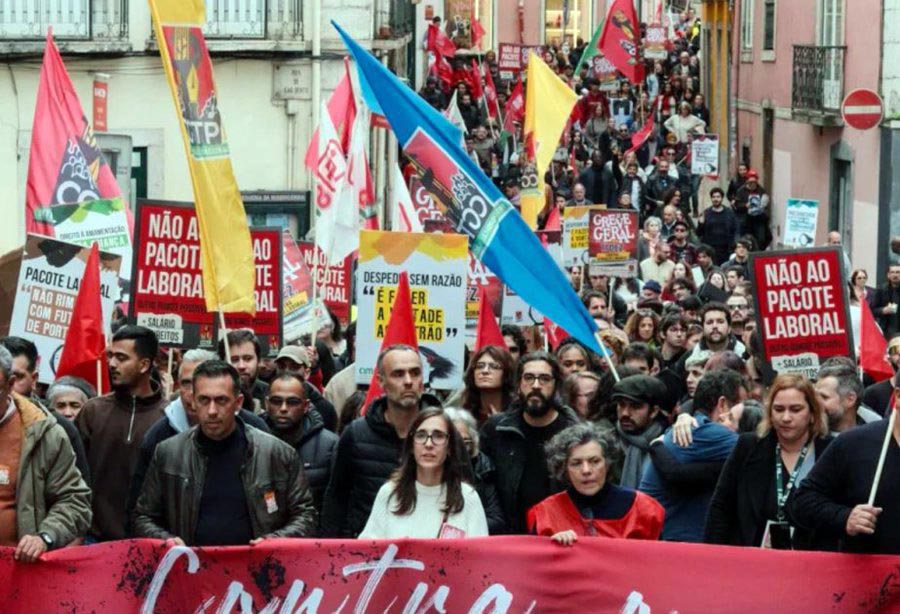
A second general strike in six months which started on Tuesday evening disrupted services across Portugal on Wednesday and continued into Thursday.
The nationwide action, which involved workers in both the public and private sectors, halted trains, cancelled hundreds of flights and closed almost all the country’s schools, as trade unions protested against the right-wing government’s labour reform plans which attack pay and conditions and make privatisation easier to do.
Portugal’s minority centre-right government is likely to pass a bill with support from the far-right Chega party proposing changes to over 100 articles of the labour code that ‘aim to boost productivity and spur growth’ after talks with unions collapsed.
Tiago Oliveira, head of Portugal’s largest trade union federation the General Confederation of the Portuguese Workers (CGTP), which called the general strike, said that the reform would worsen workers’ conditions by helping companies that use cheap labour to deregulate working hours, making it easier to sack workers and curbing the right to strike and parental protections.
Rodrigo Azevedo, a 30-year-old bank employee, said: ‘The reform would leave young workers stuck on precarious contracts for life, forcing them to work 50 hours a week without extra pay instead of the current standard of 40 hours, while making it easier to dismiss and replace them with cheaper outsourced labour.’
Rafael Medeiros, a transport worker, said: ‘The strike is the signal the government and parliament need to slow down the reform.
‘The labour package is a major threat not just to the future of young workers, but to our present.’
State-owned railway, CP, suspended all long-distance trains and the vast majority of regional trains, while Lisbon’s metro shut from Tuesday until Friday.
Schools closed nationwide due to staff shortages, and hospitals postponed most surgeries and appointments following a nursing walkout.
Portugal’s national airline TAP said it would operate just 79 of its usual 300-plus daily flights on Wednesday, while Iberia had education of over 75 per cent.
In the public transport sector, Tiago Oliveira cited 100 per cent participation at Lisbon Metro (underground trains), Transdev Viseu, the Urban Transport Company of Guarda and the urban transport company of Covilhã, as well as ‘Carris workshops with 98 per cent participation; Soflusa/Transtejo, 85 per cent participation; and CP operating only minimum services’.
The government’s reform envisions making just-cause dismissals easier, allowing companies to deny workers reinstatement in cases of illegal dismissal provided they pay compensation, and lifting limits on outsourcing.
An earlier strike in December was the first general shutdown since protests against austerity in 2013.
No UN Security Council seat for Germany
GERMANY suffered a humiliating defeat in its bid for a non-permanent UN Security Council seat, with Berlin acknowledging that its unwavering support for Israel had cost it key votes in the General Assembly.
The country was also criticised for massive cuts to its foreign aid budget.
Chancellor Friedrich Merz’s effort to restore Germany’s influence on the global stage was dealt a severe blow on Wednesday when the United Nations General Assembly awarded the two coveted Western European Security Council seats to Portugal and Austria instead.
German Foreign Minister Johann Wadephul described the outcome as a ‘bitter defeat’, attributing part of the loss to Berlin’s steadfast support for Israel, which he suggested alienated crucial UN allies.
However, he added that the result would not deter Germany from what he called continuing ‘to stand by our historical responsibility’ to the Tel Aviv regime.
Despite a lobbying blitz that included personal appeals to 80 ministers and ambassadors, Wadephul’s campaign failed as UN delegates favoured smaller nations like Portugal and Austria.
Germany received only 104 votes in the race for the two United Nations Security Council seats allocated to the Western European and Others Group (WEOG), while Portugal, with 134 votes, and Austria, with 131 votes, secured seats on the Security Council.
Kyrgyzstan, Trinidad and Tobago and Zimbabwe were also elected to the Security Council, which is the only UN body that can make legally binding decisions such as imposing sanctions and authorising use of force.
SPD foreign policy spokesman Adis Ahmetovic warned that the vote served as ‘a gauge of how Germany is perceived internationally’ and was ‘not a mere mishap, but a warning sign’.
Wadepul said: ‘We have always taken a clear stance on certain issues, and these are positions that not all member states share.
‘The fact that Germany must always assume a special responsibility for Israel in the Middle East conflict may also have cost votes.’
Merz said: ‘This result does not alter the tasks we face at the United Nations. Germany remains a reliable pillar of the multilateral system.’
Craig Mokhiber, former director of the New York office of the Office of the UN High Commissioner for Human Rights (OHCHR), also linked the defeat to Germany’s position on Israel and Palestine.
Mokhiber said: ‘In a rare moment of justice at the UN General Assembly today, Germany lost its bid for a UN Security Council seat.
‘Germany’s scandalous support for genocide in Palestine and aggression against Iran, and its repression of human rights defenders inside Germany, were all on display as the body handed Germany this unprecedented loss.’
Lisa Ditlmann, the director in Germany of the ONE charity which encourages countries to send aid o African countries, said: ‘Those who, like the German government, want to make massive cuts to development cooperation for the fifth time in a row should not be surprised by a lack of support on the international stage.’
In addition to the five permanent members – the US, China, Russia, France and the United Kingdom – there are 10 non-permanent members who rotate every two years.
Since 1987, Germany, one of the world’s most economically powerful countries, had been elected to the body every eight years.