BOLIVIA’S political crisis deepened on Tuesday after Defence Minister Marcelo Salinas and Education Minister Beatriz García resigned amid ongoing protests and road blockades demanding the resignation of right wing President Rodrigo Paz.
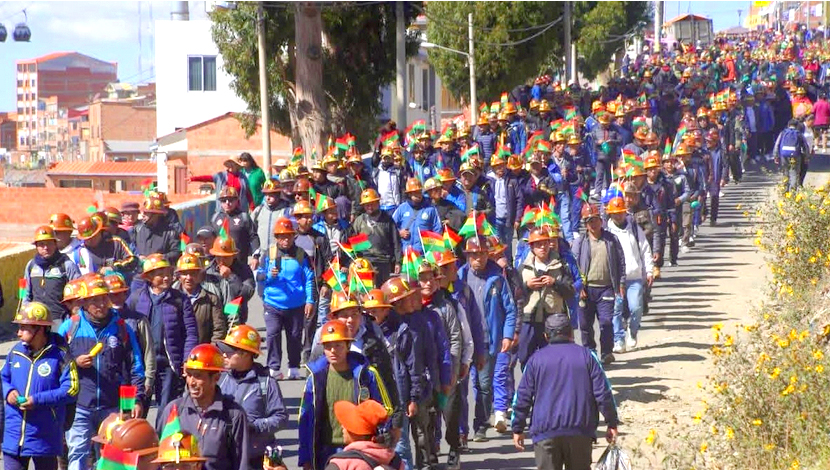
The resignations came on the 33rd day of demonstrations led by the Central Obrera Boliviana (COB) and peasant organisations in the department of La Paz.
Protesters continue to reject the government’s economic policies and are calling for Paz to leave office.
Both ministers stepped down after refusing to sign a decree establishing a state of exception following the enactment of Law 1732.
The government is considering the measure to authorise military intervention against more than 90 road blockades registered across eight regions of the country.
The departures were announced after a cabinet meeting at the Government Palace in La Paz.
Salinas had headed the Defence Ministry since November 2025, overseeing the country’s armed forces and state security structures.
He was replaced immediately by Ernesto Justiniano, who previously served as deputy minister for Social Defence and Controlled Substances.
Justiniano, currently Bolivia’s top anti-narcotics official, was appointed to lead a potential intervention in the Tropic of Cochabamba, a political stronghold of former president Evo Morales.
The appointment was reportedly made following instructions from the United States embassy.
Education Minister Beatriz García also resigned on Tuesday. No official explanation for her departure was provided, and the government has not announced a successor.
The latest cabinet departures add to mounting instability within the administration.
On May 21st, Labour Minister Edgar Morales also resigned after facing sustained pressure from the COB and industrial unions participating in the nationwide mobilisations.
Social organisations have continued to reject dialogue with the government while road blockades have disrupted transportation and economic activity across western Bolivia.
The situation has contributed to shortages of food, medicines and fuel in La Paz.
Among the protesters’ principal demands are the resignation of President Paz, who took office nearly seven months ago, the release of detained social leaders, the withdrawal of legislative proposals including the so-called Anti-Blockade Law, and opposition to privatisation initiatives promoted by the government.
Tensions have intensified after the Legislative Assembly, where right-wing forces control 93 per cent of seats, repealed legislation that limited the declaration of a state of exception.
The move leaves the executive branch with greater latitude to deploy the armed forces in response to the protests, despite continued resistance from the COB and other unions and indigenous groups.
The resignations came on the same day as thousands of Bolivians gathered to protest in the city of El Alto to reaffirm their demand for the immediate resignation of Paz and to declare themselves in a state of emergency and permanent mobilisation.
Participants also decided to intensify pressure measures, reject the alleged dialogue proposed by the right wing government, and sign a unity pact with the Bolivian Workers’ Central (COB).
The demonstration was convened by the Federation of Neighbourhood Councils (FEJUVE), an organisation that mobilises neighbourhoods in El Alto and La Paz, which have participated in the protests taking place since early May.
‘After days of conflict, there are more than 100 road blockades in seven out of the country’s nine departments,’ outlet El Deber recalled, adding that shortages of food and fuel are being felt in major cities.
‘The different sectors propose continuing the struggle for the resignation of President Paz, rejecting the entirety of his adjustment and plundering policies, which are aligned with the interests of imperialism in the region,’ outlet La Izquierda Diario stated.
‘Bolivia awoke with more than one hundred blockades across the country, demonstrating a growing willingness to fight after a month of mobilisations and roadblocks at different locations,’ it added.
Social tensions intensified after the conservative-controlled National Assembly repealed a law that limited presidential powers to declare a ‘State of Emergency’.
As a result, Paz can now deploy the armed forces at any moment against the workers, miners, farmers and students leading the resistance.
- Meanwhile, Brazilian President Luiz Inácio Lula da Silva described US Secretary of State Marco Rubio as ‘an enemy of Latin America’ on Tuesday, following renewed tariff threats from Washington.
He also accused allies of former President Jair Bolsonaro of supporting foreign interference in Brazil by backing US measures against the country.
Speaking at an event in the state of Goiás, Lula said he had conveyed his objections to US policies directly to President Donald Trump during a three-hour meeting.
Lula said: ‘He is anti-Latin America. He is a mortal enemy of Cuba and several other Latin American countries.’
The remarks came after Rubio’s statements before the US Senate, where he excluded Brazil, Colombia, Venezuela, Nicaragua and Cuba from a list of hemispheric allies.
Rubio also supported a proposal by the Office of the United States Trade Representative to impose additional tariffs of 25 per cent on Brazilian exports.
Lula said his government would defend Brazil’s economy against pressure from Washington.
He also accused the United States of using security allegations and terrorist designations to expand its economic and military influence in Latin America amid growing competition with China.
Lula added: ‘As I do not have ships to wage Trump’s wars, nuclear bombs or military power, my war is that of truth against lies, against narratives.’
The Brazilian president also condemned members of the Bolsonaro family for publicly supporting US measures against Brazil, calling their actions a betrayal of national interests.
‘They are traitors to the homeland. They went and asked a foreign country to interfere in Brazilian decisions,’ Lula said.
He pointed to Senator Flávio Bolsonaro’s public support for trade restrictions imposed by Donald Trump last year and also criticised former congressman Eduardo Bolsonaro for backing economic pressure against Brazil.
- On Monday, leftist presidential candidate Roberto Sanchez, of the ‘Together for Peru’ coalition, presented a new government plan, developed in consensus with other political forces, ahead of the presidential run-off against far-right candidate Keiko Fujimori.
He highlighted changes such as respecting Free Trade Agreements (FTAs), which he had initially promised to review during his campaign.
The candidate asserted that he seeks to restore democracy, justice, and progress.
The programme, titled: Strategic Priorities for Governance and Equitable Development of the Peruvian Nation: 2026-2031, incorporates contributions from allied leftist parties such as Now Nation and People First.
Sanchez emphasised that the current democracy does not represent Peruvians and that the mainstream economic model ‘sees them only as a number’, calling on citizens of diverse traditions and backgrounds to build a political majority.
During a press conference, he introduced his technical team, comprised of former ministers Pedro Francke, Anahi Durand, Manuel Rodriguez, and Hernando Cevallos, all linked to the government of former president Pedro Castillo (2021-2022).
He also included national experts such as Gustavo Guerra, Walter Ayala, Jose Domingo Perez, Gianina Avendaño, Oscar Dancourt, Giovanna Vasquez, Duberli Rodriguez, Andres Alencastre, and Sinesio Lopez.
The announcement came after a tense electoral debate with Fujimori, where both candidates accused each other of being responsible for the national ‘chaos’ on the eve of the presidential run-off.
Fujimori and Sanchez received the first and second highest vote totals, respectively, in the 12th April general election and concluded their campaigns yesterday, before the run-off on Sunday.