
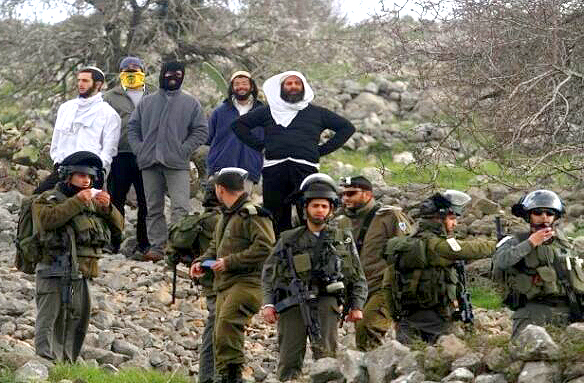
ISRAELI occupation forces seized four Palestinian homes in the town of Till, southwest of Nablus, on Thursday and converted them into military outposts, as settler organisations circulated calls for a mass incursion into the town on Friday.
Local sources said troops took over the home of Arab Ramadan in the Al-Hawuz area and warehouses belonging to Abdul Salam Shteyah in Al-Qabala.
Two further homes were seized, that of Basil Maarouf Hindi on the road to Surra and that of Abu Ali Shehadeh near the Bir Al-Ghazal junction, with soldiers positioned inside as part of preparations to secure settler movement through the area.
In the same operation, the road running alongside the Yitzhar settlement, built on land belonging to the village of Burin south of Nablus, was closed to vehicles until Friday evening to clear the way for provocative marches planned by settlers.
The incursion called for Friday is to take the form of a field tour of Till’s land under the supervision of settler organisations, framed as retracing the steps of a settler killed there last week.
That killing followed a settler raid on Till the previous Friday in which four young Palestinians were killed, two of them brothers.
An armed settler and an Israeli soldier were also killed after one of the villagers, Farouq Ramadan, seized a settler’s weapon and opened fire before being shot dead by settlers and Israeli forces.
The pattern repeated itself at Burin, where soldiers and settlers carried out a joint incursion and clashes broke out.
Troops fired tear gas and stun grenades to open the way for the settlers, who tried to attack a concrete factory on the western edge of the village before moving into its eastern neighbourhoods. Residents confronted them.
The episode fits a form of settler violence now routine across the West Bank, carried out with army protection and, increasingly, with the army clearing ground in advance.
Further north, the occupation authorities extended military closure orders on the Jenin, Tulkarm and Nur Shams refugee camps until the end of September.
The extension was issued two days before the existing order was due to lapse, and prohibits anyone from entering, remaining in or leaving the three camps without a permit issued by the Israeli military.
The effect is to give formal cover to military operations that have been running for months.
Those operations have gutted the camps. Since the start of the year, Israeli forces have carried out sustained demolition and bulldozing in Jenin and Tulkarm camps, wrecking homes and the infrastructure beneath them.
Thousands of families have been displaced, and residents have been barred from returning even to inspect what is left of their property or to repair it.
Raids and arrest sweeps continued alongside the closures. In Jenin governorate, forces stormed the town of Qabatiya and searched homes and businesses at length. Several young men were arrested and taken to undisclosed locations.
In Ramallah governorate, the town of Turmus Ayya and the villages of Abu Falah and Al-Mughayyir were left without power overnight after soldiers fired live ammunition and tear gas directly at the area’s main electricity transformer during a raid.
Troops moved into residential neighbourhoods in Turmus Ayya on foot and fired heavily, damaging the network and cutting essential services. Palestinian utility crews had been working since early morning to restore supply.
The sharpest escalation is in the northern Jordan Valley, where the objective is stated openly. Settlers have renewed their incursions into the Palestinian community of Ras al-Ahmar, east of Atouf, and have given residents ten days to leave their homes.
Local sources said settlers wearing uniforms resembling those of the Israeli military raided houses overnight and cut electricity to the eastern part of the community.
Roads into the area have been closed, leaving a single difficult route open, and residents warn that a planned new road would sever Ras al-Ahmar from its surroundings entirely.
Water has been targeted directly. The occupation authorities recently demolished three artesian wells in Khirbet Atouf and Ras al-Ahmar, part of what residents describe as a campaign to strip the community of the water it needs to remain.
The demolitions sit within a wider land-clearing operation running since the start of the year across the Al-Baqi’a Plain and Atouf, known as the Scarlet Thread Project, which local sources say involves military roads and a separation barrier seizing large areas of Tubas governorate and the northern Jordan Valley.
The bulldozing has destroyed major water networks and uprooted trees, cutting supply to some 30,000 dunums, roughly a third of the Al-Baqi’a Plain and among the most productive agricultural land in the West Bank.
An eviction ultimatum delivered by armed civilians, backed by well demolitions and road closures, describes the forcible transfer of a protected population under occupation.
The scale is documented. More than 1,182 Palestinians have been killed in the occupied West Bank since October 2023, with thousands wounded and close to 24,000 arrested over the same period.
Israeli forces and settlers carried out more than 11,074 attacks in the West Bank during the first half of 2026 alone.
Around 750,000 settlers now live in the occupied West Bank across 141 settlements and 224 outposts, including some 250,000 in occupied Jerusalem.
The Euro-Mediterranean Human Rights Monitor warned on Thursday that the the campaign against the International Criminal Court is deliberately weakening it.
The United States is leading a push with Israeli backing that combines sanctions, threats and public calls for states to leave the court.
Member states are withdrawing while investigations are live, or by picking and choosing which of the court’s decisions to comply with.
US sanctions imposed on ICC officials over cases involving American and Israeli figures amount to direct interference in the independence of international justice, Euro-Med Monitor said.
The arrest warrants issued against Israeli Prime Minister Benjamin Netanyahu and former war minister Yoav Gallant remain in force, and member states are under a legal obligation to cooperate in executing them.
It criticised Greece, Italy and France for permitting a government aircraft carrying Netanyahu to transit their airspace despite the outstanding warrant.
Euro-Med Monitor called on these withdrawing states to reverse course, urged Washington to abandon its campaign against the court, and demanded that European governments convert declared support into practice, including arresting wanted individuals who enter their territory.