Many world capitals witnessed on Saturday demonstrations denouncing Israel’s ongoing violations of the ceasefire agreement in Gaza, calling for an end to the war of extermination and the entry of humanitarian aid.
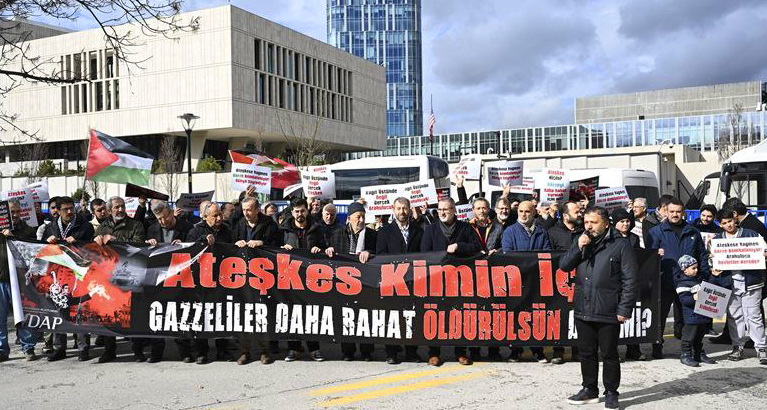
In the Turkish capital Ankara, the Ankara Platform for Solidarity with Palestine organised a demonstration denouncing Israel’s violations of the ceasefire agreement in the Gaza Strip.
Demonstrators gathered in front of the US embassy in the Turkish capital and chanted slogans against Israel.
The platform’s spokesperson, Aziz Oguzhan Karaman, delivered a press statement in which he said that Gaza, which has been under an Israeli blockade for 20 years, has been suffering from continuous Israeli attacks since October 2023.
Karaman pointed out that Israel continues its attacks despite the ceasefire agreement, and has violated the agreement 1,520 times, resulting in the killing of 566 Palestinians and the injury of 1,418 people.
During the ceasefire period, Israel destroyed 221 homes.
He emphasised that the ceasefire in Gaza must not lead to forgetting the genocide committed by Israel, calling on people of conscience around the world to continue raising their voices against the occupation.
In the Tunisian capital, there was an event organised under the title ‘A Stand of Anger Against the Continuation of the Aggression’, called by activists from associations and organisations such as the Tunisian Coalition to Support the Palestinian Right, the Coordination of Joint Action for Palestine, and the Tunisian Network to Oppose Normalisation.
The head of the Ansar Palestine Association, Mourad Al Yaacoubi, said that the rally was a response to the call issued by the Hamas Movement to all free people among Arabs and Muslims and throughout the world to make Friday, Saturday, and Sunday days of uprising and continuous demonstrations to remind of the tragedy of Gaza.
Al Yaacoubi added that the siege on Gaza is still ongoing and the genocide continues, stressing the necessity for Tunisians to continue supporting Gaza because it is being subjected to an ongoing genocide, in response to the call of the Hamas Movement, in support of Palestine, and in denunciation of the crime committed by Israel against it.
He said: ‘Our goal is to urge and raise the awareness of Tunisians about the importance of the Palestinian right, and that it is an Arab and Islamic right that everyone must remember.’
He stressed that all forms of support for the cause must not be underestimated, through demonstrating, or sending humanitarian and financial aid to Gaza, or boycotts, and that we must not lag behind the caravan of support for Palestinians.
During the demonstration, Tunisian protesters, who carried Palestinian flags, chanted slogans including: ‘At your service, at your service, O Aqsa’, ‘Gaza is calling, they besieged me and starved my children’, and ‘Gaza drowned, Gaza starved.’
The Hamas Movement had called for continuous global mobilisation on Fridays, Saturdays, and Sundays of every week to pressure the Israeli government to stop the aggression on the Gaza Strip, adhere to the ceasefire, open the crossings, begin relief efforts, and start reconstruction.
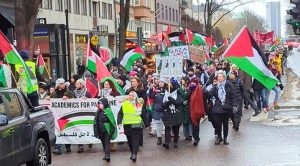
In the Swedish capital, hundreds of people supporting Palestine demonstrated in protest against Israel’s breach of the ceasefire agreement in the Gaza Strip.
Media outlets reported that hundreds of supporters of Palestine gathered in Odenplan Square in central Stockholm, at the invitation of civil society organisations.
The demonstrators expressed their anger over Israel’s attacks on Gaza, in violation of the ceasefire that entered into force on 11 October 2025. The demonstrators also condemned the restrictions and obstacles imposed by Israeli forces on the entry of humanitarian aid to those in need in Gaza.
Later, the demonstrators marched to the Swedish parliament building, raising placards bearing phrases calling for an end to the genocide in the enclave.
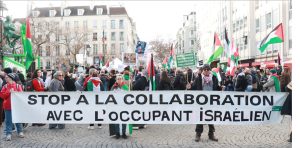 On the other hand, the French capital Paris witnessed a demonstration in solidarity with the peoples of Palestine, Sudan, and Venezuela raising placards with phrases such as ‘Boycott Israel’, while carrying the flags of Palestine and Venezuela.
The demonstration came in response to a call by associations and organisations, with hundreds of demonstrators participating to express their protest against the discrimination and repression faced by the peoples of those countries.
The death toll of the Israeli genocide in Gaza Strip has risen since the beginning of the war on 7th October 2023 to 72,027, with 171,561 wounded.
It has also left massive destruction in 90% of civilian infrastructure, with reconstruction costs estimated by the United Nations at about 70 billion dollars.
These Israeli violations come despite the announcement by the United States administration in mid-January of the start of the second phase of the ceasefire agreement.
US seeks to silence Francesca Albanese
 The United States has imposed what critics describe as ‘terrorist-grade sanctions’ on United Nations human rights expert Francesca Albanese and multiple judges and prosecutors at the International Criminal Court (ICC).
The move has extended punitive economic measures traditionally reserved for criminals and terror suspects to international legal officials examining the Israeli regime’s war crimes in Gaza.
According to an investigative report, the Trump administration has placed Francesca Albanese, the United Nations special rapporteur on the occupied Palestinian territories, along with senior ICC staff, on the US Treasury Department’s Specially Designated Nationals list, freezing assets and cutting access to the global financial system.
United States officials have tried to justify the measures by accusing the ICC of pursuing ‘illegitimate and baseless’ investigations into Israeli officials over the regime’s war of genocide on Gaza, as well as past probes involving US military personnel.
The move followed arrest warrants issued by the ICC in November 2024 for Israeli prime minister Benjamin Netanyahu and his minister for military affairs at the time, Yoav Gallant, on charges including war crimes and crimes against humanity, notably the use of starvation as a method of warfare against Gazans.
The investigation found that the sanctions against Albanese were preceded by confidential letters she sent to more than a dozen US companies, warning they could be named in a UN report for ‘contributing to gross violations of human rights’ linked to Israeli military operations in Gaza and the occupied West Bank.
Companies contacted included Alphabet, Amazon, Caterpillar, Chevron, Hewlett-Packard, IBM, Lockheed Martin, Microsoft, and Palantir.
At least two companies sought help from the White House after receiving the letters, US officials claimed.
The Trump administration later cited the correspondence as evidence that Albanese was conducting what it described as ‘political and economic warfare.’
Under the same executive order, Washington sanctioned eight ICC judges and several prosecutors, including officials involved in authorising investigations related to Gaza and Afghanistan.
Those targeted were added to the same sanctions list used for suspected al-Qaeda affiliates, drug traffickers, and arms proliferators.
Legal experts said targeting judges and UN mandate holders marked a sharp escalation in the use of US sanctions.
The United Nations pointed out that Albanese enjoyed diplomatic immunity in relation to her official duties and that this status had been communicated directly to US authorities. Despite this, Washington proceeded with sanctions.
‘It is clear that my diplomatic immunity has not been respected,’ Albanese told the agency, adding that responsibility lay with member states’ failure to act decisively.
The US State Department said its correspondence with the UN had focused on calls for Albanese’s removal and rejected the court’s jurisdiction over US and Israeli individuals.
According to the report, the measures form part of a broader US campaign to pressure international institutions viewed as threatening American or allied interests.
Beyond freezing assets, the sanctions effectively bar access to banking services, restrict travel, and expose third parties to penalties for providing assistance.
Human rights advocates and legal scholars warned that such actions risk crippling the ICC’s ability to function and set a precedent for using economic force to target international courts and UN mechanisms.
The ICC has condemned the sanctions and said it would continue its work ‘to provide justice and hope to millions of innocent victims of atrocities.’