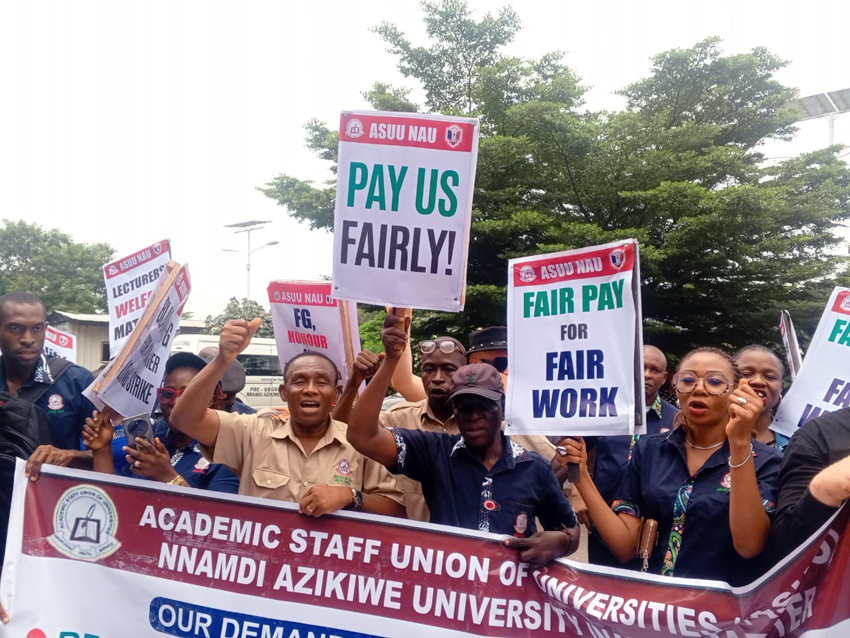
The University of Lagos (UNILAG) chapter of the Academic Staff Union of Universities (ASUU) started an indefinite strike on Wednesday over unexplained cuts in January and February salaries.
The decision was reached at an emergency meeting held on Tuesday, according to a statement signed by the ASUU-UNILAG Chairperson, Idowu Kehinde, and its secretary, Adesina Arikawe.
The union noted that the strike will remain in force until the university releases the remainder of the January and February salaries, as well as other withheld allowances.
The union said the university has also failed to pay both the EAA and Consolidated Academic Tools Allowance (CATA) to academics at the Idi-Araba campus.
A statement said: ‘The University unilaterally and wickedly paid amputated February 2026 salary to all our members.
‘We reject in its entirety the recent action that resulted in all our members receiving lower January and February 2026 salaries.
‘We therefore withdraw our services effective Wednesday, 11 March 2026, since the University has failed to pay our January and February 2026 salaries in full.’
The agreement, unveiled in January, introduced CATA allowance that ranges from 952,412 niara (£512) annually for Graduate Assistants to 3,790,676 niara (£2,032) annually for full professors.
The comprehensive agreement also increased the amounts payable to lecturers under the EAA. The EAA includes allowances for postgraduate supervision, industrial training and teaching practice supervision allowance and an overtime allowance.
Meanwhile, in an attempt to break their strike, the Taraba State Government has issued a formal reminder to striking university unions at the State University, Jalingo, reiterating its enforcement of the ‘No Work, No Pay’ policy during the ongoing industrial action.
In a notice on Wednesday, addressed to the Vice Chancellor of the University and the Academic Staff Union of Universities, ASUU, branch of the institution, the government referenced provisions of the Trade Union Disputes Act, specifically Section 43, which states that employers, particularly government institutions, are not obligated to pay wages to employees who participate in strike actions.
According to the statement signed by the commissioner of tertiary institutions (universities), Mike Dio, the law clearly stipulates that workers who withdraw their services during a strike are not entitled to salaries for the duration of the industrial action.
Additionally, the period spent on strike, according to the statement, will not be considered part of pensionable service.
ASUU is on strike as it says that the state government has failed to pay funding that has been promised since September 2024.
Chris Piwuna, ASUU president said: ‘We believe there should be closer scrutiny of how the Tertiary Education Trust fund (TET) interventions are implemented, especially in the centres of excellence, to ensure that the objectives of the programme are achieved. We demand that all outstanding funding is paid immediately.
‘Furthermore will will not be intimidated; the strike will continue.
‘The measures taken by the Taraba State Government make it very hard for members financially.
‘However we are fighting for students and we are fighting for academic staff.
‘Members have said to me on numerous occasions that they will undergo this hardship in order to do what is right.’
Meanwhile, South Africa’s major public sector unions say workers are ‘united and outraged’ over the 9.5 per cent premium increase introduced by the Government Employees Medical Scheme (GEMS), prompting days of protests and marches outside GEMS offices nationwide following those that have already taken place in the last month.
Trade union federations, the Congress of South African Unions (COSATU) the South African Federation of Trade Unions (SAFTU) and the Federation of Unions of South Africa (FEDUSA), are now preparing for urgent talks with the scheme in a bid to halt further demonstrations and push for an overhaul of its contribution structure.
FEDUSA General Secretary Riefdah Ajam described the increase as ‘regressive’, ‘unjustifiable’ and a betrayal of GEMS’s founding purpose. ‘Over a two year period, the scheme has experienced an increase of more than 23 per cent.
‘Workers cannot afford to pay more money for health services. It is catastrophic.’
Ajam warned that the impact on public servants, especially those in lower income bands, is severe.
She added: ‘When collective bargaining delivers a 4.4 per cent wage rise, and medical increases reach nearly 10 per cent this year after 13.4 per cent last year, how do you expect members to live a dignified life? This is crippling them.
‘This is not consultation. It weakens collective bargaining and defies every principle of engagement.
‘The increase contradicts recommendations from the Council for Medical Schemes and undermines GEMS’s original mandate as a social solidarity instrument created to ensure affordable access to healthcare for public servants.
‘GEMS was never intended to operate like a commercial enterprise.
‘How do you justify holding more than 28 meetings in one financial year at a huge cost enriching board members while crippling workers with double digit increases?’ she said. ‘This is thuggery at the worst levels.
‘We need constructive, honest engagement. Workers cannot be pushed into destitution.’
- The office of the Eastern Cape Department of Social Development (DSD) in Stutterheim was found to be unsafe for staff during an inspection by the Department of Labour in November. But the offices are still open.
Several social workers in the trade unions the (National Education, Health and Allied Workers’ Union) and the PSA (Public Servants Association of South Africa) which represent workers there, have spoken to the media and said they are refusing to work from the building after the labour inspection.
They say they come into the building in the morning to collect files and then work from cars, from courts or from police stations.
Spokesperson Teboho Thejane said that there was no provision of drinking water and that toilets were not in a good state of repair, they were unhygienic and were not functioning properly.
He said the roof leaked and there was extensive mould on the walls, and no cleaners on site.