THE fears of residents and displaced people in the Gaza Strip are escalating as Israeli raids continue at the same time as their statements about stepping up military control from 60% to 70% of the area of Gaza.
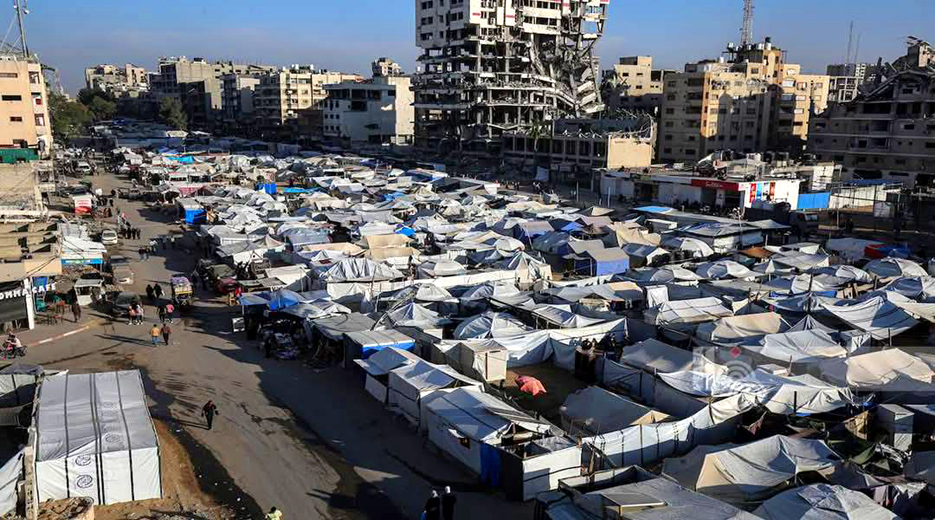
This raises the state of anxiety and fear among families already living in extremely difficult humanitarian conditions inside shelter centres and displacement camps.
In the Unknown Soldier camp, west of Gaza City, camp director, Abu Maher, said that the recent wave of Israeli attacks, especially in the Rimal neighbourhood, which was previously regarded as one of the relatively safe areas in the Strip, have prompted many displaced people to think about having to flee yet again.
He explained that families are living under increasing psychological pressure under the Israeli threat to expand military operations, pointing out that many of the displaced no longer have the ability to move again or give up what remains of their few belongings.
He told Al Jazeera Mubasher, ‘It has become an obsession for us that we leave this place,’ stressing that the current circumstances are ‘more severe than they were while the war was active.’
Regarding the Israeli statements related to expanding military control, Abu Maher said that the displaced people were pinning hopes on returning to the eastern areas of Gaza, but those hopes were dashed with the talk of increasing the area of Israeli control.
He added: ‘We were hoping to return to the eastern areas, now hope has become completely non-existent,’ considering that any additional expansion could place the current areas of displacement within the circle of direct danger.
In a scene reflecting the deep psychological impact of the war on children, young Yazan Talal Al-Basyouni recounted his experience during one of the raids that occurred before Eid al-Adha. He said that he was arranging Eid clothes in preparation for the next day when a bomb hit nearby, ‘I hugged the Eid clothes, fearing for them, and hid them with me.’
When asked about his feelings during the raid, he answered, ‘I felt as if it was doomsday,’ as the state of panic swept the area forcing him, along with dozens of residents, to flee.
The child stressed that he fears the return of the war and what worries him most is the repetition of scenes of displacement, hunger, and bombing, adding: ‘I hope that the war stops, reconstruction takes place, and I live in my house.’
Yazan’s uncle spoke about the difficult living conditions inside the camp, where families live in a state of permanent fear because of the repeated raids near displacement camps.
He pointed out that flying shrapnel and stones from the bombing fall on the dilapidated tents, while the suffering of the residents is exacerbated by repeated displacement and deteriorating economic conditions.
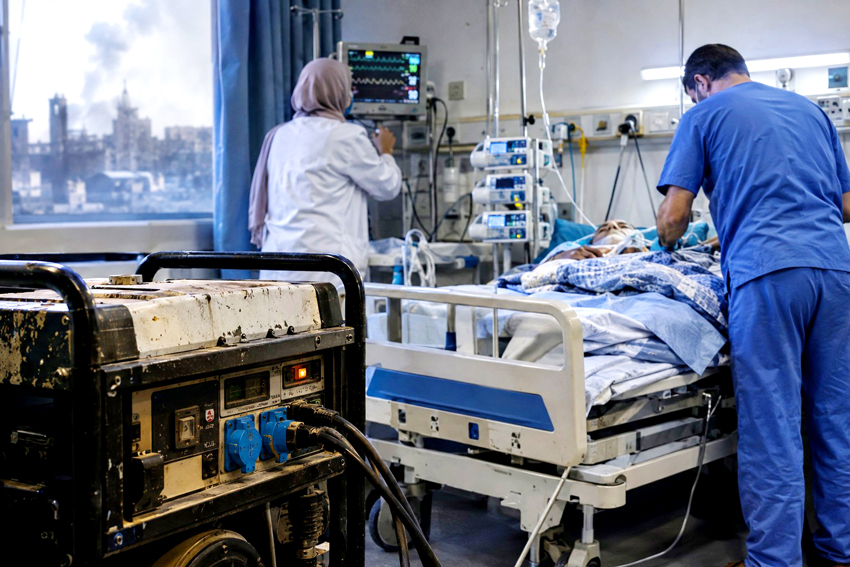
He said that merely hearing the sounds of bombing prompts parents to think about the safety of their children, especially in light of the acute shortage of medical services and supplies, and the closure of crossings, so many patients cannot find the necessary care inside the Strip.
He also explained that security fears have come to greatly restrict the movement of children, as parents have become fearful to even to send them to nearby shops for fear of being bombed.
He also spoke about the worsening of the humanitarian crisis inside the camps after some food aid programmes stopped, pointing out that many families were relying mainly on meals provided to the displaced.
Residents also face increasing difficulties in obtaining water, in addition to the spread of rodents and insects inside the camps, as well as the deterioration of health and environmental conditions.
During the past few days, Israeli raids targeted the vicinity of the Unknown Soldier camp, and some of them were very close to the displaced camp, reinforcing fears of the return of the war at its previous pace.
He explained that the displaced families already suffer many burdens, including hunger, water scarcity, and difficulty in obtaining food or even basic services, while Israel’s obsession with resuming large-scale military operations remains the biggest concern for residents who are desperately hoping for any development that might allow them to return to their original homes in the neighbourhoods of Shuja’iyya, Beit Hanoun, and other areas of the Gaza Strip.
Israel’s ongoing assault on Gaza has inflicted losses that many Palestinians describe as among the most devastating and painful in their modern history not only because of the staggering human and material destruction, but also because it has left behind a profound void through the deaths of figures and leaders whose names became inseparable from pivotal chapters in the Palestinian struggle over decades.
The deaths of individuals who played central roles in the major transformations of Palestinian political life is not viewed as a temporary setback. Rather, it is regarded as the loss of accumulated experience forged through years of resistance, organisation, and political engagement.
Their lives embodied political and field expertise that left a lasting imprint on the trajectory of the Palestinian cause and on the collective memory of Palestinians both inside Gaza and across the wider diaspora.
Throughout the Palestinian national experience, the loss of historic generations of leaders has never marked the end of the story, despite the immense weight of such losses and the difficulty of replacing figures who occupied prominent places in the Palestinian national consciousness.
Every era has witnessed the departure of influential leaders and personalities. Each loss has left a deep wound, yet it has simultaneously opened the way for new generations to emerge and shoulder the responsibilities of the next phase often under even more difficult and oppressive circumstances.
In Gaza in particular, the loss feels doubly severe.
The territory has endured war in all its dimensions. It has lost its children, its homes, and the spaces where people once found safety.
At the same time, it has lost figures whose names became intertwined with decades of political and military transformations and with the lived experiences of ordinary Palestinians.
Caught between grief and the crushing weight of the humanitarian catastrophe, Palestinians continue to navigate a reality marked by extreme hardship, where sorrow is inseparable from anger and from unanswered questions about what the future may hold.
Many Palestinians argue that, despite passing through some of the bloodiest chapters of its history, the Palestinian national movement has consistently demonstrated an ability to produce new generations committed to the same narrative, the same aspirations, and the same rights.
Political and security realities may change, they say, but those shifts have failed to erase the Palestinian presence or extinguish the Palestinian cause.
As the war on Gaza continues, loss remains a constant feature of daily life. Yet Palestinians continue to hold fast to their collective memory and to a national narrative passed from one generation to the next.
It is a reality where suffering and resilience coexist, where grief merges with open-ended questions about the future and the many possibilities it may bring.