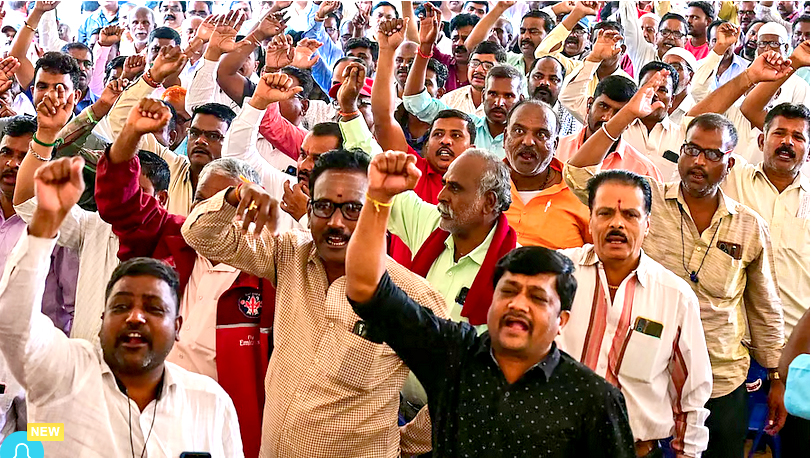
ROAD Transport Corporation (RTC) employees in Bengaluru in Karnataka, south India held a demonstration at Freedom Park on Monday, demanding the payment of 38 months wages arrears and a fresh salary revision under the 7th Pay Commission which sets pay for public sector workers in the state.
The protest was spearheaded by the Karnataka State Transport Employees’ League.
It took place ahead of an indefinite strike which starts on 20th May
In a letter to Chief Minister Siddaramaiah, the league demanded that Karnataka’s Congress government emulate Telangana in fulfilling its election manifesto promise of bringing RTC employees on a par with state government employees and giving them a pay hike as per the 7th Pay Commission.
League president Rajeev Chandra Shekar said that, although Transport Minister Ramalinga Reddy and the Managing Director of the Karnataka State Road Transport Corporation (KSRTC) held meetings, they did not fulfil the demands placed by the employees.
While the government issued a circular to pay 1,271.92 rupees (£9.91) as 26 months’ arrears, the league demanded 38 months’ arrears totalling 17.85 billion rupees (13.91), starting January 1st, 2020.
The government offered a 7 per cent pay rise starting 1st January, 2024, but the league demanded that RTC employees receive pay equal to state government staff RTC employees’ union.
The league is one of several unions that represents RTC employees in the state.
The demonstration was called by the Joint Action Committee of the Trade Unions of Karnataka State Road Transport Corporation over arrears payment and higher wages.
It has also sought 1,785 rupees (£13.90) in arrears for 38 months (January 1st, 2020, to February 28th, 2023) and a 25 per cent pay rise starting 1st January 2024.
The committee wants the government to match the 27.5 per cent hike granted to local government employees under the 7th Pay Commission.
The Bruhat Bengaluru Mahanagara Palike (BBMP) Pourakarmikara Sangha has written to the Commissioner of Bengaluru Central City Corporation, urging immediate action to protect sanitation workers from the severe heat in the city.
In the letter, the association flagged concerns over the working conditions of sanitation workers.
The letter said: ‘They are being compelled to work under scorching heat from 6.30am to 2.30pm, often seven days a week without rest, and are denied national and festival holidays.
Outdoor workers have no access to shelters, and these conditions pose serious risks to their health and well-being.
Meanwhile, the members of the Punjab Roadways, PUNBUS, and PRTC Contract Workers’ Union held protests at bus depots across the northern India state on International Labour Day 1st May to press for their demands. They also announced a series of strikes throughout May.
The protesters are demanding the release of detained colleagues and an end to ‘systematic privatisation’ of the state’s public transport network.
Union leaders addressed ‘gate rallies’ simultaneously across all 27 bus depots in the state and outlined a protest calendar that could ‘severely disrupt bus services’ in the state.
The workers’ union announced a demonstration at the residence of the Punjab transport minister on 10th May; a one-day state-wide strike on 18th May; and a three-day strike from 25th-27th May, culminating in a permanent sit-in outside the chief minister’s residence.
The workers’ union warned that if its demands were not met by 27th May, it would call for an indefinite suspension of services.
The protest centres around the state government’s ‘Kilometre Scheme’, under which private bus operators were inducted into the state fleet and paid on a per-kilometre basis.
The workers’ union termed the policy ‘a backdoor attempt to bring in private buses and dismantle the state-run transport system, enabling private operators to run buses on government-notified routes’.
Last year, in November, the stand-off followed violence during protests against the opening of tenders under the scheme, with clashes between the protesters and the police.
Those arrested in connection with the November protests remain in jail. Several workers detained in cases registered in Sangrur and Patiala after protests against the government policies also remained behind bars for months.
The workers’ union alleged that the charges were fabricated to suppress dissent and demanded their immediate release as a non-negotiable precondition for any resolution.
PRTC Punbus Contractual Employee Union leader Harkesh Kumar Vicky also cited the operational condition of the fleet.
He said the PRTC operated around 1,200 buses while Punjab Roadways had about 1,500, and no new buses were added to the PRTC fleet in the last four years.
Elsewhere, civil rights groups and workers’ organisations called for sweeping labour reforms, including fixing minimum wages at 800 rupees per day at a large International Labour Day gathering in Bhim town, in the state of Rajasthan in the north west of the country on May 1st.
The event, organised by the Mazdoor Kisan Shakti Sangathan (MKSS) at Patia ka Chauraha, also marked the organisation’s foundation day and saw participation from workers, farmers, women and youth across Rajasthan and several other states.
The gathering unanimously adopted a set of resolutions focusing on labour rights and social protection.
These included a demand to fix minimum wages at 800 rupees per day and to link social security pensions to at least half of the minimum wage, roll back amendments to the Right to Information Act, implement rules under the Right to Health Act in Rajasthan, and introduce a minimum income guarantee law in the state.
Addressing the rally, social activist Aruna Roy said: ‘Labour Day is a reminder to carry forward the legacy of workers’ struggles.
‘In today’s times, unity among workers is more important than ever.’
Senior advocate Prashant Bhushan stressed that safeguarding labour rights requires sustained public action, saying: ‘Mass movements play a critical role in protecting rights.
‘There should be a guarantee of 365 days of work for every individual.’
Speakers including Nisha Sidhu of the Indian Women’s Federation and Rajasthan Unorganised Workers’ Union member Shankar Singh also called for intensifying struggles for workers’ rights, particularly for women labourers.
Earlier in the day, three separate rallies began from Bhim Bus Stand, Balaiyon ka Kooda and Badnor Chauraha, converging at Sujaji Chowk before proceeding to the main venue.
Participants raised slogans demanding higher wages, employment guarantees and protection of labour rights.
A large number of women workers participated in the rally and subsequent fair, sharing concerns over wage delays, lack of job security and difficulties in accessing welfare schemes.
Participants from districts including Bhilwara, Pali, Ajmer, Udaipur and Jaipur, along with delegations from Kerala, Karnataka, Telangana, Uttar Pradesh and Gujarat, attended the event.
The programme concluded with a call for sustained mobilisation to secure labour rights and ensure accountability, with participants pledging to work towards a society based on justice, equality and fraternity.
- India and the European Union (EU) have jointly launched a 15.2-million-euro (about £13.1 million) initiative to strengthen electric vehicle (EV) battery recycling, officials said on Wednesday.
The move is aimed at promoting a circular economy, thus marking a significant step in their growing partnership on clean and green technologies.
The initiative includes a coordinated call for proposals focused on EV battery recycling.
According to officials, the programme will focus on developing advanced recycling technologies, including high-efficiency material recovery, safe and digitalised collection systems, and pilot-scale demonstration of innovative processes.