Iran’s Parliament speaker has warned the United States that any aggression against the country will be met with a ‘faster, heavier, and more painful’ response than any received by the enemy so far.
Mohammad Baqer Qalibaf made the remarks during a parliamentary session on Sunday as tensions escalate between Iran and the US due to the latter’s ‘shift to economic terrorism after suffering a disgraceful military defeat.’
He said: ‘The Americans must have realised by now that the days of ‘proportionate responses’ are over. The strikes we carried out in recent operations against the aggressor’s bases were only the beginning.
‘If they still haven’t got the message, they need to understand – before it’s too late – that the rules of the game have changed.
‘From now on, any aggression against Iran’s interests and security will be met with a response that is faster, heavier, and more painful.’
Iran’s military strategy has now moved from a primarily defensive posture to one that includes preemptive operations.
According to Iranian officials, this new doctrine has already been put into practice. For example, they point to an attack early this month on a US base in Jordan that was carried out as American forces were ‘mobilising troops and equipment for further attacks on Iran.’
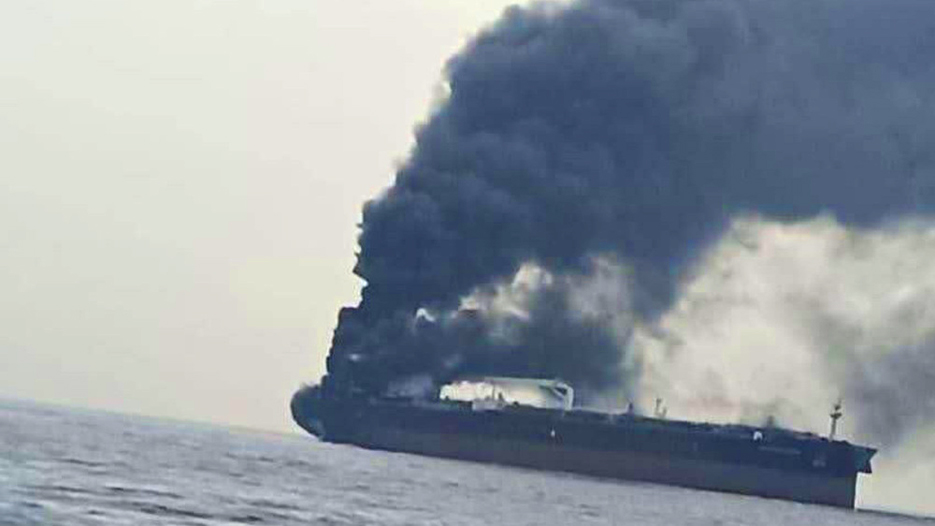
On Sunday, the Islamic Revolution Guards Corps (IRGC) Navy announced that it had struck three US-linked vessels and three oil tankers in retaliation for American attacks on Iranian ships under the US’s newly-announced ‘economic terrorism’ strategy.
Qalibaf hoped that through the efforts of the country’s institutions and the extraordinary resilience of the Iranian people, it will defeat the enemy in the economic war just as decisively as it did in the military and diplomatic arenas.
‘Standing firm and maintaining our authority are essential when we are in the midst of an all-out war against the entire front of disbelief,’ he said.
‘Following devastating strikes by our military forces on US bases, American leaders have been driven into a state of desperation while resorting to empty rhetoric and slogans, and using artificial intelligence to create images and videos of the battlefield,’ he added.
Qalibaf emphasised that alongside the military front, the most important battle today is in the sphere of production and people’s livelihoods.
He called for both short-term and lasting solutions for Iran’s major challenges, including severe fluctuations in currency prices, inflation, and unemployment, relying on domestic production and the technological potential of young, talented experts.
‘At a time when the enemy is seeking to paralyse the supply chain and energy management by intensifying sanctions, we must build a barrier against foreign ambitions by creating new capacities for smart import management, encouraging domestic production, and drawing on the capabilities of our talented experts,’ he said.
Additionally, maintaining ‘internal cohesion’ and ‘external deterrent power’ are two important tools for confronting the adversary.
The United States and Israel launched their illegal war of aggression against Iran on February 28 by assassinating Leader of the Islamic Revolution Ayatollah Seyyed Ali Khamenei, along with senior military commanders.
Forty days later, on April 8th, the enemies were forced to accept a ceasefire due to Iran’s resistance, successful retaliatory operations, and a powerful grip on the Strait of Hormuz.
In July, the US conducted waves of deadly air raids on Iran and imposed a naval blockade of the country in violation of the Islamabad Memorandum of Understanding (MoU) with the Islamic Republic, signed on June 17, to end the war.
In response, the Iranian armed forces launched devastating strikes against strategic American targets across West Asia and declared the Strait of Hormuz closed to all traffic.
Iran’s top military commander says Tehran will not yield to US pressure, and that Washington’s turn to economic, psychological and cognitive warfare will fail just as its military aggression has.
Chief of the General Staff of Iran’s Armed Forces, Major General Ali Abdollahi, said the US is trying to offset its strategic shortfalls and battlefield setbacks by shifting the fight onto other fronts.
He said Iran would not surrender, and that the enemy would not prevail in its combined campaign of economic pressure, media operations and cognitive warfare – Washington’s expectation of Iranian capitulation is a ‘false illusion’ that will never be realised.
For more than 80 years, he said, the US had grown used to facing no refusal from other countries. Its assumption before moving against Iran, that the Iranian people would submit unconditionally, was therefore a ‘false dream.’
The only answer Iran has given, and will continue to give, is ‘no’.
Abdollahi said the American and Israeli enemies are now attempting to close the gap left by their military and regional defeats through soft war, cognitive operations and economic coercion.
Those efforts, he said, will also fail. ‘By God’s grace, the steadfastness of the Iranian people and the prudence of the country’s officials, Washington will only add another defeat to an already humiliating record.
‘The world of the future will be different from that of the past,’ he said, adding that this shift will inevitably mean a decline in US power.
He also stressed the growing importance of the ‘war of narratives’, calling media work central to holding the initiative and protecting public morale.
The remarks followed a similarly firm warning from Islamic Revolution Guard Corps spokesman Brigadier General Hossein Mohebi, who said Iran would not surrender to Washington’s economic pressure.
Mohebi said that President Donald Trump had calculated that US military power, its naval fleet and its aircraft carriers could force Iran to retreat.
Recent developments, he said, have shown that calculation to be detached from reality. A country already burdened by heavy debt and intensifying economic rivalry cannot impose an economic war on Iran without paying a steeper price itself.
US economic and maritime pressure, Mohebi said, can rebound on Washington.
‘If the United States seeks to inflict one dollar of damage on Iran, it may incur several dollars in costs and losses of its own, including through disruption to energy markets, strategic reserves and regional supplies of raw materials.’
Sanctions and blockade, he concluded, are not a path to victory. ‘They are another front on which the United States can lose.’
The Islamic Revolution Guards Corps (IRGC)’s Navy announced on Sunday that it had struck three United States-linked vessels and three trespassing oil tankers in retaliation for earlier American attacks on Iranian tankers.
‘This morning, the terrorist and aggressor US military, in a brutal act born of desperation from the closure of the Strait of Hormuz, attacked three oil tankers belonging to the Islamic Republic, causing damage,’ the force said in a statement on Saturday.
In response, ‘the fighters of the IRGC Navy targeted three oil tankers travelling along an unauthorised route through the Strait of Hormuz, as well as three vessels affiliated with the child-killing United States, in other areas,’ it added.
Iran closed the chokepoint following the launch of the latest bout of unprovoked American-Israeli aggression against the country on February 28.
The Islamic Republic and the United States agreed on a 60-day reopening period as part of the Pakistan-mediated memorandum of understanding in June.
Iran devised the Persian Gulf Strait Authority (PGSA), a mechanism aimed at ensuring safe and legal transit through the chokepoint, towards implementation of the understanding, but American violations forced Iran to reestablish the closure.
Tehran has conditioned reopening of the waterway on realisation of a number of prerequisites, including the complete lifting of the US’s illegal naval and economic blockade against the Islamic Republic, durable cessation of aggression on all fronts, including Lebanon, and clarification of the situation concerning the blockade of Yemen.
The Islamic Republic has, meanwhile, sternly warned vessels against buying into Washington’s claims that the Strait remains open, asserting that any vessel, relying on such claims, attempting to transit the waterway does so at its own risk, and will be targeted.
The IRGC Navy reiterated the warning to all vessels present in the Persian Gulf and in the vicinity of the Strait of Hormuz, urging them not to ‘fall for the deception of the terrorist US military, and refrain from any suspicious movement aimed at transiting unauthorised waterways.’
‘Otherwise, you will be targeted,’ the statement concluded.