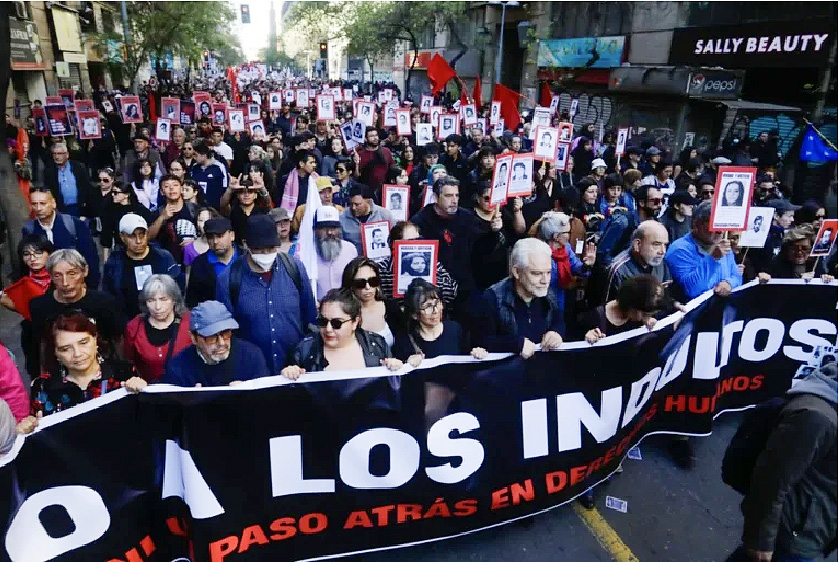
A Chile coup memorial march brought thousands of people to the streets of Santiago on Sunday, 6th September, as organisations commemorated the 53rd anniversary of the September 11, 1973 coup that overthrew President Salvador Allende.
Friday 11th September will be the 53rd anniversary of the seizure of power by the Chilean military, led by General Augusto Pinochet, backed by the CIA, which brought in a brutal military dictatorship that murdered thousands of workers and peasants and imposed on Chile the economic theories of monetarism and savage austerity.
On that day in 1973, jet planes of the Chilean air force bombed the presidential residence of President Salvador Allende, killing the man described in the bourgeois press as the world’s first ‘democratically elected Marxist leader’.
Allende was elected as president in 1970 leading a Popular Unity Alliance (UP), a coalition of socialist, Communist and social democratic parties pledged to a programme of agrarian reform, limited nationalisation of industry and the creation of a ‘mixed economy’.
The key pledge of the UP was that of ‘gradualism’ – to work within the existing bourgeois state and its institutions for gradual change.
Change was what the Chilean workers, peasants and youth were demanding as the country was in the savage grip of a recession that emerged in 1967 and reached its height in 1970.
With the Chilean working class and masses demanding higher wages and jobs they threw their support behind the UP in the presidential election held on September 4th 1970.
On taking power in November 1970, the Allende government sought to make concessions to the demands of the working class through a programme of state subsidies, nationalisation, land distribution and wage increases.
At the same time, Allende agreed to uphold the bourgeois constitution and the complete independence of the military.
The government nationalised or intervened in the crucial American-owned copper industry, along with the coal, iron, nitrates and steel industries while 2.4 million hectares of land were taken over and distributed to the landless farmers.
Wages were increased, including a substantial rise awarded to the army, and prices frozen.
None of these measures could stave off the impact of the world crisis and by 1972 the Chilean economy was collapsing, helped along by a financial blockade of the country instigated by the United States furious at the nationalisation of the copper industry.
Meanwhile, workers and the poor had pushed Allende’s reformist policies further than the UP wanted, taking over factories and land not intended for nationalisation.
A revolutionary confrontation between workers and the masses against the ruling class backed by the military reached explosion point in Chile.
While the powerful working class and Chilean masses were arming themselves, in the full knowledge that the army were preparing to overthrow his government, Allende and his Stalinist supporters in the Communist Party were actively allowing the army to enter occupied factories and disarm workers, under the treacherous theory of the peaceful, democratic road to socialism.
Instead of turning to the masses, Allende clung to the delusion that the army and police of the bourgeois state would impartially serve any democratically elected government.
On September 11 1973, the army made their move, killing Allende and instituting a reign of terror over the working class by the military dictatorship under Pinochet.
Tens of thousands of workers and youth were tortured and murdered by the brutal military dictatorship of General Pinochet, while almost 1,500 simply disappeared and their bodies were never recovered.
The National Stadium Chile was used as a detention center where roughly 14,000 people were held at the stadium in the early months of the coup where scores were tortured and killed Between November and July of 1974
Some 130,000 people were arrested and questioned in the three years following the coup, by the military’s secret police and the armed forces.
Sunday’s demonstration, which advanced toward the General Cemetery, was marked by strong denunciations of current Chilean President José Antonio Kast.
The Chile coup memorial march is part of a long-standing tradition of remembering the victims of the civil-military dictatorship.
Marchers reported police interventions involving water cannons and tear gas on side streets and near the General Cemetery, while Carabineros de Chile deployed ‘crowd-control measures’ attacking the march and making multiple arrests.
At the General Cemetery, attendees gathered at memorials to honour victims of the military dictatorship, underscoring the ongoing search for more than 1,500 Chileans whose whereabouts are still unknown.
A central symbol referenced during the Chile coup memorial march is Escotilla 8 of the National Stadium in Santiago, which functioned as a mass collective cell and transit point to torture workers during the dictatorship.
The space held hundreds of political prisoners, many of whom left messages, initials and song verses engraved on the walls with keys and other objects.
Each cell held approximately 300 to 400 detainees, with men confined in locker rooms and hatch areas.
Conditions were harsh, with cold, damp cement walls, flooded sections after rain, limited blankets and inadequate food and hygiene.
Disease spread quickly, worsened by constant physical violence and sleep deprivation on floors or improvised bunks.
Testimonies of surviving victims are preserved as part of Chile’s historical memory, highlighting the systematic nature of capitalist repression and the resilience of the working class.
The burning lesson of Chile that has to be driven home is that the building of a conscious revolutionary party that bases itself on the Marxist understanding that the capitalist state is an instrument for class oppression which must be smashed and cannot just be ‘taken over’ and used as an instrument for working class rule, is absolutely essential for the victory of the working class.
Today, when capitalist ‘democracies’, under the impact of a world crisis a thousand times more acute than that of the 1970s, are rapidly shedding their democratic façade, the lesson from Chile is clear.
A revolutionary movement of workers, no matter how powerful and determined, cannot overthrow capitalism without a leadership that is prepared to lead workers in the struggle to expropriate the bosses and bankers, disband the police and army and replace the capitalist state with a workers state and socialism.
The world crisis is driving world revolution.
Its victory requires the building of the revolutionary leadership, sections of the Fourth International in every country. This is the only way forward.