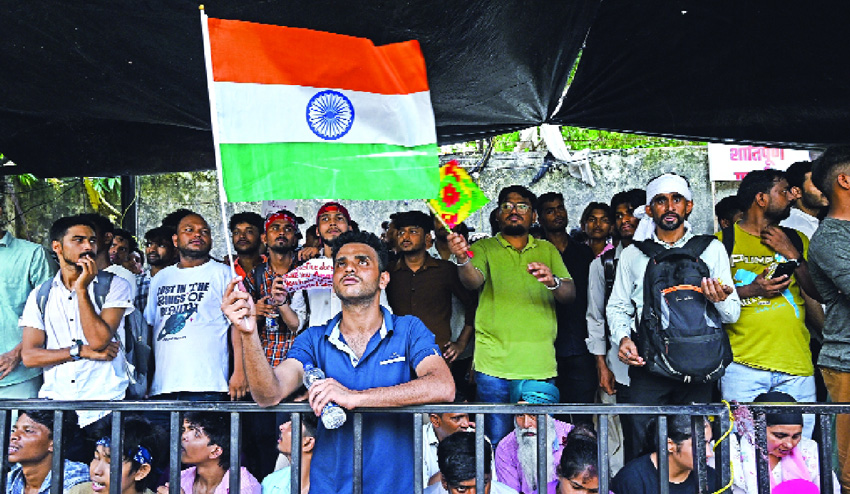
MORE than 100 students were injured on 20 July when Delhi police broke up a march on India’s parliament.
The march was called by the Cockroach Janta Party (CJP), the youth movement demanding the resignation of Education Minister Dharmendra Pradhan over serial leaks of national examination papers. Tens of thousands of demonstrators occupied the roads leading to the corridors of power, bringing central New Delhi to a standstill.
Police, operating under the direct instructions of Prime Minister Narendra Modi’s government, used batons and tear gas.
Mobile internet was suspended across parts of the centre until that evening, and an order under section 163 of the Bharatiya Nagarik Suraksha Sanhita banned assemblies of more than four people.
Police denied every account of excessive force.
The denial did not survive contact with the footage and within hours the material was everywhere.
An officer driving a baton into a woman’s back … a mother pleading with a wall of police. … another officer slapping students and chasing them down … officers wearing Meta glasses … law enforcement agents planting a damaged car outside the protest strip.
Also an officer casually tripping a student running from tear gas. There was also the first recorded use of pellet guns in the capital, apparently by a paramilitary force deployed alongside the police.
Sahil Lochab, a Delhi University student carrying the national flag on the march, has had eye surgery and may lose the sight in his right eye.
His family says doctors identified the cause as a pellet gun. Shaikh Irshad Mansoori had pellets removed from his face and neck; he says a Rapid Action Force officer fired the weapon.
A 21-year-old student, Sakshi, remains in intensive care after being trapped beneath a crush of demonstrators when police charged into uneven ground littered with broken barricades. A journalist covering the march was left with puncture wounds.
Delhi police say they neither possess nor used pellet guns but the weapon left protesters blinded and dead in Kashmir in 2016 and 2017, and reappeared at the farmers’ protests of 2024.
Human Rights Watch verified ten videos, found that police met a peaceful march with batons, tear gas and internet shutdowns.
When lawyers asked the Supreme Court to examine the footage on Wednesday, Chief Justice Surya Kant told them the bench had no time to watch videos.
Avanshika Singh, 18, ran through the sprinting crowd that day, eyes stinging so badly she could barely see, filming as she went.
‘I saw policemen brutally beating up unarmed girls and peaceful children,’ she said. At home she assembled a rough cut and captioned it on Instagram: ‘Today, we rang Parliament’s doorbell and ran.’
‘This is the only thing anyone is talking about. If nothing, we are televising our revolution,’ she said on Wednesday, standing in the crowd choking Parliament Street.
‘The entire country today feels the sting of batons and tear gas with us.’
Twelve years ago Modi built his route to power partly through social media, reaching voters at a scale the Congress party never matched and has struggled to match since.
Gen Z has now turned those platforms back on the Bharatiya Janata Party. ‘Hating Modi is cool on the internet now, after years of criminalising dissent,’ Singh said, before breaking into a chant.
‘Uncle Modi, go back, go back.’
The CJP says the demonstrations will continue ‘peacefully’ until three demands are met. It wants Pradhan out, an assurance that no criminal cases will be pursued against protesters, and 10 million rupees for each of the families of students who have died by suicide after paper leaks and cancellations.
At least 12 such deaths have been recorded since the recent cancellations, which forced more than two million medical candidates to sit the examination again.
Niharika Soni, 19, had paid the 20 July march no attention. Then the footage reached her feed. ‘My mother and I cried for two hours, watching the videos together at home,’ she said, of a mother who has been a staunch supporter of Modi.
‘We hugged each other and come here every day now,’ she added, holding her mother’s hand as part of a human chain, ready for the police.
Nothing escapes the cameras at Jantar Mantar, the 18th century observatory that serves as Delhi’s designated protest site, where thousands have been recording round the clock since the occupation began on 6 June.
Momentum built on 18 July, when police removed the activist Sonam Wangchuk, on hunger strike since 28 June, and took him to hospital. The images from 20 July have since set off demonstrations in Mumbai, Bengaluru, Patna, Lucknow and Aizawl.
It is also a meme fest. Protesters pose beside the police lines, mock the officers stationed there, offer them flowers while reminding them what the officers offered in return.
Two demonstrators carried the Japanese manga One Piece, a symbol borrowed from Gen Z movements elsewhere. A group of friends came dressed as Spider-Man, Iron Man and the Hulk and sat on the barricades, looking out onto Parliament Street.
‘This government is lacking any responsibility towards the youth of this country,’ said Ipshita Gulyari, 20. Modi, she said, had messed with the ‘wrong generation.
‘There is a lot of arrogance in him, and, you know, teenagers do not tolerate that.
‘We, the Gen Z people, are born on and for the internet. We were using Instagram before I could read a clock,’ she said.
Television channels friendly to Modi failed to cover the protests so she and her friends relied instead on small independent publications and, above all, on each other’s feeds.
‘Gen Z is taking it lightly, being funny about it, because humour is our coping mechanism,’ said Yashvi Kumar, 18, a friend of Gulyari at the protest.
‘In the middle of all chaos, somewhere we decided that to rebel, we need to find a way that unites us. The memes are uniting us.’
There are thousands demanding the minister’s resignation.
Meanwhile India slid down successive democratic indices and government critics were jailed for years without trial.
The movement’s name came from the bench. At a hearing on 15 May, Chief Justice Kant said youngsters who find no employment become ‘like cockroaches’, turning to media and RTI activism to attack the system, and spoke of ‘parasites of society’.
He said afterwards that he had meant only those practising on fraudulent degrees. Abhijeet Dipke, a political communications strategist, launched the CJP as a joke the following day.
Before that, said Anurag Minus Verma, a cultural critic and author of The Great Indian Brain Rot, ‘there was an undercurrent of memes from anonymous accounts, masked people, mocking the government.’
‘In a post-ironical world, anything said with irony travels faster, and irony becomes a central feature of the internet during this kind of protest,’ he said.
‘The pent-up anger found a channel at Jantar Mantar, allowing youth to do their thing, speak in their language.’
‘Some are recreating the popular memes from Nepal, Bangladesh and Hong Kong uprisings,’ he said. ‘The criticism and hate directed at Modi in the capital is not only acceptable now, but even cool.’
On Thursday morning Modi finally spoke, on X. ‘Nothing is more important than the welfare and future of our youth!’ he wrote, announcing fast-track courts to punish those behind the leaks.
Dipke replied within the hour, laying the prime minister’s own words over a photograph of Pradhan: ‘Hi, my name is Nothing’.
CJP spokesperson Ashutosh Ranka called the courts a distraction, saying leaks happen because Pradhan has been incompetent, not because India lacked tribunals.
Opposition MPs disrupted the monsoon session for a fourth day, chanting for Pradhan to resign.