FRIDAY 2 January was a typical day in Venezuelan capital Caracas. The roads were unusually quiet and few people were out on the streets, the city still slowing down after the New Year’s celebrations.
Nobody realised that in the early hours of Saturday 3 January they would witness one of the most dangerous and traumatic episodes Venezuela has experienced in decades.
The US bombed several strategic locations in Caracas, as well as in Aragua State, La Guaira State and Miranda State, all within the vicinity of the Venezuelan capital.
Sofía Vargas (not her real name), noticed that the power went out at around 1am on that day.
She, her husband and her son were still awake at the time.
She says the bombing began at approximately 1.30am, with thunderous sounds unlike anything she had ever heard before.
At first, she thought it was an earthquake. The building where she lives, on the fourth floor, began to shake, along with everything inside her flat.
Living close to the military base Fuerte Tiuna, an area officially classified as a ‘strategic zone’ and one that was heavily bombed by the US, meant Sofía was close enough to the main attack. What she heard that night still haunts her.
She said: ‘I thought all the windows in the flat would shatter.
‘At first, we all ran downstairs and out of the building. We could hear aircraft, planes or helicopters, but we could not see anything.
‘The noise felt as if it was right above us. My son had a panic attack. Eventually, we decided to go back to our flats and wait for the news.’
It is now known that electricity was cut across much of Caracas after US forces struck a power station supplying five major areas of the city, including Sofía’s neighbourhood.
There is now a strong and widespread feeling of patriotism and solidarity with Maduro and his wife Cilia Flores.
The most politically organised sectors, such as the Patriotic Pole, which supported Maduro in last year’s presidential elections, and the PSUV, Maduro’s party, have been the most vocal.
However, the indignation over the US attack extends far beyond these groups:
To this you have to add the anger caused by Trump’s statements, which humiliated Venezuela and treated it as if it were a US colony.
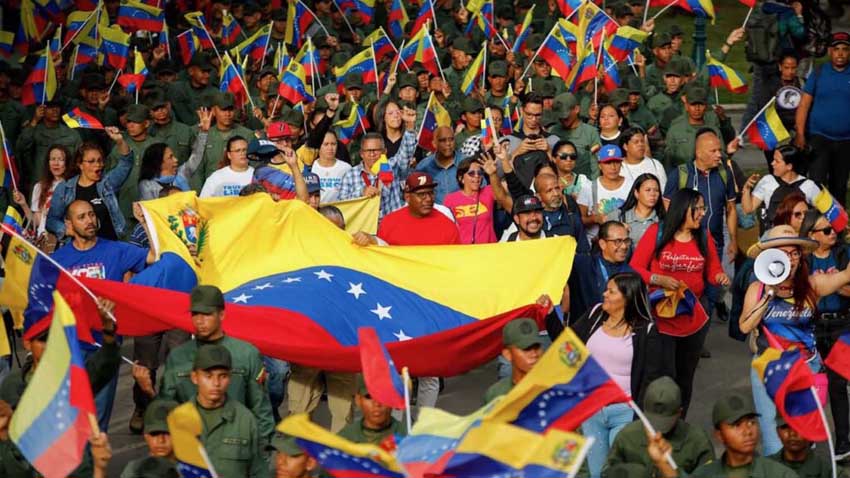
The marches in favour of Maduro continue.
Jouseline Rodriguez attended the march in Caracas on Sunday, the day after the US attack. She said that people marching in support of Maduro and Flores were deeply angry and indignant:
‘People are also feeling heartened by the strength shown by our President Nicolás Maduro.
‘He is a man with spiritual force. We can imagine the things they are doing to him now to humiliate him, but you can see that he remains strong and resolute.
‘Demonstrators were demanding the release of Maduro and Flores, and their return to Venezuela, emphasising that he was elected by the majority of Venezuelans as their president:
‘We do not deny the existence of an opposition. But the majority of the Venezuelan people are Chavistas, and we showed wisdom and restraint by not going out to burn cars or destroy the streets to express our frustration.
‘This respect for life and for Venezuelan institutions is something the international community should recognise.’
She also pointed out that even opposition supporters, whom she estimates make up around 15 per cent of the population, did not take to the streets to cause unrest, as they did in the days following the 2024 presidential elections:
The area next to the Presidential Palace of Miraflores was not bombed or attacked, but some drones exploded in the air nearby. The objective of the explosions was to scare people.
One drone fell near the entrance to the working class neighbourhood 23 de Enero, breaking part of a building.
There were no fatalities, but the incident was deeply shocking. The Cuartel de la Montaña, where the body of former president Hugo Chávez lies, was not damaged.
Monday’s march went from Bellas Artes, passing through Avenida Universidad and ending at the National Assembly. Sunday’s march went from Plaza La Candelaria along Urdaneta Avenue to the Presidential Palace of Miraflores. In both marches, entire avenues were packed with people.
On Monday morning the main road leading to the National Assembly was cordoned off, as it formed part of the march route.
While access to the Presidential Palace of Miraflores is restricted to vehicles, pedestrians can still pass through, and much of central Caracas remains walkable:
There are security forces throughout the area and across Caracas, but they are not stopping people. They are simply carrying out routine security to prevent access to normally restricted zones.
On Tuesday there will be a march of women in Caracas in solidarity with Maduro and Flores, with members of grass roots movements and communes, mostly from Caracas, expected to attend.
From the very beginning, the imperialist attack was interpreted for what it is: a direct aggression against national sovereignty and against a people who have decided not to kneel.
During these days, there have been constant mobilisations. On the day of the vile attack, people spontaneously gathered at Miraflores Palace.
Cira Pascual, a community educator at Pluriversidad, and a member of the International Network for Communal Democracy, told us that in recent days, in a way she described as unprecedented and characteristic of the Bolivarian Revolution, organised popular power has taken on the task of territorial defence alongside the Bolivarian National Armed Forces:
The people’s militias are protecting their communes, not through violence, but through a deep awareness that sovereignty is defended collectively.
Pascual confirmed she has not seen a single person in the streets, on public transport or in everyday conversations celebrating the kidnapping of Maduro and Flores:
Even broad sectors of the opposition have expressed their rejection of this imperialist attack, aware that it is a threat that transcends political differences and directly targets the right of peoples to decide their own destiny.
The majority of people are out on the streets showing solidarity.
The communal movement, made up of organised communities alongside members of political parties aligned with the Venezuelan government, forms the vanguard of the Bolivarian Revolution and is ready to defend the country against any aggression.
The attack against Venezuela is not an isolated incident but part of a broader offensive against the peoples of Latin America, particularly those who challenge an imperialist order whose hegemony is under strain:
The popular response is not only Venezuelan. It is profoundly Latin Americanist. Here, Maduro is defended, yes, but so is the very possibility of a sovereign, just and free Greater Homeland.
If the US attacks again, the Venezuelan army will not be caught off guard. However, an attack on the civilian population would result in catastrophic bloodshed:
If US forces try to come in and stay, we are more than ready to face them.
They will not leave Venezuela alive. Not a single drop of oil will go to the US.
They will face one, two or even three Vietnams. There will be no turning back.