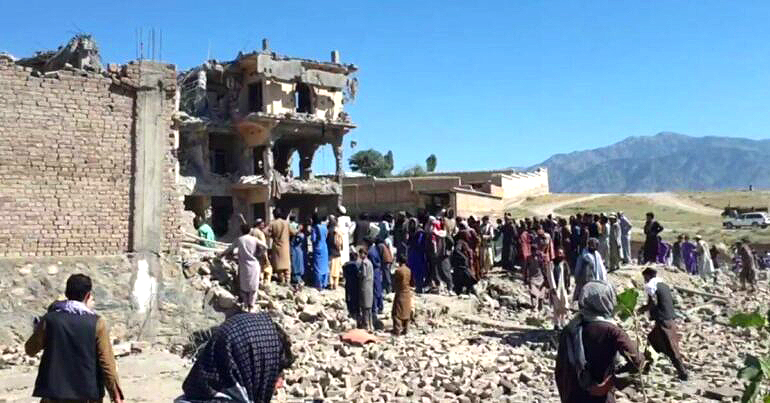
AT LEAST 22 civilians were killed and 47 wounded when Pakistani aircraft struck a residential area of Samkani district in Afghanistan’s Paktia province twice in succession on the night of June 29, according to the United Nations Assistance Mission in Afghanistan.
Five children were among the dead. The UN found that most of the casualties occurred during the second strike, which fell while local people were trying to rescue victims from the rubble of the first.
The attack on Samkani was part of a wider Pakistani operation across the eastern Afghan provinces of Paktia, Paktika and Kunar that night.
Pakistan said the strikes targeted camps belonging to the militant group Jamaat-ul-Ahrar and the Tehrik-e-Taliban Pakistan, claiming that 25 militants were killed.
Islamabad said the operation was launched in response to TTP attacks inside Pakistan, including an assault on a regional headquarters of the paramilitary Rangers in Karachi the previous day.
Pakistan has faced an increasing number of militant attacks in recent months, including ambushes and attacks on police stations near its border with Afghanistan.
Afghan authorities said residential areas in Samkani were struck and that the victims included women and children.
According to local residents, the first Pakistani jet struck shortly before midnight, killing a child and burying others in the debris of what had been their home.
As the loudspeakers of the village’s mosques called out across the area to alert others to what had happened, neighbours rushed to the scene with shovels and bare hands to dig through the debris. It was then that the second bomb fell.
Dr Amanullah Aman, medical director of Paktia Central Hospital, was asleep at home with his children when the phone rang in the early hours. On the other end was Dr Masoom Sahak, the physician on duty that night.
The news was urgent: dozens were believed wounded or killed, and the local hospital was already overwhelmed with patients arriving by ambulance with traumatic injuries.
Dr Aman rushed through the corridors to organise his staff. He instructed the entrance team on how to direct and park the incoming vehicles, then waited in front of the emergency gate.
At 3.30 in the morning, as the first call to prayer echoed across the city, the caravan of wounded began arriving. They came in local cars, not professional ambulances.
‘Some of the wounded were transferred with their intestines exposed. Some were bleeding or burned by flames,’ Dr Aman recalled.
Among them were children, women and old men.
The hospital declared an emergency.
Patients who had undergone operations only hours earlier were sent home to make space.
The emergency room, recovery wards and hallways filled with the wounded.
Additional beds were ordered for every room and corridor, and stretchers were brought in.
Dr Aman and his team worked without rest.
Some of his nurses and orthopaedic specialists performed as many as nineteen surgeries without a single break, taking neither breakfast nor lunch.
‘We called on doctors from the private hospital to help,’ Dr Aman said. ‘The corridors were covered in blood.
The cleaners worked just to clean the blood. Even the guards were busy cleaning.’
Of the critically wounded, 20 were flown to Kabul by helicopter and four others taken by road ambulance. In total, 74 wounded reached the hospital. Twenty-five required operations for blunt trauma, broken limbs and head injuries. Four of them died there.
Dr M. Farooq Samimi, another doctor on duty, said: ‘I saw patients that I had never seen before — they were all braindead, deadly injured or beyond repair. When I saw them, it was heartbreaking.’
Dr Aman credited mass casualty management training provided by the World Health Organisation with helping his team cope. ‘We were trained for natural and human-made disasters. That training helped us a lot.’
The medical staff worked under the constant fear that the hospital itself would be hit.
‘My staff were worried. There were rumours that the hospital would be bombed next,’ Dr Aman said. The doctors and nurses worked through it.
The Samkani attack was one episode in a conflict that has been escalating for months.
Between October 2025 and the end of June 2026, 499 civilians were killed and 1,216 wounded inside Afghanistan during fighting with Pakistan.
The Taliban-led Afghan government has vowed revenge for the attacks, with government spokesman Zabihullah Mujahid denouncing the Pakistani campaign as a war of aggression.
The attacks on Afghanistan come as Pakistan pursues a widening crackdown internally, including mass killings of demonstrators in Kashmir and the ongoing suppression of a nascent insurgency in Balochistan.
In recent weeks, the aerial campaign appears to have paused, but Afghan officials have accused Pakistan of launching armed incursions aimed at exacerbating local tribal conflicts, a charge the Pakistani government denies.
The bombing has taken its toll on a population still recovering from the legacy of a two-decade US occupation.
On August 23, local news outlets reported that another victim of the Samkani strike, wounded in the attack, had died of their injuries nearly two months after the bombing.
The report added that some of the injured are in such difficult financial circumstances that they cannot afford even ordinary povidone iodine to dress and treat their wounds.
When Dr Aman finally returned home to rest after that night, he tied a cloth around his legs. He had walked too far between the wards, trying to find space for the wounded.
‘We wanted to cry,’ he said, ‘but we had no time for it.’