Over 250 people took action on Saturday 29 November against the government’s complicity in genocide and against the ban on Palestine Action in ten towns and cities across the UK.
They were all peacefully holding signs saying: ‘I oppose genocide. I support Palestine Action’.
Yet police only arrested 164 of them as police forces in Edinburgh and Exeter decided not to make arrests of the 55 and 35 sitters there respectively.
The action brings the total of arrests to 636 in the ‘most widespread wave of civil disobedience in modern UK history’ with many more people sitting with signs that police failed to arrest.
This brings the total number of Lift The Ban sign-holding arrests since the proscription of Palestine Action as ‘terrorist’ to 2,717.
The day of action comes in the middle of the Judicial Review which ended yesterday, Tuesday 2nd December, and which was plagued by allegations of a last minute ‘stitch up’.
A spokesman for Defend Our Juries said: ‘Yet again the ban has proven unenforceable, with police forces in Belfast, Derry, Edinburgh, Totnes and now Exeter choosing not to arrest peaceful sign-holders under ‘terror’ laws, while other forces have given up making arrests half way through.
‘This historic wave of action has seen people of courage and conscience taking action to resist the government’s clampdown on our fundamental rights to protest and free speech.
‘In the face of our government’s steadfast support for Israel as it carried out crimes against humanity, collective punishment and genocide, Palestine Action were the one group who made a material impact by hitting the profits of companies supplying hardware to Israel’s killing machine.
‘In court this week, the government has had to try and defend the proportionality of the ban. Yet it hasn’t been able to offer any argument that proscription was in the public interest. Repeated statements by government barristers make it clear that it was simply to protect the profits of arms companies.
‘The ban was never in the public interest as Palestine Action never posed any threat to the public. Conflating property damage with terrorism, as the Terrorism Act 2000 does, is an insult to everyone who has lost loved ones through acts of genuine terror.
‘The proscription of Palestine Action was an act of authoritarian overreach whose only purpose was to protect Israel, the arms companies supplying its genocide, and the government ministers who have been so shamefully complicit in that genocide.’
UPDATE ON THE JUDICIAL REVIEW
The campaign group Avaaz has launched a petition demanding an explanation from Justice Secretary David Lammy MP as to why the judge overseeing the case was removed last week just days before it was about to begin.
The last minute switch has meant that the Judicial Review has been dogged by allegations of a ‘stitch-up’ with questions about the suitability and independence of the three replacement judges demanding to be answered.
A former British ambassador suggested the result had been to ‘load the dice for Israel’.
On the opening day of the Judicial Review, Raza Husain KC, representing Palestine Action co-founder Huda Ammori, noted that the group was the ‘first direct-action civil disobedience organisation that does not advocate for violence ever to be proscribed as terrorist.’
He said the ban was an ‘ill-considered, discriminatory, due process-lacking, authoritarian abuse of statutory power … that is alien to the basic tradition of common law and the European Convention on Human Rights.’
Defend Our Juries’ Lift The Ban campaign was cited as evidence of mass civil society disagreement with the proscription.
Intervening in the Judicial Review, United Nations Special Rapporteur Ben Saul warned the ban makes the UK ‘out of step with comparable liberal democracies’ and ‘sets a precedent’ for further crackdown on other protest movements in the UK such as climate protesters.
Amnesty International UK said it represented a substantial departure from established responses to protest movements which use direct action tactics and that it breached our fundamental rights to protest and free speech.
Liberty argued that the ban was disproportionate because counter-terror powers have historically been directed at groups whose modus operandi includes intentional violence against people
Best-selling author Sally Rooney told the hearing how she might no longer be able to sell or publish her books in the UK due to her support for Palestine Action.
The court also heard how Prime Minister Keir Starmer discussed Palestine Action with Donald Trump in two phone calls before the ban after Palestine Action painted ‘Gaza is not for sale’ on his golf course in Scotland.
The Judicial Review concluded yesterday, Tuesday 2nd December, when the government presented part of its defence using the secret court system known as Closed Material Procedure which has come under criticism for allowing evidence to be presented without challenge and has been described as being a system ‘in meltdown’.
A judgement will be given at a later date. Skeleton arguments for the applicant are available on request.
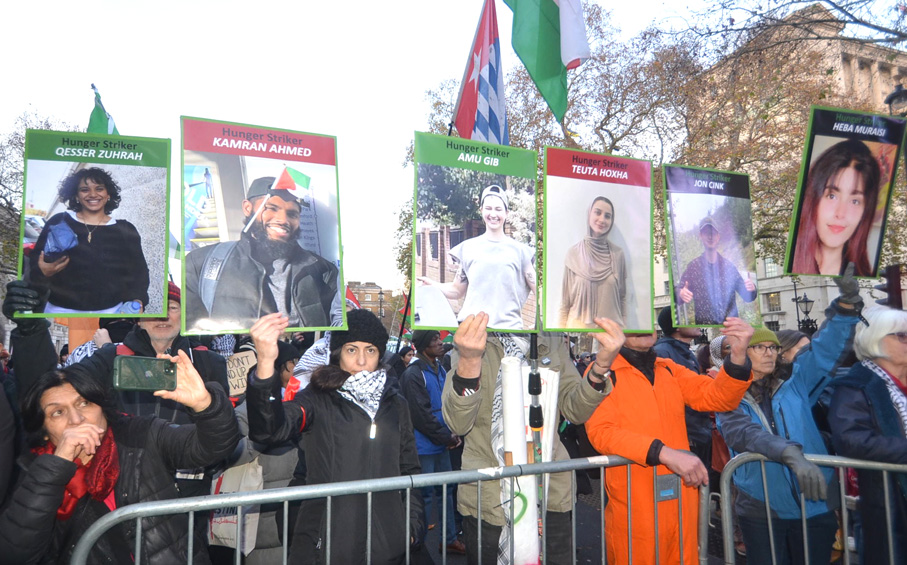
SECOND HUNGER STRIKER HOSPITALISED
28 prisoners, known as the Filton 24 and the Brize Norton 5, are currently being held in UK prisons without trial for allegedly taking part in actions claimed by Palestine Action.
Most will be held for two years without trial – exceeding the six month pre-trial custody limit – because the Crown Prosecution Service is claiming there is a ‘terrorist connection’ on the basis of criminal damage.
However, no charges have been brought under the Terrorism Act against these prisoners and the actions took place before Palestine Action was proscribed by the government.
Six prisoners are now on a rolling hunger strike, some will today enter their fifth week.
The hunger strike started on Saturday 2nd November – Balfour Day – with two people after the Home Secretary failed to respond to their demands including immediate bail, access to documents necessary for the right to a fair trial and the de-proscription of Palestine Action.
The strike is ‘rolling’ because more people continue to join the strike as their demands remain unmet.
The conditions of their detention have been criticised by United Nations experts in a letter to the UK government.
It was revealed that Teuta ‘T’ Hoxha is now the second prisoner on hunger strike to be hospitalised.
She was moved to the healthcare wing last Thursday, due to her rapidly deteriorating health after 20 days on hunger strike. Kamran Ahmed was hospitalised on Tuesday after collapsing on Friday 21 November.
In August of this year T Hoxa of the Filton 24 went on hunger strike for 28 days, eventually winning most of her demands. For more information on the hunger strikers see Prisoners for Palestine.
SCOTLAND SIGN-HOLDING ‘TERRORISTS’ REJECT £100 FINE OFFER
At the action in Edinburgh on Saturday, six people charged under section 13 of the Terrorism Act 2000 in Scotland for peaceful sign-holding read out a statement rejecting the offer of a £100 fine instead of a court trial.
They said: ‘In the context of the immense weight of the tragedy in Palestine and the seriousness of these campaigns, we are not playing games.
‘The scale of suffering and violence in Gaza is such that thousands of Scottish citizens have campaigned for years, especially since October 7th 2023, for our government to stop supporting Israel.
‘Now is not the moment to betray those years of campaigning.
‘We therefore reject the absurd offer of a fine or a warning, and demand all our charges are dropped.
‘Our demand is that Scottish Police stop arresting us and stop charging us: that they completely end the persecution of those taking direct action to protect the Palestinian people from genocide.’
The numbers recorded taking sign-holding action in Edinburgh since the proscription comes to at least 149. No arrests have been made at any of the actions but a seemingly random 19 people have been charged after investigations.
People who have been charged for wearing t-shirts, including award-winning screenwriter Paul Laverty, have also received offers and fines and have publicly burnt them.