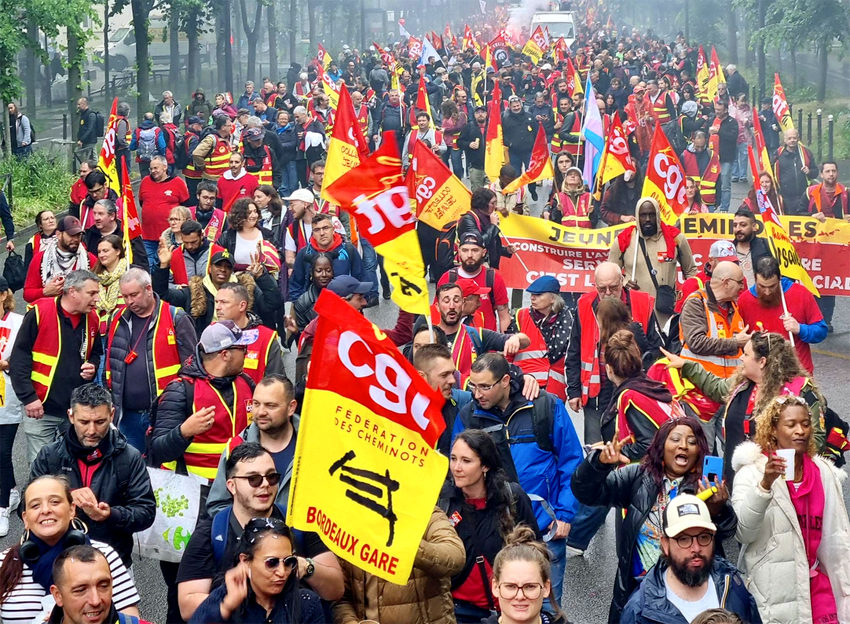
FRANCE had a nationwide public sector strike and over 150 protests on Tuesday as workers trade unions, young people and the Yellow Vest movement came out against the government of President Emmanuel Macron.
There were mass demonstrations all around the country with the largest taking place in Paris, Marseille and Lyon and Bordeaux
Striking workers had picket lines at Ports, in healthcare and the postal sector, with teachers, school staff, students, high school pupils and railway workers also took action.
Workers in Force Ouvrière (FO) and the CGT Cheminots (Confédération Générale du Travail) UNSA Ferroviaire (Union Nationale des Syndicats Autonomes) SUD-Rail (Solidaires Unitaires Démocratiques) and CFDT Cheminots (Confédération Française Démocratique du Travail) mobilised against cuts being made by the government of French President Emmanuel Macron and for higher pay.
The transport strike left regional train services disrupted and several Paris metro stations closed. Rail operator SNCF severely reduced services in the Paris region and there was severe disruptions on some regional lines.
A CGT source estimated that over 500,000 people were expected to demonstrate nationwide, including 40,000 to 80,000 in the capital, where a main rally began at 2.00 pm.
The police imposed restrictions on undeclared gatherings near several schools and universities in Paris.
Last Friday, Prime Minister Sebastien Lecornu failed to satisfy unions, which had been pushing for across-the-board pay rises since last week’s boost to the minimum wage for private-sector workers.
The unions want the government to raise the rate used to calculate public employees’ base salaries, saying their purchasing power has fallen 16 per cent since 2017.
The draft 2027 budget leaves that rate unchanged for a fourth consecutive year, with the government ruling out any general pay rise.
Seventeen-year-old Nohlan, a student at Lycée Professionnel Frédéric Bartholdi a vocational senior high school (trade school) in Saint-Denis, a northern suburb of Paris said: ‘Sometimes, we see rats in the courtyard and in the restrooms.
‘The restrooms are a mess. We don’t have enough water; it flows very slowly. We don’t have enough to drink, and the restrooms are dirty.
‘The hallways are dirty, the classrooms are dirty, and there are cockroaches.’
The FO stated: ‘Public sector workers cannot be left behind and used as a means of adjusting budgetary austerity policies.
‘The demands put forward by the FO federations and unions of the public sector remain unheard, even though they are more legitimate than ever.
‘FO reiterates that more than 1.2 million public sector workers will find themselves earning less than the minimum wage on 1st December Public sector workers are the pillars of the Republic and deserve immediate, comprehensive, and lasting solutions. The government must take responsibility.
‘The priority is the immediate unfreezing and significant increase of the index point value.
‘Ad hoc or limited measures targeting lower-level employees cannot replace a comprehensive response to the loss of purchasing power and the stagnation of salary scales.
‘FO supports the actions and demands of all workers. In the private sector, FO remains vigilant to ensure that commitments made are honoured.
CGT Cheminots said: ‘Through our demands regarding wages, particularly a single pay scale for all railway workers and the implementation of a sliding wage scale, through our demands concerning employment, the uniformity of rights for all railway workers in the sector, and access to the professional training necessary for railway jobs, our struggle is clearly in the public interest and an integral part of the mobilisations of recent weeks.
Following this day of action, the CGT Railway Workers’ Federation, acting responsibly, will once again contact the other representative unions within the General Union of Railway Workers (GPU) to analyse this day of mobilisation and consider the next steps.
In parallel, the CGT Railway Workers’ Federation invites all railway workers to contact their local CGT unions to discuss the conditions for continuing the mobilisation.
SUD-Rail (Solidaires Unitaires Démocratiques) said: ‘On the ground, the reality is clear to everyone: staff exhausted by understaffing, equipment on its last legs, a lack of recognition, and a daily grind that feels like a logistical miracle!
‘Teams, already struggling with staff shortages and unfilled or even eliminated positions, are being forced to compensate for the organisational deficiencies. This cannot continue.’
Government spokesperson Mathieu Lefevre said it would meet unions after public sector elections on 11th December.
CFDT Cheminots said: ‘SNCF has just announced a record net profit of 1.2 billion euros for the first half of 2026 – up from 950 million euros a year earlier and a historic ridership of 83.4 million passengers.
‘These results were achieved despite three winter storms, recurring heatwaves, and fires. Yet workers are not feeling the benefit.’
‘These results are the product of the work of the railway employees themselves.
‘Record-breaking profits should not be an end in themselves, but rather a means — a way to invest in infrastructure, equipment, and the men and women who, day and night — weekends included — keep the public railway service running.’
The European Union’s second-largest economy has been rocked by more than a month of high school blockades and cost-of-living protests, with presidential elections looming next year.
The latest demonstrations follow weekend protests over grievances ranging from inflation to a proposed police law, and some of the largely peaceful rallies have seen fringe violence as well as accusations of police brutality. France is racing to adopt a 2027 budget under pressure to reduce its deficit.
Meanwhile, in Spain there was a 24-hour national rail strike on Tuesday which impacted services run by train operators Renfe, Iryo and SNCF’s Ouigo.
Industrial action was taken by train drivers’ union SEMAF, as well as the larger CCOO and UFT unions, to demand improved safety and staffing on the Spanish rail network, following the deadly crash between two-high speed trains last month.
Workers for Spain’s rail infrastructure body ADIF walked out.
The strike by train drivers called for this Tuesday, 17 November, disrupts the rail traffic in Spain.
The workday affects different Renfe services, from Cercanías to High Speed and Long Distance, with traffic guaranteed through minimum services.
The mobilisation was in response to the demands of the unions regarding rail safety and to compliance with the commitments made to workers.
The action took place after the most recent contacts with the Ministry of Transport, without an agreement having been reached that would allow the stoppages to be called off.
The call by the Sindicato Español de Maquinistas Ferroviarios (SEMAF) affects driving staff of the Renfe Group across the entire national territory.
There are also stoppages called by the General Committee of the Renfe Group and by other unions for the entire company workforce.
SEMAF demands that the commitments regarding rail safety be made concrete and that technical and operational measures be implemented that, in its view, are still pending.
Among its demands are the creation of specific weather alerts for the railway by AEMET, action protocols in response to serious warnings, and a centralised risk register supervised by the State Railway Safety Agency.
The union also asks to reinforce the High-Speed protection systems, to publish a technical guide to act in the event of anomalies in the Linienzugbeeinflussung (LZB) cab signalling system, and to establish effective monitoring of temporary speed limitations.