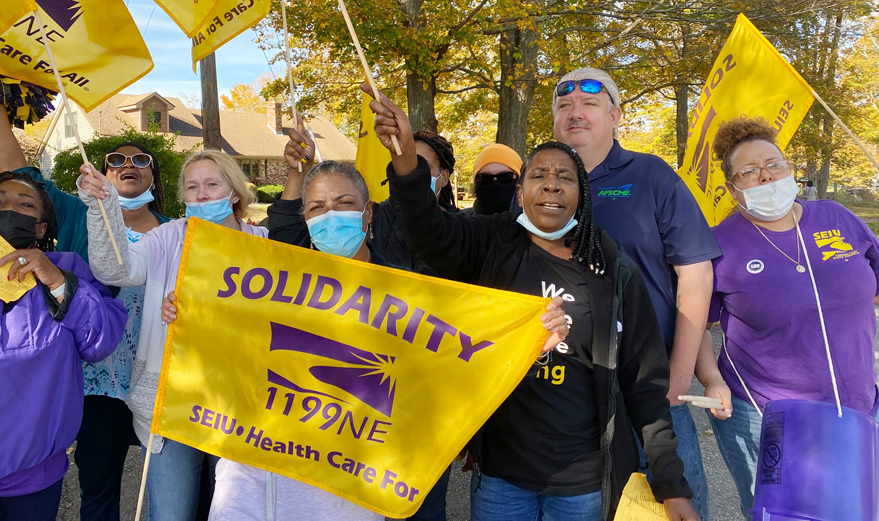

A coalition of Minneapolis trade unions and community organisations is calling for a general strike to take place this coming Friday with the goal of forcing federal Immigration and Customs Enforcement (ICE) agents to leave their city.
The groups announced their plans to create a day of ‘no work, no school, no shopping’, which will take place on Friday, 23rd January.
JaNaé Bates Imari, a local resident who supports the strike, said that this coming Friday would be ‘a day when every single Minnesotan who loves this state – who loves the idea of truth and freedom – will refuse to work, shop, and go to school’.
She added: ‘We are asking every single person, every family member, every teacher, every bus driver, every childcare worker, to come together, to be in community, to stand with one another.
Abdikarim Khasim, a Minnesota rideshare driver, said the strike was necessary because ‘we are facing a tsunami of hate from our own federal government’, while also vowing that ‘we are going to overcome this’.
Several local Minneapolis unions – including Amalgamated Transit Union (ATU) Local 1005, SEIU Local 26, UNITE HERE Local 17, CWA Local 7250, and St. Paul Federation of Educators Local 28 – have lent their support to the strike.
The Minneapolis Federation of Educators has also signed up to the action.
In addition to the labour organisations, faith-based social justice group Faith in Minnesota has declared its support for the strike.
Charles Booker, a Democratic candidate for the US Senate in Kentucky, praised the organisations for showing solidarity in the face of a crackdown by federal agents.
He said: ‘This is what it takes.
‘It is time for the people to stand and take back our power. We need a general strike! Love and solidarity to our family in Minneapolis who are refusing to go along with a status quo, more of this!’
Thousands of demonstrators hit the streets to protest last weekend after Immigration and Customs Enforcement (ICE) agent Jonathan Ross fatally shot Minneapolis resident Renee Good.
In the days since Good’s killing, federal agents have been repeatedly captured on video brutally detaining anti-ICE demonstrators and assorted bystanders, including some who have been confirmed as US citizens.
- More than 300 bus workers in Missouri have voted to join Teamsters Local 610.
The group organised to demand fair pay, improved working conditions, and a powerful voice on the job.
‘We are so happy and proud to welcome our newest members to the Teamsters,’ said Daniel Thacker, Secretary-Treasurer of Teamsters Local 610. ‘These workers chose to come together and fight for a better future that includes fair wages, better benefits, and respect on the job. We are ready to fight for a strong Teamsters contract for the group.’
The workers stopped an aggressive union-busting campaign from Zum and persevered in their fight to form a union. Now, they will have the backing of the Teamsters in the fight for a fair and timely first contract.
Thane Wright, a bus worker and member of Local 610 said: ‘Becoming Teamsters means we have the support we deserve and the ability to negotiate a contract we have earned.
‘We love this community and our work is essential to its success. We are ready to finally feel like that is appreciated.’
- Renaming the ‘Department of Defence’ the ‘Department of War’ could cost US taxpayers as much as $125 million (£94 million) depending on how broadly and quickly the change is made, according to an analysis released Wednesday from the Congressional Budget Office.
Donald Trump signed an executive order in September that authorised the Department of War as a secondary title for the Pentagon.
At the time, Trump said the switch was intended to signal to the world that the US was a force to be reckoned with, and he complained that the Department of Defence’s name was ‘woke’.
Congress has to formally approve a new name for the department, and it has shown no serious interest in doing so.
Nevertheless, Pete Hegseth, the US secretary of war, embraced the rebrand and proceeded to use it immediately on several signs after Trump’s order.
He had employees remove the large gold letters that spelled ‘Secretary of Defence’ outside his office and replaced the sign on his door to read ‘Secretary of War’.
The Pentagon’s website also went from ‘defense.gov’ to ‘war.gov’ the same day the executive order was signed.
Pentagon officials said then that they could not offer a cost estimate for the name change because they expected costs to fluctuate. They promised a clearer estimate later.
The new report from the Congressional Budget Office says costs would be at least a few million dollars if the name change was phased in with minimal implementation, but could reach $125 million if it was implemented broadly and rapidly throughout the department.
The report says: ‘A statutory renaming could cost hundreds of millions of dollars,’ depending on how Congress and the Defence Department choose to do it, the report says.
The Pentagon has more than 6.5 million square feet of office space, and many of the signs, logos and seals have remained unchanged. Republican lawmakers, including senators Mike Lee, Rick Scott and Marsha Blackburn, introduced legislation to make the name change official shortly after Trump signed the executive order but the measure has not progressed.
The order had tasked Hegseth with recommending actions required to change the name permanently.
Pentagon officials did not answer questions about what, if any, recommendations have been made.
The new analysis was requested by Senate Democratic leader Chuck Schumer and Democratic senator Jeff Merkley.
- The US has finalised its first $500 million (£374 million) sale of Venezuelan oil, claiming billions are needed to ‘revive’ the country’s energy sector following its illegal military intervention in Caracas.
The first shipment has already been completed, with further sales expected in the coming weeks.
It was reported by US news agencies that Venezuelan crude oil was being sold at discount prices to traders in Canada.
Meanwhile, the Trump administration’s efforts to steal Venezuelan oil have run into resistance from major US energy firms, which have questioned the feasibility and legal framework for large scale investment.
Oil executives gathering at the White House earlier this month described Venezuela’s oil sector as ‘uninvestable’ under current conditions, citing legal and commercial obstacles.
Darren Woods, CEO of ExxonMobil, a major US multinational oil company, told US administration officials that Venezuela’s existing legal and investment frameworks do not allow American firms to do business in the country.
He said: ‘There are a number of legal and commercial frameworks that would have to be established to even understand what kind of returns we would get on the investment.’
Several other US oil executives also expressed reluctance in doing business in the Bolivarian state.