SUNDAY’S Brazilian election result in which Luiz Inacio Lula da Silva defeated the Trump-backed Flávio Bolsonaro reflects the public’s determination to protect public services and national sovereignty, said São Paulo-based journalist and analyst Shobhan Saxena.
‘Brazil’s election demonstrated that Latin American voters could reject political choices favoured by Washington,’ he said.
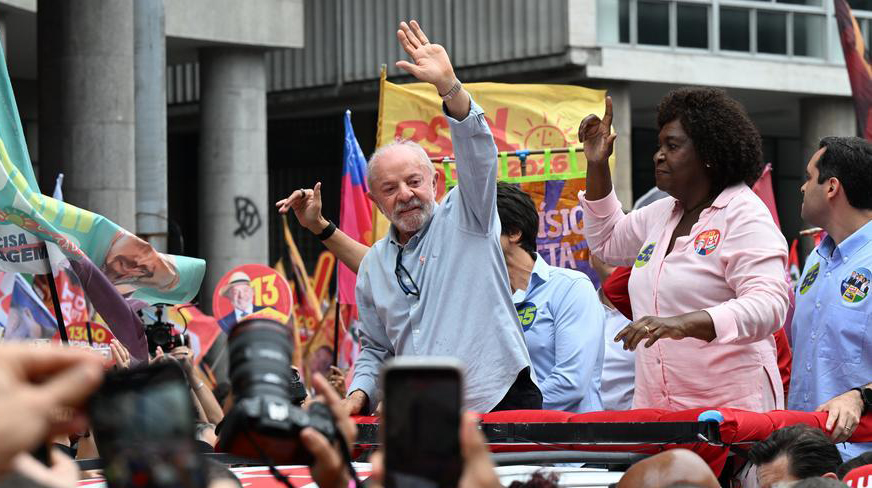
Lula won a fourth, non-consecutive term in the October 25th run-off, defeating right wing Senator Flávio Bolsonaro, the son of former president Jair Bolsonaro, who was publicly backed by the United States.
Brazil’s electoral authorities said Lula won 51.8% of the vote against his opponent’s 48.2%, a difference of about 4.4 million votes.
Saxena called it a record victory, with Lula securing more than 64 million votes.
Lula had trailed Bolsonaro in the October 4th first round but made a strong comeback, becoming the first candidate since the Latin American country’s return to democracy to win the presidency after finishing second in the initial vote.
Saxena, originally from India who has been based in Brazil for over 14 years, said Trump’s approach to Brazil reflected a preference for political leadership aligned with his far right world view and his broader regional agenda.
Trump repeatedly made clear that Bolsonaro was his preferred candidate, the analyst said, just as Lula was seeking to defend the country’s sovereignty and an independent foreign policy.
In his reading, that support suggested an effort to steer the region’s political direction towards governments aligned with Washington’s priorities.
Lula, for his part, denounced foreign actors and digital platforms for interfering in the election.
Saxena also referred to reports of social media manipulation, with Meta admitting that its artificial intelligence tool had blocked the generation of campaign material supporting Lula while allowing similar technology to be used by Flávio’s campaign.
Lula pledged to regulate big technology companies as the election exposed tensions over the role of digital platforms in the country.
‘Trump’s intervention ultimately failed to secure a victory for his preferred candidate,’ Saxena said.
In his victory speech, Lula defended Brazil’s sovereignty, declaring that ‘Brazil is nobody’s backyard.’
Saxena said the line reflected the electorate’s desire to protect national sovereignty against foreign interference.
Trump responded on October 26th by questioning the legitimacy of the result, claiming – without evidence – that it looked like ‘another rigged election’.
A day later, a senior US State Department official confirmed that Bolsonaro and his family would receive US visas amid reports that the defeated opponent of Lula had fled the country with US assistance.
Saxena said Trump’s response, including his questioning of the result, reinforced the impression that his administration was unwilling to accept political outcomes that contradicted its preferences.
His involvement may also have reinforced concerns among Brazilian voters about foreign interference, he said, and strengthened Lula’s argument that the election was also a contest over national independence.
Celso Amorim, Lula’s special foreign policy advisor, underscored the high regional stakes, Saxena noted.
Amorim described the result as a defeat for the US strategy in Latin America based on the Shield of the Americas, and ruled out Brazil joining the alliance Trump launched to allegedly combat drug trafficking.
At home, Saxena said, the outcome was driven by something broader than foreign policy. Lula’s victory reflected the electorate’s determination to protect democracy, public services and national sovereignty.
His comeback was driven by a mobilisation of young people, women and older voters, many of them concerned about the future of public education, healthcare and transport under a Bolsonaro presidency.
Millions joined rallies and social media campaigns, Saxena said, demanding the protection of public services and backing Lula’s campaign promises to increase investment in healthcare, expand public universities and strengthen the digital and creative economies.
The result was also a rejection of the political direction advocated by Bolsonaro, whose campaign faced opposition from voters concerned about the return of the far right to power.
Saxena said Lula’s victory showed that mobilisation around democracy and concrete public policy promises could overcome a challenge from the right.
Meanwhile, Brazilian Supreme Court Justice, Flavio Dino, has ordered an investigation into links between the Rockbridge Network, a donor organisation co-founded by US Vice President JD Vance, and the presidential campaign of Flavio Bolsonaro.
Dino directed federal police on Tuesday to investigate whether the network provided financial resources, personnel, services or other economic benefits to Bolsonaro’s campaign.
Brazilian law strictly prohibits presidential candidates from receiving foreign campaign funding or assistance of any kind.
The investigation follows an election campaign shaped partly by the relationship between US President Donald Trump and the Bolsonaro family, whose political movement has sought Washington’s support against Brazil’s current government.
In addition to Vance, several figures associated with Rockbridge are senior members of Trump’s administration, including White House political adviser James Blair, Secretary of Treasury Scott Bessent, and Secretary of State Marco Rubio.
Trump has repeatedly defended former Brazilian President Jair Bolsonaro, who was sentenced to more than 27 years in prison for plotting a coup after losing the 2022 election to Luiz Inacio Lula da Silva.
Trump portrayed the prosecution as politically motivated and called for Bolsonaro to be spared punishment.
The move made the former Brazilian president’s legal case a major source of tension between Washington and Brasília.
In July 2025, Trump announced steep tariffs on Brazilian imports and later imposed sanctions on Supreme Court Justice Alexandre de Moraes, who oversaw Bolsonaro’s case.
The measures sharply strained relations between Washington and Brasília, with Lula condemning the tariffs as political pressure.
Bolsonaro’s son Eduardo played a central role in seeking US intervention on behalf of his father, moving to the US to lobby Trump’s allies and publicly welcoming sanctions against Brazilian officials.
Flavio Bolsonaro, a senator who ran for president on a promise to pardon his father, also cultivated ties with Trump’s administration and supported US pressure on Brazil.
Trump questioned Lula’s victory without presenting evidence of fraud, saying the result looked like ‘another rigged election’.
Flavio Bolsonaro initially sought to challenge the election result but later withdrew his request to annul the vote, while saying he would lead the opposition to Lula’s government.
It was confirmed on Tuesday that Bolsonaro has left Brazil for the United States after losing Sunday’s presidential election to Lula, despite a court order requiring him to surrender his passports.
He arrived at Miami-Opa Locka Executuive Airport on Wednesday.