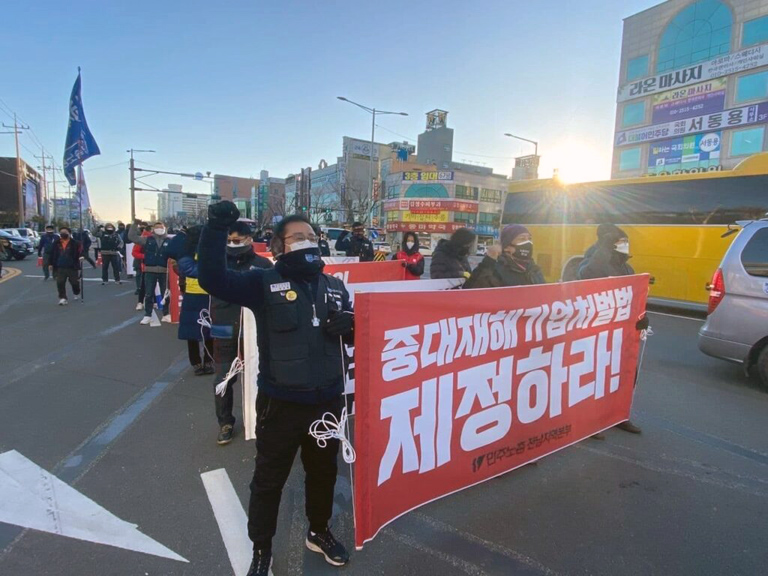
The POSCO Labour Union which represents workers at the massive iron and steel maker in South Korea on Thursday approved industrial action with a 92 per cent yes vote.
In a strike-authorisation vote related to the 2026 collective bargaining held on the 8th-9th July by the POSCO labour union of the Federation of Korean Trade Unions Metal Workers’ Federation, the representative bargaining union at POSCO, 97.1 per cent of members participated and 92.2 per cent of them voted in favour.
Kim Seong-ho, Chairperson of the POSCO labour union (head of the strike countermeasures committee), said: ‘The record turnout and overwhelming support are not because we want a strike, but a desperate on-site warning to set the company straight,’ and added: ‘If the company ultimately ignores on-site voices and repeats insincere bargaining, all conflicts and responsibility arising from that lie entirely with the company.’
POSCO labour and management have held three rounds of talks since a courtesy meeting on the 12th.
The POSCO union argued that this result is a strong warning from on-site workers that has built up since the physical split.
It criticised that although the steel institutional sector serves as the group’s cash cow, only sacrifices are being demanded of on-site workers.
The union also said that in the midst of a management crisis, dividends sent to POSCO Holdings are rising without standards.
The union said management has continued to reject its demand, raised since last year’s talks, to disclose the standards for dividends.
The union said the result of this strike-authorisation vote is not aimed at a strike.
POSCO has maintained a no-strike tradition since its founding in 1968.
POSCO labour and management will proceed with additional negotiations and the National Labour Relations Commission’s collective bargaining mediation process.
If mediation is suspended, a strike would be allowed.
Korean delivery riders recognised as workers
THE SOUTH Korean High Court has ruled that delivery riders working through platforms are considered employees under the Labour Standards Act.
The 38-1 Civil Division of the Seoul High Court (Presiding Judges Lee Ji-young, Hwang Seong-mi, and Park Seong-yun) ruled in favour of the plaintiff in part on July 3, overturning a lower court decision that had denied the worker status of a delivery rider, identified as A, a member of the Rider Union.
The rider had filed a lawsuit against a delivery platform company seeking to invalidate their dismissal and claiming unpaid wages.
This marks the first time a court has recognised the worker status of a delivery rider.
The court emphasised that whether an individual qualifies as an employee under the Labour Standards Act should be determined based on whether they provided labour for wages in a subordinate relationship, rather than the form of the contract.
The court stated: ‘The plaintiff (A) is an employee under the Labour Standards Act who provided labour in the form of delivery services in a subordinate relationship, under the direction and command of the defendant company, for the purpose of earning wages.’
The court based its decision on the fact that the rider could only perform delivery tasks through the platform’s app, that the platform set both the working hours and compensation standards, and that the rider was subject to specific direction and supervision by the platform.
The court explained: ‘It is acknowledged that the plaintiff provided labour in a form significantly more flexible than that of a typical employee defined by the current Labour Standards Act.’
The court added: ‘However, even if there are provisions in the Labour Standards Act that are not suitable for application to riders and delivery platforms.
‘Even if it is desirable for separate legislation to be enacted that better suits the labour provided by platform workers like the plaintiff, it is preferable to flexibly interpret the Labour Standards Act in individual cases where worker status is recognised to regulate labour relations according to their substance, rather than indiscriminately denying worker status until such legislation is in place.’
Regarding the ruling, the Korean Public Service and Transport Workers’ Union stated: ‘This reaffirms that employers cannot evade their obligations under the Labour Standards Act, such as social insurance, paid leave, and severance pay, simply because the work is performed through a platform.
‘Platform companies must come up with measures to guarantee rights under labour law in line with the spirit of this ruling.’
- The Hyundai Motor Company labour union will commence a three-day partial strike starting on the 13th after failing to narrow differences with management in this year’s wage and collective bargaining negotiations.
The union announced on the 8th, following its second Central Labour Dispute Committee meeting, that it will conduct daily two-hour partial strikes from the 13th to the 15th.
On the final day, the 15th, it plans to join a nationwide strike organised by the National Metal Labour (NML) union.
If the strike proceeds, it will mark the second consecutive year of labour action, following last year’s walkout.
Key issues in this year’s negotiations include wage increases, expanded bonuses, and retirement age extensions.
The company expressed regret over the union’s strike decision, stating: ‘We urge avoiding unnecessary conflicts and will continue negotiations to reach a reasonable outcome that benefits both parties.’
The union initially demanded in May a monthly base pay increase of 149,600 Korean won (excluding seniority-based raises), performance bonuses equivalent to 30 per cent of last year’s net profit, job and working condition guarantees amid AI adoption, full monthly salary system implementation, reduced working hours, and new hires.
Both sides have agreed on principles to stabilise employment amid industrial transitions and improve working conditions with AI technology.
They also formed a task force to discuss the full monthly salary system and reduced working hours separately.