
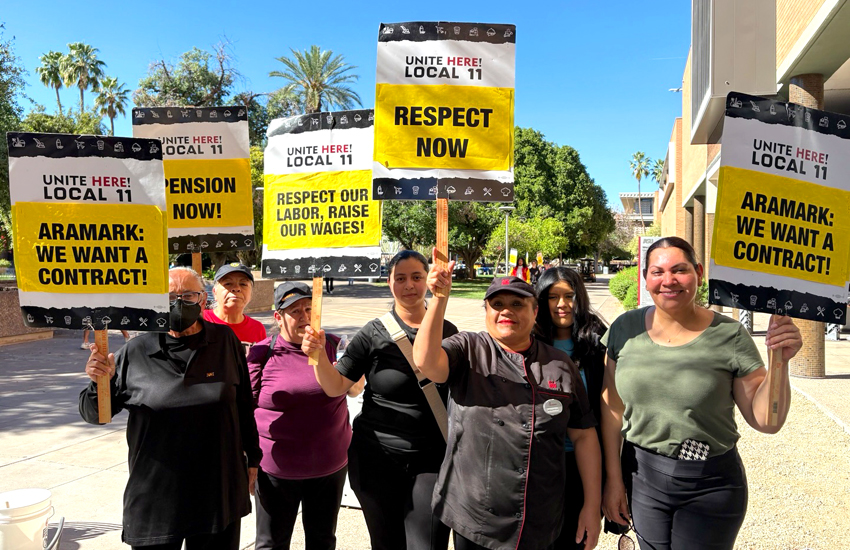
The Unite Here trade union which represents over 2,000 food service workers at the Los Angeles Stadium on Tuesday asked football’s governing body FIFA to keep United States Immigration and Customs Enforcement (ICE) away from World Cup operations and warned workers will strike if their concerns are not addressed.
Unite Here Local 11, which represents cooks, servers and bartenders at the Inglewood venue, said on Monday that the workers remain without a labour contract as the World Cup approaches.
The union laid out three main demands to FIFA and stadium owner Kroenke Sports & Entertainment: A public commitment that ICE and Border Patrol will play no role in the tournament, protections for union jobs and working conditions, and support for affordable housing for hospitality workers.
Acting director of ICE, Todd Lyons, has said ICE would play a ‘key part’ in the World Cup, a prospect the union said threatened worker and guest safety in Los Angeles.
Unite Here said it also wanted assurances that artificial intelligence and automation would not be used during the tournament to eliminate union jobs.
The union linked its labour demands to broader concerns over housing costs in the Los Angeles area, particularly in Inglewood, and called for support for a workforce housing fund, restrictions on short-term rentals and tax measures aimed at funding affordable housing and immigrant family protections.
The union said it had repeatedly sought meetings with FIFA since Los Angeles was chosen as a host city, but had been ignored.
Los Angeles is set to host eight World Cup matches at the stadium, the first being the US against Paraguay on 12th June.
Meanwhile, the Harvard Academic Workers-United Auto Workers union pressed the University for major wage increases and expanded benefits during a bargaining session on Tuesday, the first since the union strike ballot after 18 months without a contract.
Union negotiators introduced a set of economic proposals – 15 articles in total – which they said were aimed at accelerating talks and addressing long-standing concerns over pay and benefits.
The union is seeking a one-time 20 per cent wage increase, along with five per cent annual raises and an additional three per cent raise for workers moving between employment steps. The proposal also includes a $3,000 ratification bonus and retroactive back pay to 1st July 2026.
Bargaining committee member Adam Sychla said the proposal is intended to address wages that have not kept pace with rising costs.
He said: ‘We want to really be able to catch up after years of raises that have been under what cost of living adjustments should have been, especially for the cost of living in places like Cambridge.’
He added that some workers have gone ‘over several years’ without raises.
The proposal significantly exceeds Harvard’s last offer – roughly two per cent annual raises with no upfront increase, presented in October 2025.
Beyond wages, the union is seeking expanded benefits, including student loan repayment assistance and housing benefits that would cap how much Harvard can raise the cost of housing.
The proposal would also extend childcare and family benefits to all workers in the bargaining unit and expand access to retirement savings.
Union leaders said many of those benefits are currently unavailable to portions of the workforce.
In a statement they said: ‘We cannot compromise on some of our key issues that affect the safety of our members, whether they are US citizens or not.
‘It is reasonable that the current policy about immigration enforcement could be enshrined in our contract,’ she added, ‘unless Harvard is planning to make us less safe.’
At the same session, Harvard presented four proposals related to job security procedures, including appointments, reappointments, discipline, and lay-offs. Union negotiators said two of those largely reflected previously agreed-upon language, while others remain unresolved.
Union leaders described mounting frustration with the pace of negotiations, saying that they have participated in more than 30 bargaining sessions and over 100 hours of talks.
The union said it hopes the new proposals will push negotiations toward a resolution and avert a strike, but warned it is prepared to escalate if necessary.
- Workers in the International Association of Machinists and Aerospace Workers union are continuing an indefinite strike at Olin Winchester and the Lake City Army Ammunition plant in Independence Missouri walked off the job last Saturday, when their contract expired.
Scott Brown with IAM Local 778 said the package that they were presented with didn’t reflect the economic times they’re in.
Brown said 1,350 workers are now on strike at the plant. Brown said longer mandatory hours are leading to burnout, which is dangerous at a plant like that.
He said: ‘This group works a ton of overtime, and they’re tired.
‘It is dangerous work, and you combine that with long hours that they’re working – it’s a recipe for disaster, really.
‘They run so lean that if somebody needs a day off work, they’re forcing other people to cover those, and whenever you take a day off work, you get forced on the back end of your shift at the end of your week.
‘They go to work to feed their families. If they can’t support those things and spend time with their family, then what’s the point of going to work?’
Scott said the last contract was agreed to in 2020 during the Covid-19 pandemic.
Employees at the Lake City Army Ammunition Plant manufacture small arms ammunition and said a fair work-life balance is really the issue.
- The United States government on Wednesday reaffirmed its position that it plans to deport Salvadoran immigrant Kilmar Abrego Garcia to Liberia, despite arguments that doing so would be vindictive.
On Tuesday, lawyers for the administration of President Donald Trump told US federal judge Paula Xinis that it remains committed to Liberia as a destination.
Abrego Garcia, however, has said that, if he must be deported, he would prefer to be sent to Costa Rica, and the government there has indicated it would accept him.
Critics have accused the US government of seeking retribution against Abrego Garcia, whose case has spurred scrutiny over the legality of Trump’s mass deportation campaign.
The case began with a high-profile mistake. In March 2025, less than three months into Trump’s second term, Abrego Garcia was wrongfully deported to his native El Salvador, in violation of a 2019 protection order that found he could face gang violence if returned to the country.
The Trump administration, at the time, described Abrego Garcia’s removal as an ‘administrative error’.
Still, it initially refused to seek his return, arguing that Abrego Garcia was a gang member and that, once abroad, he was subject to El Salvador’s leadership. Abrego Garcia, though, had no criminal record at the time of his deportation.
Abrego Garcia was imprisoned, first at El Salvador’s Terrorism Confinement Centre (CECOT) and later in a second prison in Santa Ana, El Salvador.
Lawyers in the US had turned to US courts to reverse his deportation.
In April 2025, Judge Xinis ruled that the US government had to ‘facilitate’ Abrego Garcia’s return to the country, and later that month, the US Supreme Court upheld her ruling in a unanimous decision.
But it was only in June 2025 that Abrego Garcia was brought back to the US. In announcing Abrego Garcia’s return, the Trump administration revealed it would be filing criminal charges against him for ‘human smuggling’.
He pleaded not guilty, but was forced to remain in prison. The Trump administration claimed he was a flight risk, and his own lawyers feared that stepping out of his jail cell would land him in immigration detention instead.
When a court ordered his release last August, this is exactly what happened: Immigration agents took him back into custody within days. Authorities at the time said they would deport him to Uganda. Later, they changed the proposed destination to Liberia.
Abrego Garcia was freed from immigration detention in December, but he continues to fight both his criminal charges and his deportation proceedings. At Tuesday’s hearing, Judge Xinis questioned why the Trump administration would not consider deporting Abrego Garcia to Costa Rica instead of Liberia.