THE WORLD’S attention is drawn to the small city of Rafah in the far south of the Gaza Strip on the Palestinian coast with the Arab Republic of Egypt, which is threatened with full-scale invasion by Israel.
It has become the most densely populated city in the world, after becoming the destination for refugees displaced by the Israeli occupation army from the northern and central areas of the Strip.
Rafah is an ancient city, established about 5,000 years ago, and it serves as the gateway of the Strip to the world, housing the Rafah Crossing, the only passage for the residents of Gaza to the outside world.
It also holds a strategic position due to its location on the hot confrontation line in the region with Israel.
After the genocidal war launched by Israel last October, the city has become an involuntary home for Palestinian refugees from all areas of the Strip, numbering more than a million. They live in harsh humanitarian conditions and under Israeli pressure aiming to displace them to the Egyptian Sinai desert.
The city of Rafah is located in the far south of the Gaza Strip, on the border with the Sinai Peninsula, bordered by Khan Younis to the north, Egyptian territories to the south, the Mediterranean Sea to the west, and the Green Line to the east, which separates the Palestinian territories occupied in 1967 from the occupied territories in 1948.
The city is situated near the Mediterranean Sea, rising 48 metres above sea level, and is encompassed by the Palestinian coastal plain, where it meets the Sinai Desert on one side and the Negev Desert on the other. Hence, it forms a semi-desert environment with sandy barren soil and scattered dunes.
Rafah enjoys a semi-desert climate due to its proximity to the desert region of Sinai and the Negev. Summers are hot and humid, while winters are cold and dry.
Temperatures usually range from 9 degrees Celsius in winter to 31 degrees Celsius in summer, rarely falling below 6 degrees Celsius or rising above 33 degrees Celsius. Rainfall mostly occurs in winter, with an average annual precipitation of about 250 millimetres.
The city is the centre of Rafah Governorate, comprising 10 neighbourhoods and residential clusters, including Al-Mawasi, Tell Al-Sultan, Downtown, Al-Hashash, Western Rafah, Al-Nakla neighbourhood, Khirbat Al-Adas, Al-Salam neighbourhood, Al-Janina, and Al-Bayouk. Its area is estimated at 63 square kilometres, according to the Palestinian Central Bureau of Statistics for 2017.
Rafah occupies a significant strategic position for Palestine and the Gaza Strip, serving as the southern gateway closest to Egypt. It is the twin city of Egyptian Rafah, located less than two kilometres away, and holds the same importance for Egypt.
Before the Israeli occupation, it was an important link between Egypt and Palestine, as well as the Arab Levant in general, with the railway line connecting Cairo and Haifa passing through its territory, which was destroyed after 1967.
Following the Israeli occupation of Palestine, the area became a sensitive focal point in the conflict with Israel. The city is barely more than 7.6 kilometres from the ceasefire line drawn according to the 1949 agreement, and it is close to the Philadelphi Route, the most politically charged line of confrontation and military escalation.
It is also near the Gaza envelope settlements, being 12 kilometres away from the ‘Nir Eshkol’ settlement, making it a constant military alert zone for Israel and an area of continuous confrontations.
One of the most important crossings to the Strip is located in the Rafah area, where the Rafah Crossing lies, the main lifeline for the Strip, and its gateway to the outside world. About 4 kilometres from it is the ‘Kerem Shalom Crossing’, an important link between the Strip and the West Bank, where goods from occupied Palestine and some international aids pass through.
Throughout its long history, Rafah has been called by many names. In ancient Egyptian times, it was called ‘Rubihoi’, then the Assyrians called it ‘Refiho’, and it was known to the Greeks and Romans as ‘Raphia’. It was known to the Arabs as ‘Rafah’, a name believed to be derived from its ancient historical names.
The city contains some historical landmarks that commemorate its long history. It has a collection of hills and archaeological ruins in various parts of the city, such as Tel Rafah, which is mentioned as the location of the Roman city ‘Raphia’, as well as ‘Tel Al-Musbah’ and the hills of ‘Um Al-Madida’ and ‘Khirbat Rafah’ and ‘Khirbat Al-Adas’.
These places contain archaeological remains and ruins that include ancient pottery pieces, gravel, mosaics, columns, and historical monuments, as well as an archaeological cemetery.
The population of Rafah Governorate is estimated at about 260,000 people, while the population of the city is about 191,000 people according to the Palestinian Central Bureau of Statistics for 2021. The origins of most of its inhabitants can be traced back to the Negev Bedouins, the Sinai Desert, and the neighbouring city of Khan Younis, with many migrants from various parts of occupied Palestine and the Gaza Strip joining them after 1948.
Commercial activity is the main resource for the people of Rafah, attributed to its geographical location as a border point on the dividing line with Egypt. The city served as a trading hub between Egyptians and Palestinians, and its proximity to the sea facilitated many of its inhabitants to specialise in fishing.
Despite its sandy soil nature, the residents of the area have managed since the 1960s to dig wells and cultivate areas of land, especially in the Al-Mawasi area, planting citrus fruits, almonds, grapevines, and palm trees, in addition to various types of vegetables.
With the ‘Al-Aqsa Flood’ operation on October 7, 2023, and the subsequent Israeli aggression on Gaza, the Rafah area became an involuntary home for Palestinian refugees from all parts of the Strip, numbering more than a million by the beginning of February 2024. They suffer under harsh humanitarian conditions and Israeli pressure aiming to displace them to Sinai.
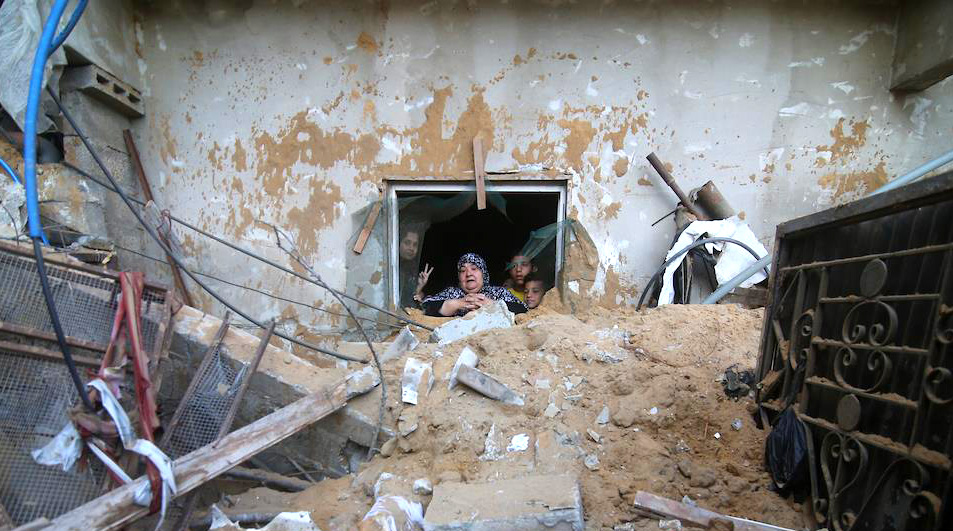
Following the war launched by Israel on the Gaza Strip, after the ‘Al-Aqsa Flood’ battle, Rafah became a displacement hub for Strip residents. Civilians, forced under intense Israeli bombardment, were compelled to head south to Rafah, which turned into a large camp for refugees, accommodating more than a million displaced people, residing in schools, public facilities, and tents under tragic conditions and severe shortages in basic humanitarian requirements.
Amidst these circumstances, Israeli forces continuously shelled the city and carried out intense airstrikes, resulting in hundreds of martyrs and casualties. Israel also threatened a ground military invasion of the city, and the official Israeli broadcasting authority announced that the Israeli army had approved a plan to launch the operation.
The Israeli Prime Minister, Benjamin Netanyahu, announced plans for a military operation in Rafah, stating that ‘the Israeli army is ready for the operational side and for evacuating the residents’, without providing details about this operation that Tel Aviv has been hinting at for weeks.
The announcement of approving invasion plans for Rafah comes despite international warnings that an attack on the densely populated city of displaced people could lead to a major massacre.
This declaration came a day after Netanyahu announced that he would not succumb to international pressure to refrain from launching a military operation in Rafah, justifying his stance by claiming that the aim of attacking Rafah is to eliminate the remaining armed wings of Hamas, according to his claim.
Netanyahu and other Israeli officials claim that the Israeli army has eliminated about three-quarters of Hamas armed wings since the beginning of the ground invasion of the Gaza Strip in late October last year.
On the other hand, Israeli media reported that the Israeli army is not ready to start a military operation in Rafah, even if the political leadership approves plans to do so.
The United Nations had warned of dire consequences if the occupation carried out its threat. Amnesty International also warned of an imminent genocide, as there is no safe refuge for civilians.
On his part, the head of Hamas’s political bureau, Ismail Haniyeh, warned against the Israeli army’s invasion of Rafah in the Gaza Strip, while affirming the readiness of the resistance factions on the ground.
In his statement to Anadolu Agency, Haniyeh clarified his opinion on Washington’s position regarding the invasion of Rafah, stating that the American position is deceptive, and their talk about the need to see plans to avoid harm to civilians is just a deception.
Haniyeh supported his statement by saying: ‘All the civilians who were killed in Gaza were killed with American weapons and missiles, and with American political cover.’
He also emphasised that when Washington resorts to using its veto power in the UN Security Council against a ceasefire resolution, it means that it gives full cover for the continuation of killing and massacre in Gaza.
He called on all sisterly countries in Egypt, Turkey, Qatar, and all relevant European countries, to take action to stop the Israeli aggression, prevent an invasion of Rafah, and insist on the urgent need to completely withdraw Israeli forces from the Gaza Strip and end the aggression.
Haniyeh concluded by saying: ‘If the Israeli enemy decides to go to Rafah, our Palestinian people will not raise the white flag either, and the resistance in Rafah is ready to defend itself, confront aggression, and protect itself and its people.’