
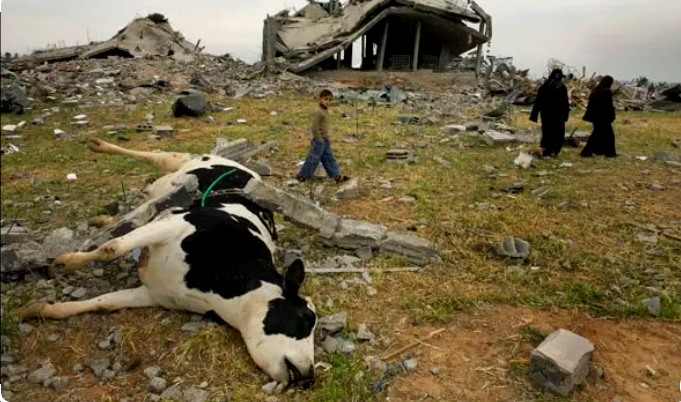
LOSSES in the Gaza Strip’s agricultural sector because of the the vast destruction caused by the Israeli war of genocide, have now reached some 3.49 billion dollars.
It has led to a near-total collapse in the agricultural productive infrastructure and damaged over 85% of the sector.
The Ministry of Agriculture reported, in a statement issued on Monday, that the total losses of the agricultural sector are estimated at about 3.49 billion US dollars, distributed between 1.9 billion dollars in direct damages, and 1.59 billion dollars in indirect damages.
It explained that the plant production sector suffered a sharp decline in crop production, which reflected on the ability to provide local food, after about 158,909 dunums out of 182,247 dunums were damaged, with a total damage rate of 87.1%.
It emphasised that the war caused a near-total collapse in the agricultural irrigation system, after about 8,700 agricultural water wells were put completely out of service, in addition to the damage of 3,828 agricultural ponds, and the destruction of 1,371 kilometres of agricultural water pipes.
The livestock production sector recorded a damage rate of 90.3%, including damage to more than 5,450 cattle and sheep farms and about 2,300 poultry farms.
The war has killed 69,000 head of ruminant animals and 2.79 million birds, as well as damage to 28,400 beehives.
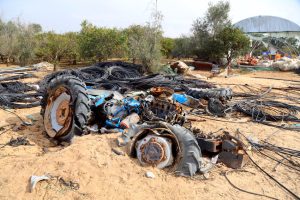
The Ministry added that the fisheries sector as not been immune to the effects of the aggression, as 1,674 marine fishing vessels, seven fish farming farms, and about 450 dual-use ponds have been damaged, in addition to the destruction of the only fish hatchery in the Strip.
It noted that the damage extended to the agricultural infrastructure, and included 93 agricultural nurseries, 18 hatcheries, and 134 agricultural storage refrigerators that were almost completely destroyed.
The damage also affected government centres, veterinary laboratories, experimental stations, and water treatment stations, along with the severe destruction caused to fishermen’s facilities, ports, and related service infrastructure.
The Ministry stressed that this unprecedented destruction led to a near-total paralysis in the agricultural production system, and a sharp decline in the level of food security for the residents of the Gaza Strip.
Thousands of families have lost their source of income because of the destruction of the agricultural sector, leading to an increased dependence on humanitarian and relief aid and worsening living conditions.
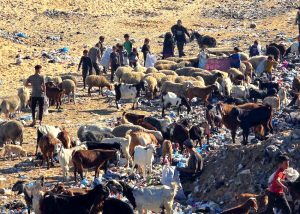
The Ministry called on international community institutions, United Nations agencies, and donors to take urgent action to support the recovery and rehabilitation of the agricultural sector, rehabilitate its infrastructure, and enable farmers, fishermen, and livestock breeders to resume production.
The Government Media Office had previously announced that the ongoing Israeli war on the Gaza Strip – for more than 1,000 days now – has caused initial direct losses estimated at about 80 billion dollars, distributed as 34 billion dollars in the housing sector, six billion dollars in the health sector, and six billion dollars in the services and municipalities sector, in addition to heavy losses in various economic and productive sectors.
Meanwhile, a United Nations official has accused Hamas of hampering humanitarian operations in Gaza and putting aid workers at risk, an allegation the Palestinian group rejects.
‘Humanitarian workers were forced to halt food distributions after armed personnel affiliated with the de facto authorities forcibly entered the Abu Rashid food distribution point in Jabalia, North Gaza,’ UN Deputy Special Coordinator for the Middle East Peace Process Ramiz Alakbarov said in a statement on Monday.
He said the armed personnel entered a World Food Programme (WFP) warehouse and assaulted two truck drivers who were delivering humanitarian supplies.
Alakbarov said ‘these incidents are not isolated’ and ‘reflect an increasingly dangerous pattern of intimidation, violence and obstruction, including smuggling attempts, targeting and abusing humanitarian operations.’
Hamas, which controls parts of Gaza, strongly denied the allegations.
‘We categorically reject the language of incitement, the distortion of facts, and the manufactured narrative presented in the statement,’ the group said in a statement.
The group said the WFP distribution centre was not attacked or raided but was instead the site of an ‘official law enforcement operation’ carried out after the discovery of smuggled items ‘concealed inside humanitarian aid parcels’.
It added that a unit of the Palestinian police uncovered an attempt to exploit humanitarian convoys to smuggle in cigarettes and mobile phone screens for commercial purposes.
‘The police intervention in this incident constituted a responsible governmental measure aimed fundamentally at safeguarding the independence, integrity, and neutrality of humanitarian action,’ the group said.
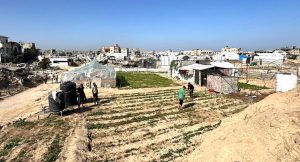
Palestinians in Gaza continue to live in dire humanitarian conditions after Israel’s genocidal war and severe restriction on supplies of humanitarian aid.
Israel launched the war in October 2023 after Hamas-led fighters attacked communities in southern Israel, killing more than 1,100 people and taking about 240 captive.
In October last year, the two sides agreed to a US-brokered ‘ceasefire’, which Israel has breached consistently. While the intensity of the fighting has reduced, more than 1,100 Palestinians have been killed and more than 3,500 have been wounded since the ‘ceasefire’ took effect. At least four Israeli soldiers have also been killed.
Altogether, more than 73,000 Palestinians have been killed in the war.
Meanwhile, negotiations to move to a second phase of the United States plan to end the war have been stalled for months.
According to the plan, Hamas should disarm and Israel should withdraw its forces from Gaza. Neither has taken place. Israel instead has expanded the area under its control to more than 60 per cent of Gaza, compared to the 53 per cent stipulated in the first phase of the deal.
- The Hamas Movement has condemned the Israeli occupation government’s decision to grant city status to the illegal Giv’at Ze’ev settlement in northern Jerusalem.
In a statement released on Monday, Hamas called the decision a ‘dangerous escalation’ and a ‘blatant act of aggression’.
They warned that this move is an attempt by the Israeli government to establish permanent, illegal colonial faits accomplis in the occupied Palestinian territories to advance annexation and displacement.
Hamas stressed that all Israeli measures, laws, and decisions regarding settlement expansion and Judaization in the West Bank are null and void and violate international law and the Palestinian people’s historical rights.
They also warned that such decisions are aimed at ‘liquidating the Palestinian cause by expanding settlements, turning outposts and settlements into major cities, linking them together, fragmenting the West Bank, isolating Jerusalem, and destroying any prospect of establishing a Palestinian state.’
The Movement called on the ‘international community, the United Nations, and the world’s free people to move beyond statements of condemnation and start taking practical steps to confront Israel’s settlement plans and hold it accountable for its ongoing violations.’
The Gaza Centre for Human Rights has also condemned Israel’s continued expansion of the ‘Yellow Line’ in eastern Gaza, saying the move reflects a systematic policy to impose new facts on the ground by force, evade ongoing understandings and consolidate military control over additional areas of the territory.
In a statement on Monday, the centre said its field team has documented Israeli forces expanding the Yellow Line in the Al-Shuja’iya neighbourhood, east of Gaza City, toward the Souq Al-Bastat area by moving yellow concrete blocks, further tightening military restrictions on residents.
The centre also reported the presence of two Israeli military bulldozers and a tank beyond the Yellow Line in the Barbera/Al-Shakoush area of Al-Mawasi, Rafah. It said the bulldozers began levelling agricultural land while intermittent gunfire was directed at tents sheltering displaced Palestinians.
The group warned that repeated gunfire by Israeli occupation forces and affiliated armed militias toward tents in the area appeared aimed at pushing residents to leave.
It said these steps coincided with the Peace Council’s announcement that it was ready to launch the first so-called humanitarian shelter centres in Rafah, warning that such centres could be used to reshape Gaza’s demographic situation by confining residents to specific areas, dividing the territory geographically and forcing civilians to move under military pressure.
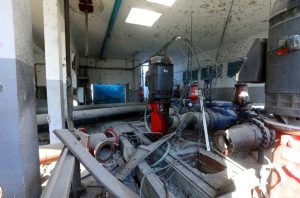
The centre also condemned Israel’s repeated targeting of water-related infrastructure, describing it as part of a policy of turning thirst into a weapon of war.
It said Israeli aircraft bombed a metal workshop in Gaza City on Sunday evening that was used to prepare equipment for drilling water wells, killing four Palestinians and wounding others. Warplanes later struck the same site again, causing widespread damage to residential buildings and shops and injuring more civilians.
The rights group explained that the targeting of well-drilling workshops and equipment was part of an Israeli effort to cripple attempts to address Gaza’s worsening water crisis, as more than two million Palestinians face one of the most severe shortages of water in the territory’s history.
According to the centre, water production has fallen to about half its prewar level, less than half of Gaza’s population receives water through public networks, and network losses have risen to around 65% because of widespread destruction.
It said the average daily water share per person has dropped to around 25 litres, while many displaced Palestinians receive less than five litres a day, far below the minimum needed for survival.
The centre said the combination of expanding military zones, destroying basic necessities, targeting water sources and establishing shelter centres in areas under Israeli control reveals an integrated policy aimed at reshaping Gaza’s geographic and demographic conditions by force.
It warned that these measures create living conditions that push Palestinians toward forced displacement and amount to grave violations of international humanitarian law, including the prohibition of forcible transfer and collective punishment.
The Gaza Centre for Human Rights called on the international community to urgently stop Israel’s policy of imposing facts on the ground, halt the expansion of military zones inside Gaza, protect civilian infrastructure, especially water facilities, and ensure safe access for maintenance, drilling and relief teams.
It also urged the rejection of any humanitarian arrangements or projects used as cover to redistribute the population or entrench Gaza’s geographic division.