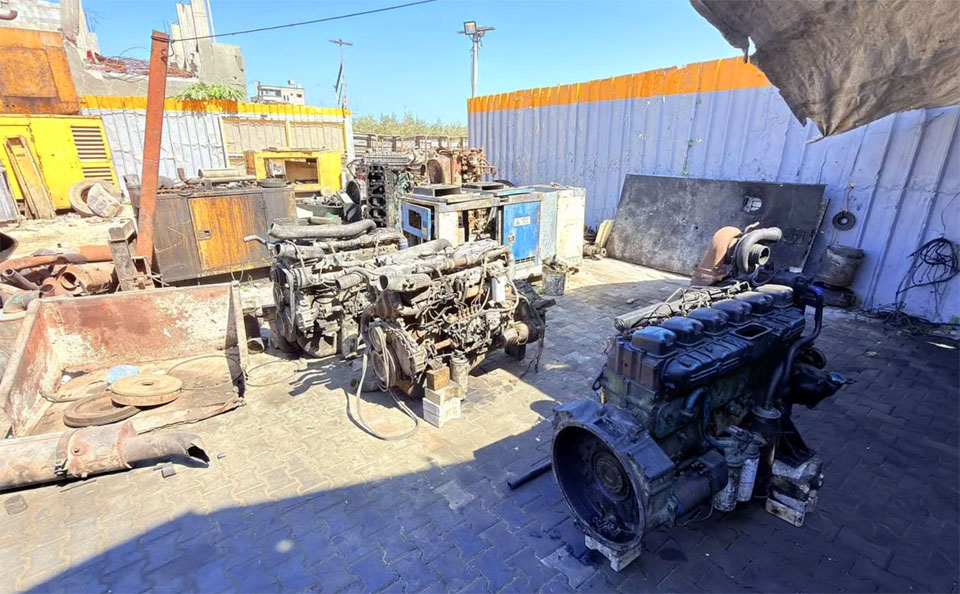
THE private generator network that has supplied the Gaza Strip with all of its electricity since the genocide began in October 2023 is now itself close to collapse.
For 32 months Israel has completely barred the entry of engine oil, lubricants, batteries and the spare parts needed to maintain diesel engines, a prohibition maintained throughout the nine months of the ceasefire, according to the Palestinian Centre for Human Rights.
Fuel has arrived in batches and generators have been restarted. The materials that keep those engines alive have not arrived at all. Generators are wearing out from the inside and failing one by one, beyond repair.
‘We will reach a complete or near-complete shutdown’, said Mohsen Siam, spokesperson for the Generators’ Owners Association.
Gaza drew around 600 megawatts of electricity before the war. The amount now entering the grid is zero.
Forty-eight engineers, technicians and staff who kept the grid running have been killed in Israeli attacks since October 2023, according to the Strip’s Electricity Distribution Company, and by June 2026, 85 per cent of the distribution network had been destroyed.
Gaza’s only power plant, on the edge of Al-Nuseirat, has not run in more than two years. Israeli bombardment cut the lines carrying electricity into the camp and across the Strip. Much of the local network still stands, damaged, and delivers nothing.
In December 2025, the Gaza Electricity Distribution Company told residents of central Gaza not to expect power to return. Its crews were working on repairs but the materials required had not been allowed in.
Company spokesperson Mohammed Thabit said no equipment for the electricity sector has entered Gaza since the start of the war.
Around 250 private generator companies operated across Gaza before October 2023. Between 80 and 100 are still running, serving some 200,000 subscriptions covering homes, shops, institutions, clinics and water wells, Siam said. The rest have shut down for want of oil and spare parts. Those still operating supply an average of 11 hours of electricity a day, and in some areas that has fallen to three.
Prices have risen tenfold. A kilowatt-hour cost three shekels before the war and now costs 30. Households using electricity only for lighting and charging telephones pay an average of 300 shekels a month, according to Ahmed Abu Qamar, an economic researcher tracking market data in Gaza.
A litre of engine oil that cost nine shekels before the war had reached around 2,000 shekels by June 2024. It now costs about 3,000 shekels when it can be found at all. Spare parts are almost entirely unavailable.
Israeli authorities classify electric generators and their spare parts as dual-use items, making entry conditional on special permits, according to the Palestinian Centre for Human Rights.
Owners have poured whatever they can find into their machines: used engine oil strained through improvised filters, car oil, olive oil, cooking oil. The fuel is improvised too.
When regular diesel stopped arriving, companies including Abna Fares Abu Zayed in Al-Zawaida turned to diesel produced locally by processing plastic waste in improvised furnaces. General manager Aya Shaheen said the cost of manufacturing it approaches the price of Israeli diesel.
No engine is designed to run on it. Mohammed Abu Alfa, maintenance manager at Abna Fares, said the plastic-derived fuel clogs filters and injectors with thick sludge and makes engines produce black smoke and unusual noises.
Heated, its compounds become unstable and thicken into deposits acidic enough to corrode steel, aluminium and the rubber seals in fuel pumps and injector lines. It ignites less readily than conventional diesel, producing incomplete combustion.
A damaged injector leaks raw fuel into the engine, washing oil from the cylinder walls and accelerating wear on rings and pistons. The only remedy is regular oil changes, which is precisely what the ban has put out of reach.
Several of the company’s generators have gone permanently out of service during the war for lack of replacement parts, Shaheen said.
In May the company secured a batch of engine oil on the black market. The oil was of poor quality and by 30 May it had disabled every generator the company operated, halting service for several days and leaving Al-Nuseirat entirely without electricity.
Most of the machines were eventually brought back. The Mega, the company’s largest generator, which runs at its Al-Nuseirat site, was not. With parts unavailable, the company has resorted to cannibalisation, Shaheen said, having ‘moved parts from one generator to another’ and bought from owners who have shut down.
At Nasser Medical Complex, the same shortages threaten life-threatening failures. Two of the hospital’s four generators are still running. The complex requires 1,000 litres of generator oil a month, said Abdul Qader Karam Aliwa, a mechatronics engineer there.
The manufacturer specifies an oil change every 250 operating hours; his team is stretching that to 1,500, and tops the engines up with used oil, which causes friction between moving parts and damages the engines further.
Two generators went out of service earlier this year for lack of oil and parts, shifting the load onto the remaining two, which now run 12 hours each. A year ago three generators covered the same load at eight hours each. No spare parts are available on the local market.
In June 2024, one of the hospital’s main generators failed at two in the morning, cutting power for 15 minutes. Aliwa said emergency calls came immediately from the intensive care unit and the neonatal incubators.
There have been several outages since. Of the 111 generators serving hospitals across the Gaza Strip, 72 had broken down as of June, according to the Palestinian Centre for Human Rights.
Filipe Ribeiro, head of mission in Palestine for Médecins Sans Frontières, described what is happening in Gaza as ‘a policy of attrition by design’.
MSF reported this month that the continued restrictions on engine oil and spare parts are increasing the risk of death and severe illness for thousands of Palestinians.
The collapse is destroying livelihoods as well. Emad Mahdi, known in Al-Nuseirat as Abu Haidar, ran a dry cleaning shop in the camp for 37 years.
He reopened in June 2026 because he had no other way to earn. His pressing boiler required 18 kilowatts, and he bought power from Abna Fares Abu Zayed at 30 shekels a kilowatt-hour, which put the cost of three hours of pressing at 800 shekels.
He held his prices at pre-war levels to keep customers and frequently worked at a loss. He closed again after two months. He sold the boiler, then the machine, with unpaid electricity bills taking more than half of what the sales brought in.
‘Piece by piece, the business disappeared’, he said. The room now holds nothing but kites, which he makes from nylon sheets and barbecue skewers and sells to the children of the camp.
Muhammad Jabr, 64, worked as a tailor for 42 years before his workshop was destroyed.
Displaced in the Hasayna area of Al-Nuseirat, he gave up his generator subscription because he could no longer afford it. Turning the sewing machine wheel by hand left him only one hand for the cloth.
‘I cannot guide the cloth that way’, he said. A treadle frees both hands but was beyond him at his age.
His son Ahmed found a bicycle in the rubble of a neighbour’s house, its frame rusted through but its rear wheel and chain still turning.
A blacksmith welded it to an iron base pulled from the street and ran a rubber belt from the wheel to the sewing machine flywheel.
Jabr works from eight in the morning until the light goes, nine or ten hours. Nobody orders new clothes. He patches trousers, alters donated aid garments to fit children in the camp and replaces broken zips, 30 to 40 pieces a day at one to three shekels each, bringing in 30 to 50 shekels on a good day.
His three-year-old grandson Omar cannot reach the pedals from the seat, so he sits on the ground and turns them with both hands while his grandfather threads the needle.