THOUSANDS of children in the Gaza Strip have gone back to school after nearly three years in which Israel’s genocidal war shut down their education.
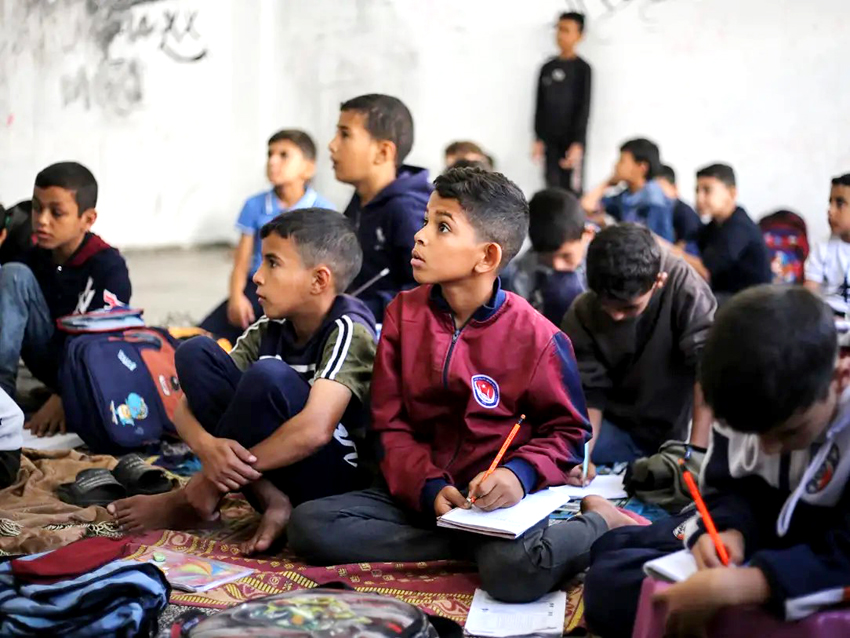
Many have found no school to return to. They sit on the ground in overcrowded tents and makeshift classrooms, with few desks and too few books, notebooks and pens to go round.
The Ministry of Education opened the 2026/2027 academic year on Saturday 19 September after a three-year interruption.
It said teaching would run on several tracks to account for students inside the Strip and those outside it.
The UN Relief and Works Agency for Palestine Refugees (UNRWA) is trying to restart lessons with what resources it has, across an education system Israel’s bombardment has largely destroyed.
The share of Gaza’s schools destroyed or damaged during the war is about 98%. About 660,000 students were kept out of regular classroom education for long periods.
Many buildings still standing are used wholly or partly as shelters for displaced families or for other humanitarian services.
Educational authorities have put up temporary learning spaces made from tents and basic materials to take in pupils.
Parents and teachers describe the return as a necessary but doubt whether education in such conditions can be regular, effective or safe.
One father said he could not persuade his son to stay for the school day.
The boy went in to begin his lessons but could not bear his surroundings and left.
A mother said conditions varied from school to school but were generally extremely difficult, and that her daughter struggled to sit and write on the ground.
Other parents spoke of classes of between 50 and 60 pupils, some of them sitting on the floor.
Abu Khalid, whose child attends one of the schools, said some classes held about 70 pupils. He questioned whether any pupil could concentrate, or any teacher keep order, in such crowding.
At one temporary school near Gaza port, first- and second-grade pupils sit on the ground and write on pieces of cardboard because there are no desks. More than 300 pupils attend that school.
Where schools double as shelters, classrooms and displaced families compete for the same space.
Abu Karim, displaced to a camp in Deir al-Balah, said some classrooms were shared between pupils and displaced people.
Teachers carry much of the weight. Um Ibrahim, a teacher, said staff were working with severe shortages of equipment while under financial pressure from cuts to their salaries.
In some classrooms, she said, neither teacher nor pupil has a desk.
Electricity and internet are scarce, and so are books, stationery and desks, while water, sanitation and overcrowding add further problems.
Teachers in these conditions must manage dozens of children in cramped spaces and teach pupils who have been out of education for long periods.
Many of those pupils bear the psychological and social damage of the war, and teachers have few tools to meet it.
Abu Raed, who teaches in UNRWA schools, said recovery could not be measured by opening learning points or announcing that classes had resumed.
It had to include teachers’ rights and better working conditions, he said, with funding that would let education continue on a stable footing.
The pupils returning to class carry a learning gap that built up over the years of war. Many were forced to rely on remote learning or on small, limited education initiatives.
Hundreds of thousands of children have returned to face-to-face education for the first time in nearly three years. Others still rely on online learning because they are displaced or have no learning space nearby.
For many families, the problem is whether a child can get hold of a book, a notebook, a pen and a desk, and whether the school can offer an environment in which lost skills and knowledge can be recovered.
A stationery trader in Gaza said that a notebook which once sold for three shekels now costs about 15.
The Joint Committee for Refugees in the Gaza Strip has insisted that UNRWA adopt full face-to-face teaching in its schools, in line with the Ministry of Education’s decision to begin the year with in-person classes.
The committee said online learning should support classroom teaching where needed, not replace it.
It called for faster rehabilitation of schools that have been cleared of displaced people. It wants them cleaned and equipped with desks, blackboards and furniture, and supplied with books, teaching materials and school supplies, so that teachers can do their jobs.
The committee also called for a clear plan to tackle the loss of learning and help pupils recover the skills and knowledge they missed during the years out of school.
None of the families objects to children going back to school, and many parents and teachers are determined they should, whatever the conditions.
Um Mahmoud, a refugee, said UNRWA schooling remained better than the other options her children had tried.
On their first day back, she said, they came home having written and studied in their notebooks, despite the poor surroundings.
Ibrahim, a teacher, said UNRWA had prepared for the year as far as its resources allowed. Some schools had been fully cleared for teaching, while parts of others had been emptied of displaced families.
He said teaching and administrative staff were in place, some basic materials had arrived and stationery was still being distributed.
Restoring education under such conditions was an attempt to protect children’s right to learn in the face of the destruction, he said.
Parents and teachers also fear that emergency measures forced by the war will harden into a permanent arrangement.
Tents, temporary learning spaces, children sitting on the ground, and shortages of books and desks were meant for a transitional period.
Educators and teachers warn that the situation could last for years without a clear plan for funding and reconstruction.
They say such a plan must cover rebuilding schools and supplying furniture and equipment.
It must also restore health facilities and water and energy networks, and support teachers and pupils.
Remote learning, whatever its value as a supplement, depends on electricity, internet access and devices that many families do not have. It cannot give every pupil an equal education.
For the children now sitting on cardboard in tents near Gaza port, in Deir al-Balah and across the Strip, the return to class is the start of a long effort.