THE Hamas Movement said on Tuesday that Israel must be compelled to fully implement its obligations under phase one of the ceasefire agreement before any discussion can begin regarding phase two.
Husam Badran, a member of Hamas’s political bureau, rejected statements by Chief of General Staff of the Israeli occupation military, Eyal Zamir, who claimed that the so-called ‘yellow line’ represents Gaza’s ‘new borders’.
Badran said the remarks clearly reveal Israel’s attempt to evade the agreement and impose new facts on the ground.
Badran said all parties overseeing the ceasefire agree that Israel has not fulfilled any of the commitments required under phase one.
He pointed to the continued closure of the Rafah crossing in both directions, Israel’s obstruction of the entry of tents and caravans designated for displaced families, the reduction of humanitarian aid, and ongoing killings and bombardment inside the enclave.
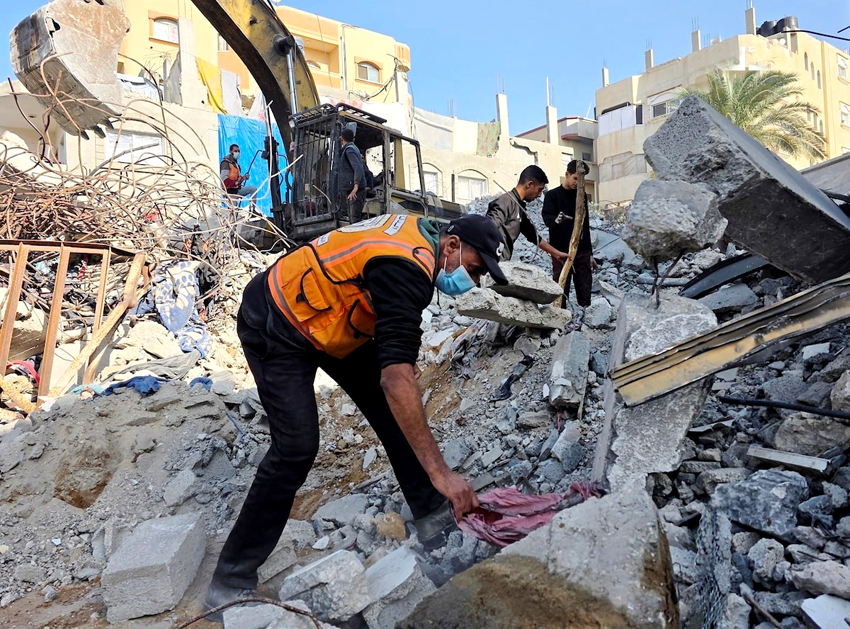
He added that Israel’s continued demolition of Palestinian homes within what it calls the ‘yellow line’ is a continuation of military operations that were supposed to stop on the first day of the agreement, underscoring that these violations persist without any meaningful compliance.
Badran emphasised that any discussion of arrangements for phase two ‘depends first on clear pressure from mediators, the United States, and all concerned parties to compel Israel to implement every provision of phase one’. He said phase two ‘cannot begin while Israel continues to violate the agreement and evade its commitments’.
Senior Hamas official Taher al-Nunu has described the exclusion of former British prime minister Tony Blair from the proposed Gaza board of peace as ‘a step in the right direction’.
In a statement on Monday, Nunu pointed out that his Movement had repeatedly asked the mediators to exclude him due to his obvious bias in favour of Israel, reiterating Hamas’s readiness to enter into a long-term truce provided that the occupation fully commits to a ceasefire.
Nunu stated: ‘Hamas has not yet received a clear vision regarding the formation of the proposed international force for Gaza, including its tasks or areas of deployment.’
He said that no country would consent to participate in a force mandated to forcibly disarm the Gaza Strip.
He added: ‘Israeli Prime Minister Benjamin Netanyahu’s ambitions go beyond the borders of Palestine and pose a threat to all countries in the region.’
Scores of extremist Israeli settlers desecrated the Aqsa Mosque in Occupied Jerusalem on Tuesday morning and afternoon, amid restrictions on the entry of Muslim worshippers to the holy site.
According to the Jerusalem Governorate, at least 960 Jewish settlers entered the Mosque through its Maghariba Gate and toured its courtyards under police protection.
During their tours at the Islamic holy site, the settlers received lectures from rabbis about the alleged temple mount and a number of them provocatively performed Talmudic prayers, especially in the eastern area of the Mosque and on the staircase leading to the plateau of the Dome of the Rock building.
The Israeli occupation police imposed movement and entry restrictions on Muslim worshippers at the Aqsa Mosque’s entrances and gates and prevented them from entering the holy site.
Israeli occupation forces also stormed Birzeit University, north of Ramallah, early Tuesday morning, entering from three different entrances and detaining several of its security guards.
They stormed the university at 4.00 am, detaining five university security personnel and confiscating their mobile phones.
The occupation forces closed the university’s three main gates, amidst a heavy deployment of soldiers in several buildings and faculties on campus.
The university announced the postponement of academic and administrative operations until 9.00 am, out of concern for the safety of students and staff.
Israeli forces also arrested six young men in a raid on the town of Birzeit.
Israel’s far-right security minister Itamar Ben-Gvir says he has received ‘hundreds of calls’ from doctors willing to carry out death sentences on Palestinian prisoners in defiance of the Israeli doctors’ union’s ethical ban.
Addressing members of the Knesset (Israel’s parliament) on Monday, Ben-Gvir claimed that since doctors were barred from taking part in any executions ordered by the regime, he had ‘received a hundred calls from doctors saying, “Itamar, just tell me when”.’
He made the remarks during a hearing on a bill that seeks to legitimise the execution of Palestinian prisoners who have long faced torture and death in Israeli prisons.
During the hearing, Ben-Gvir was wearing a yellow noose-shaped pin alongside other members of his Jewish Power Party (Otzma Yehudit).
He said the noose symbolised ‘one of the options by which the law will enforce a death penalty for terrorists.’ He added that ‘of course, there is the option of the gallows, the electric chair, and there is also the option of lethal injection’.
The Knesset passed the first reading of the legislation in early November, with 39 votes in favour and 16 against in the 120-seat chamber. The bill requires two more readings before becoming law.
The Israeli Medical Association said at the time that its doctors are not allowed to administer death penalties ordered by the regime, as that would force them to go back on their oath as doctors.
The draft bill has been widely condemned by the Palestinian Authority (PA), Hamas and human rights organisations.
The Palestine Liberation Organisation (PLO) condemned the vote, with Palestinian National Council Speaker Rawhi Fattouh calling the draft legislation ‘a political, legal, and humanitarian crime’.
The PA foreign ministry also described it as ‘a new form of escalating Israeli extremism and criminality against the Palestinian people’.
Palestinian human rights groups warn that the bill’s ‘most alarming aspect’ is the possibility that it could be applied retroactively, paving the way for ‘collective death sentences’ targeting hundreds of Palestinians currently held in Israeli prisons.
Thousands of Palestinians, including children, are arbitrarily being held in Israel’s prisons and detention sites, where torture is widespread.
The Palestinian Centre for Human Rights has documented testimonies from 100 former prisoners held between October 2023 and 2024, concluding that torture was systematic across all Israeli prison facilities.
- Monday marked the 38th anniversary of the outbreak of the First Intifada, also known as the ‘Stone Uprising’, a pivotal moment in the history of the Palestinian struggle for freedom.
The Intifada, which lasted from 1987 to 1994, marked a turning point in Palestinian resistance against Israeli occupation.
The First Intifada began in the Jabalia refugee camp in the Gaza Strip, following the killing of four Palestinian workers at the Erez checkpoint by an Israeli settler driving a truck.
The victims were identified as 46-year-old Taleb Abu Zaid, 29-year-old Issam Hamouda, 26-year-old Shabaan Nabhan, and 25-year old Ali Ismail, all from Gaza. This tragic incident sparked outrage and protests across the Gaza Strip and the West Bank, leading to widespread demonstrations and confrontations with Israeli forces.
The following day, on December 9, 1987, angry protests erupted in Jabalia camp, turning into violent clashes with the Israeli military. During these confrontations, Hatem al-Sisi, a young man from Jabalia, became the first Palestinian martyr of the uprising.
The Intifada quickly spread, first to the Balata refugee camp in Nablus, then across the West Bank and Gaza.
In the first days of the uprising, 17-year-old Ibrahim al-Aklik was killed on December 10, 1987, followed by 19-year-old Suheila al-Kaabi, and 12-year-old Ali Musa’id, from Balata on December 11, 1987. The uprising gathered momentum, with hundreds of Palestinians losing their lives and thousands more wounded or imprisoned.
Over the next seven years, the Intifada became a defining feature of Palestinian resistance, unfolding in every town, village, refugee camp, and city across the occupied territories and within Israel. As one famous revolutionary song from that period declared: ‘In every village, house, and alley, our Intifada continues’.
According to data from the Palestinian Commission for Prisoners and Martyrs Affairs, around 1,550 Palestinians were killed during the First Intifada.
Estimates from the Palestinian Prisoners’ Society indicate that between 100,000 to 200,000 Palestinians were detained during this period, with many subjected to harsh interrogation techniques.
The Intifada also left a heavy toll on the Palestinian population in terms of injuries. The Palestinian Ministry of Health reports that over 70,000 Palestinians were wounded, with around 40 per cent of them suffering from permanent disabilities.
The injuries included severe neurological damage, paralysis, and amputations of vital limbs. In addition, a report from the International Solidarity Foundation revealed that 40 Palestinians died while in Israeli prisons during the Intifada.
Many of these deaths were attributed to torture and inhumane treatment by Israeli authorities during interrogations.