
IN A marathon session that lasted until after 4.00am on Thursday, the Argentine Senate approved the interim motion for labour reform proposed by the ultra-right administration of Javier Milei.
The vote ended with 42 in favour and 30 against.
Milei’s cost cutting labour reform introduces flexible working, allowing daily shifts to extend to 12 hours with compensatory breaks instead of overtime pay.
The reform also prohibits the right to strike by designating ‘essential activities’ that must maintain a minimum coverage of 50% to 75% during labour actions.
The motion must now go through the Chamber of Deputies, where the ruling party hopes to secure the 131 votes that would turn it into law, which could happen this week.
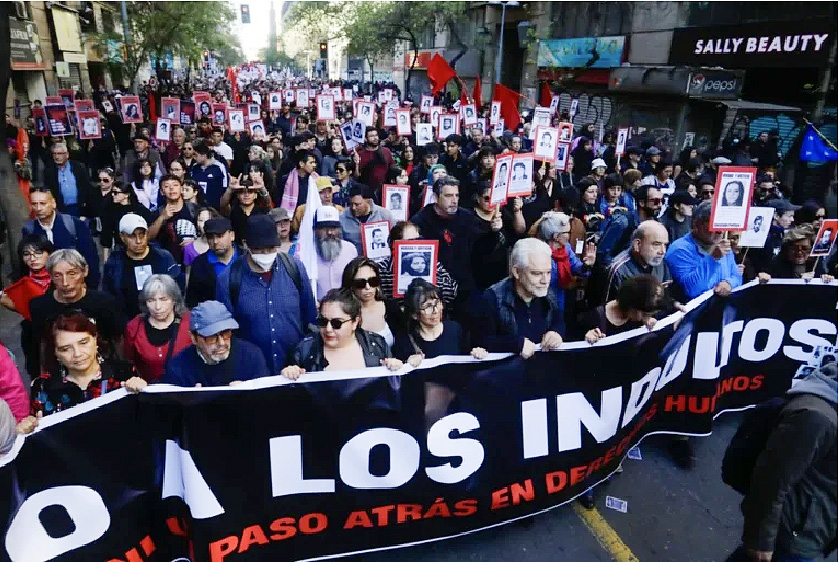
Meanwhile outside the Congress building, at least 37 people were arrested and 10 injured, as thousands of workers clashed with police, where unions and social organisations had organised a mass protest against the government-sponsored bill.
The march started from Plaza de Mayo and headed toward Congress, as debate on the measure was underway inside the chamber.
Security forces deployed water cannon, rubber bullets and tear gas, while protesters responded with Molotov cocktails, stones and water bottles.
Traffic in the centre of the capital Buenos Aires was disrupted for several hours.
The ruling party, La Libertad Avanza (LLA), with support from its allies in PRO, the Unión Cívica Radical (UCR), and provincial parties, managed to push through the package of ‘chainsaw’ policies.
Immediately following the outcome, President Milei urged the Chamber of Deputies to expedite the legislation, which they describe as ‘the modernisation of the Argentine labour market.’
Extension of Work Hours to 12
A central aspect of the project is the significant modification of the workday regime. The initiative allows for an increase in daily hours from eight to 12, provided that a minimum rest period of 12 hours between shifts is adhered to.
Another key point is the elimination of overtime pay through the creation of an ‘hour bank’, effectively removing the traditional ‘double pay’ system commonly utilised by workers to boost their incomes.
Instead of receiving additional remuneration for hours worked beyond the usual schedule, the hour bank stipulates that employees compensate for that extra time by working fewer hours on other days or taking a day off.
Furthermore, part-time contracts for periods shorter than the legal working hours will be introduced, which could represent a gateway to income precarisation.
Restrictions on the Right to Strike
Regarding collective conflicts, the reform introduces substantial modifications. The list of activities classified as essential services is expanded, mandating a minimum coverage of 75%.
The new regulatory framework identifies telecommunications – explicitly including internet and satellite communications – as essential, along with commercial aviation, air traffic control, all port activities (such as signaling, dredging, mooring, loading and unloading, and towing), customs and immigration services, hospital and health services (including medicine transport), the production and distribution of drinking water, gas, oil, fuels, and electricity, waste collection, cash transport, private security services, and education at all levels except university.
Additionally, the project establishes a new category: ‘critical services’ or ‘services of transcendental importance,’ which must guarantee a minimum operational level of 50% during disputes.
This category encompasses everything from the maritime, river, land, and underground transportation of persons and goods to customs and immigration services related to international trade, pharmaceutical production, radio and television, continuous process industries (such as steel, aluminum, chemical, and cement), the entire food supply chain, financial services, hospitality, gastronomy, e-commerce, construction, airports, mining, cold storage, mail, the agricultural sector, and production tied to export commitments.
Security forces are required to provide 100% coverage.
According to the reform, unions must give five days’ notice for strike actions.
Assemblies: With Permission and Without Pay
Another contentious issue during the debate was the new regulation of labour assemblies in the workplace. According to the approved text, union meetings ‘must not disrupt the normal activities of the business’ and will require prior authorisation from the employer.
Additionally, the union must prove it is up to date on wage payments to exercise this power. Time spent in assemblies will not be compensated.
In a departure from the original text, following the enactment of the law, contributions to business chambers cannot exceed 0.5% of remuneration; while contributions to trade union associations must not exceed 2% of salaries, both for members and non-members covered by the collective agreement.
Additionally, the final text states that starting January 1st, 2028, contributions to business chambers will be strictly voluntary, and payment of union dues cannot be imposed on workers without their explicit, prior, individual consent, which may be revoked at any time.
Payment of Judgments, Health Insurance, and Medical Leave
Concerning judicial matters, judgment liabilities against large companies may be settled in up to six consecutive monthly installments. For micro, small, and medium enterprises, the limit is extended to 12 installments.
Effective for contributions due after January 1st, 2027, the employer contribution to health insurance will be set at 6% of remuneration, one percentage point higher than the original project’s 5%. The Superintendence of Health Services will be empowered to audit the use of these contributions.
Regarding non-attributable illness leaves, two remuneration levels are established: 50% if the incapacity arises from ‘voluntary and conscious activity posing health risks,’ or 75% in other cases, for periods of three or six months depending on the presence of dependents.
Medical certificates must include diagnosis, treatment, rest days, and a digital signature issued by licensed professionals nationwide.
Workers will be required to undergo medical supervision by their employer. In case of irreconcilable dispute, a medical board may be consulted at official institutions or private institutes, at the employer’s expense.
The employer may reassign the worker to another position after prolonged absences if there is no permanent reduction in work capacity.
Lost Rights and Mobilisations
At this core, at least four key issues were identified: the attack on the preeminence of collective bargaining agreements through the prioritisation of lesser agreements, the repeal of historic professional statutes, the covert prohibition of the right to strike by the mass declaration of essential services, and the employer’s power to suspend wages during assembly time.
Workers’ Central Union declared ‘absolute rejection’ and announced they are in ‘permanent mobilisation,’ calling for protests to halt the legislative push.
Similarly, the Secretary General of the Association of State Workers (ATE), Rodolfo Aguiar, stated that the labour reform represents ‘the greatest offensive in democracy against workers.
‘They are spending millions to bulldoze us,’ he emphasised.
In a statement, the General Confederation of Labour (CGT), a trade union coalition that helped organise the demonstration, denounced the reforms, as they would, among other things, make it easier for businesses to fire employees and reduce severance pay. They would also restrict the ability of labour unions to participate in collective bargaining.
‘It’s not modernisation. It’s austerity for the workers,’ the CGT said.