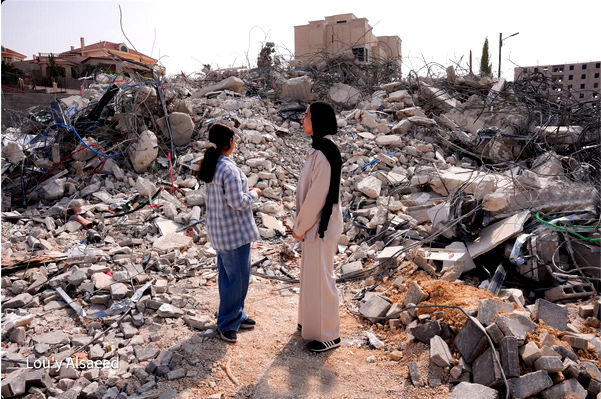
PALESTINIAN families began returning to their homes in Hebron this week after Israeli forces withdrew at dawn from the neighbourhoods they had taken over in the occupied West Bank city, ending an operation of more than ten days that displaced thousands of people, demolished 15 homes and other structures and shut 327 shops.
Hebron municipality reported 3,189 displaced people early in the operation and, according to the United Nations Children’s Fund (UNICEF), 4,304 by 29 October, including 1,845 children.
The Hebron Governorate Support and Relief Committee registered 537 families comprising 3,361 people, among them 232 infants, 1,193 children, 326 elderly people and 213 people with chronic illnesses.
The legal centre Adalah says about 5,000 Palestinians were forced from their homes.
The operation followed an attack on 23 October at a military checkpoint at the northern entrance to the city, in which two Palestinian gunmen killed two Israeli soldiers before being shot dead, according to the Israeli military.
Netanyahu announced a major operation in Hebron, saying the army would ‘evacuate the residents’ of the neighbourhoods the gunmen came from and go house to house.
Israeli forces sealed every entrance to the city and, from 24 October, ordered residents of Al-Jalda and Ein Deir Bahha to leave.
Baher Sultan, 47, told the US-based Drop Site News that soldiers took his identity card when he opened his door in the Khallet al-Maghariba neighbourhood on 24 October and told him to leave with only a few essential belongings.
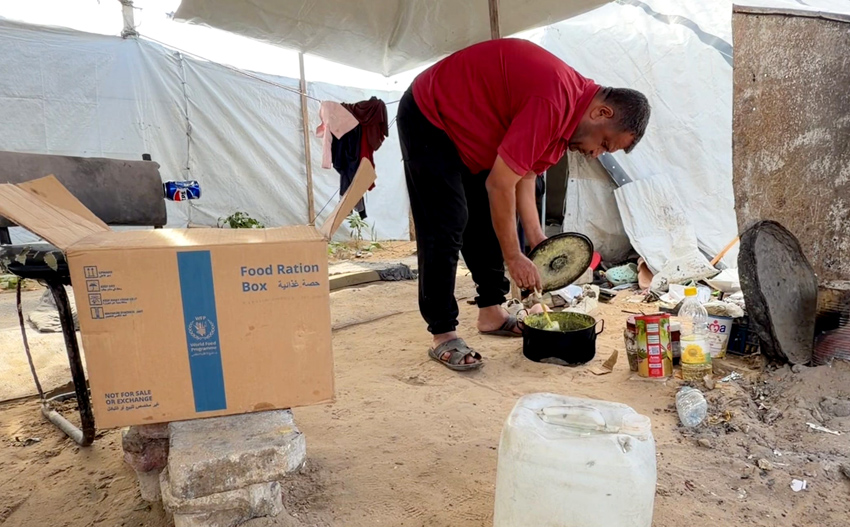
Sultan, his wife and their four children spent two days moving between relatives and then five days in a cousin’s apartment near Bab al-Zawiya in central Hebron, not knowing how long they would be away.
His children, out of school since the operation began, felt too shy to ask for food or to use the bathroom in the unfamiliar home, he said, and needed books, notebooks and room to move.
Sultan returned on Monday, the day the army withdrew, to a ransacked house. Soldiers had occupied it for several days, he said.
Abdul Shakour Mujahid said his was the first house raided in Al-Jalda. Soldiers gave him an hour to gather clothes and a few belongings and confiscated his car.
He, his wife and their three children, the eldest aged 12, moved into his father’s home in an adjacent neighbourhood, where the local relief committee supplied basic goods and milk.
From there he watched soldiers spread across the rooftops of Al-Jalda and use dozens of houses as sniper positions.
It was ‘a new Nakba for us’, he said, to see his home before his eyes and be unable to reach it.
Sufian Al-Muhtaseb, who heads the relief committee, said Hebron’s communities refused to open shelters and instead offered to host displaced families in their homes.
The hardest requests the committee received were for food and drink and, above all, baby formula. Soldiers did not let residents take their money from their homes, he said, leaving many reluctant to ask hosts for help.
An Israeli military official said the army conducted searches at multiple locations, detained and questioned people before withdrawing.
Mayor Yousef al-Jabari said that families began returning to Al-Jalda and Ein Deir Bahha the same day and that schools, universities and businesses began reopening.
On 29 October Adalah petitioned Israel’s High Court on behalf of the municipality and seven residents. The petition said troops forced hundreds of families from their homes late at night with little notice, barred their return indefinitely and gave no concrete justification for an evacuation on that scale, which it argued amounted to forcible transfer and collective punishment under the Fourth Geneva Convention.
It also cited municipal figures showing about 1,200 tonnes of rubbish piling up because garbage trucks could not reach the sealed areas.
Adalah said the court gave the state days to respond, allowing the military to continue; its lawyer Muna Haddad said the acts constituted collective punishment and forcible transfer, both war crimes the state later asked the court to dismiss the petition as moot after the withdrawal.
The next day the United Nations Relief and Works Agency for Palestine Refugees in the Near East (UNRWA) warned that the operation carried alarming echoes of Israel’s 2025 assault on three refugee camps in the northern West Bank, which displaced more than 32,000 Palestinians and which Human Rights Watch found amounted to war crimes and crimes against humanity.
About 80,000 students in Hebron were out of school during the operation. The city accounts for about 40 per cent of Palestinian industrial output in the West Bank and 30 per cent of its exports.
Adnan al-Natsheh, deputy head of the Hebron Chamber of Commerce and Industry, said direct losses from the closures came to between 10 million and 12 million shekels a day, about 3.2 million to 3.8 million dollars.
Thirteen facilities in the Farsh al-Hawa area were vandalised, bulldozed or demolished, he said. Restrictions on workers and goods threaten production and supply chains across the West Bank, he warned.
Hebron, with about 200,000 residents, is the largest city in the West Bank and has long seen the most tightly controlled. Israeli settlements in the heart of the city, with armed settlers living among Palestinians.
Under the 1997 Hebron Protocol, signed by the Palestine Liberation Organisation and the Israeli government, the city was split into H1, about 80 per cent of the city nominally under Palestinian control, and H2, about 20 per cent under full Israeli military control, including the Old City and the Ibrahimi Mosque.
About 40,000 Palestinians live in H2 alongside several hundred settlers and a heavy military presence.
This followed the 1994 Ibrahimi Mosque massacre, when Baruch Goldstein, an American-born settler, shot dead 29 worshippers.
Israel responded by partitioning the mosque and closing Shuhada Street, the Old City’s main commercial artery, to Palestinians.
By 2007, 1,829 businesses in the Israeli-controlled centre of the city had closed, at least 440 of them by military order.
Sultan, who lived through the massacre, said that then the Israeli government at least felt compelled to condemn the violence publicly, however nominally, whereas today the government and the right-wing extremists in it are carrying out the displacement, killing and demolition.
He said those who rule Israel are followers of Goldstein, a reference to national security minister Itamar Ben-Gvir, who kept a portrait of Goldstein on his living room wall for years before entering government.