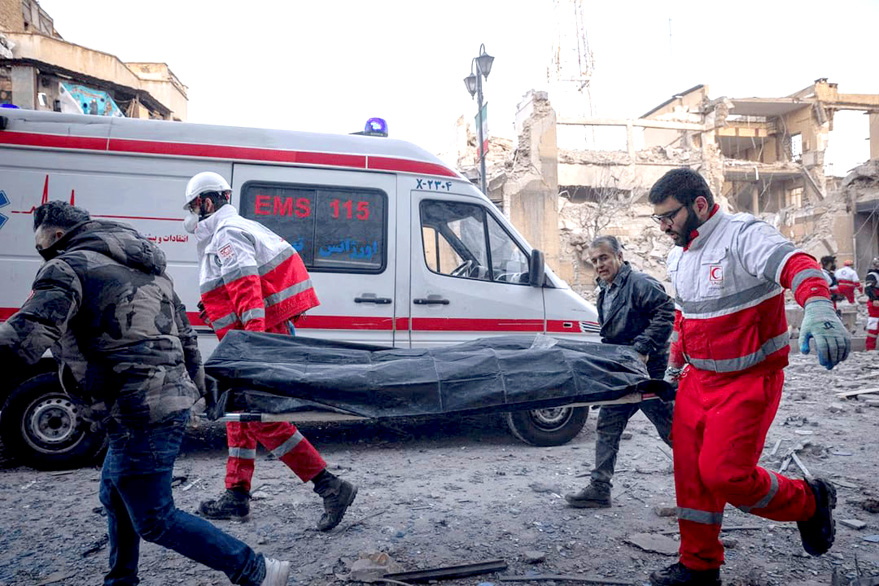
The Chief of Staff of the Iranian Armed Forces has honoured medical personnel, especially the tireless and selfless dedication of doctors, nurses, and healthcare workers during the recent 12-day and Ramadan wars.
Major General Ali Abdollahi made the remarks in a statement on Sunday, on the occasion of National Doctors’ Day, which commemorates the birth of the renowned Persian physician Avicenna (Ibn Sina), and Pharmacists’ Day, marking the birth of the famous scholar Zakariya al-Razi.
Highlighting the critical role of the medical corps in national defence, he emphasised: ‘Undoubtedly, the tireless and selfless efforts of doctors, nurses, and the medical staff of the armed forces during the 12-day war and the Ramadan war demonstrate the highest degrees of loyalty to the homeland and the ideals of the revolution, deserving the utmost appreciation and respect.’
General Abdollahi paid special tribute to the ‘martyrs of service and health,’ specifically honouring fallen physicians Dr Ahmadreza Ghayem, Dr Seyed Alireza Mirghazi Saeed, Dr Mohammad Mehrabi, Dr Abdullah Asl Alvan, and Dr Mohammad Reza Abbasi.
He expressed hope that their names and paths would forever inspire dedication, virtue, and professional commitment within the country’s health system.
General Abdollahi also expressed profound gratitude to the families of healthcare workers for their patience and unwavering support.
He prayed for the continued success of all those dedicated to serving the people of Iran and safeguarding the health and security of the nation’s defenders and guardians.
Iran’s Health Minister Mohammad-Reza Zafarghandi said in late April that the United States and Israel carried out nearly 240 attacks on medical facilities across the country during the recent war, which began on February 28, leaving at least 50 hospitals and healthcare centres damaged.
In May, the head of the Iranian Nursing Organisation, Ahmad Nejatian, stated that while 11 nurses lost their lives in the course of the 12-day US-Israeli onslaught in June 2025, another five were murdered during the latest bloody offensive, which started on February 28.
However, the Islamic Revolution Guards Corps (IRGC) says the United States’ latest economic pressure campaign against Iran amounts to an implicit admission of failure on the military front.
Speaking to reporters on Sunday, IRGC spokesman Brigadier General Hossein Mohebbi reacted to recent statements by US President Donald Trump about launching what he called the ‘most crushing economic operation’ against Iran.
‘The US president says that he ordered an economic war and launched the most severe economic campaign against Iran. This amounts to an implicit admission of the enemy’s humiliating defeat in the military arena,’ he said.
He pointed out that the US would have no need to resort to economic warfare if it had achieved a military victory.
Such pressure against Iran is nothing new, he said, as Iran’s enemies have waged an economic war and imposed sanctions on all major sectors for 47 years.
‘We have repeatedly announced that we have scenarios in place for any hostile action by the enemy. One of the enemy’s hostile actions is economic measures and warfare,’ Mohebbi said.
‘We have scenarios to counter the adverse effects of the enemy’s war, and we can easily establish economic relations with other countries. There is no concern regarding the economic situation,’ he added.
He noted that Tehran has economic interaction with other countries despite sanctions and the results will become evident very soon.
According to the IRGC spokesman, Iran’s armed forces have succeeded in dealing heavy blows to the enemy during the 40-day and 12-day wars in June 2025 and late February.
Iran targeted at least 30 to 40 enemy warships inside the Persian Gulf before the 40-day imposed war, and the enemy has now retreated to a distance of 400 kilometres from the Persian Gulf waters.
Mohebbi reiterated that Washington had deployed extensive military resources to control the Strait of Hormuz, but ultimately failed.
Last Thursday, Iranian Foreign Minister Abbas Araghchi warned the United States that intensifying ‘failed’ policies against Iran will only lead to further setbacks.
- Iran has discovered a major new gas field in southern Fars province, with recoverable reserves estimated at around 5.7 trillion cubic feet.
Speaking on state television on Sunday, Iran’s Petroleum Minister Mohsen Paknejad said the newly discovered field contains more than 7.5 trillion cubic feet of gas in total.
The recoverable volume, he added, is equivalent to about 15 years of production from phase one of the South Pars gas field.
The field, known as Takht-e, contains sweet natural gas, which has relatively low levels of sulphur compounds and is therefore expected to reduce development and operating costs.
Paknejad also said the discovery includes substantial quantities of gas condensate, a valuable hydrocarbon liquid produced alongside natural gas.
He put the value of the gas and condensate resources at tens of billions of dollars, and the combined resources would create ‘a new source of wealth for the country.’
The government plans to move ahead to develop the field as quickly as possible, bringing its gas output into production and supplying it to industrial users and energy-intensive sectors.
The discovery could provide Iran with an additional source of natural gas at a time when the country is seeking to expand domestic production and meet growing demand from industry and the energy sector.
Iran has relied on domestic investment and expertise to develop its oil and gas fields since 2018, when the US imposed sweeping sanctions on the country’s energy sector.
- Iran’s Academic Centre for Education, Culture and Research (ACECR) has localised more than 2,000 petrochemical components previously imported under sanctions, completing their technical drawings and documentation to pave the way for domestic mass production.
Speaking at a press conference marking ACECR’s 46th anniversary, Hamid Saberfarzam, head of the organisation’s Technology Commercialisation and Knowledge-Based Employment Organisation, said the institution had focused on addressing the country’s strategic needs over the past year.
‘Despite the country’s challenges, ACECR dedicated all its capacities to solving national problems. Following the directive of the organisation’s president, we placed special emphasis on four key areas: defence, self-sufficiency and localisation, food security and agriculture, and employment,’ he said.
Referring to the organisation’s activities in the energy sector, Saberfarzam said: ‘Last year, more than 2,000 parts required by the petrochemical industry, which had previously been imported, were localised by ACECR’s technologists.’
‘The technical drawings and final books for these components have also been completed and delivered to the petrochemical industry, paving the way for their mass production by domestic manufacturers,’ he added.
- Iranian Foreign Ministry spokesman Esmaeil Baghaei says the activities of two French diplomats in Iran constituted ‘unacceptable interference’ in the country’s internal affairs.
Last month, two French diplomats were briefly detained in Tehran after they were found at a meeting linked to a security investigation.
‘We acted as soon as we felt that the French Embassy in Tehran had acted beyond its responsibilities and what is stipulated in the Vienna Convention on Diplomatic Relations, and that their actions constituted interference in Iran’s internal affairs,’ Baghaei told reporters on the sidelines of an event in Tehran on Sunday.
He said Iran had formally announced that the two diplomats must leave the country and would not be allowed to return.
‘Relations between countries, including with France, should be based on mutual respect and compliance with all rules and regulations of international law, including the prohibition of interference in the internal affairs of countries,’ Baghaei said.
He added that Iran would regulate its relations with all countries on this basis and would issue warnings or take necessary measures whenever required.
‘The action taken by the French was not justifiable,’ the spokesman said, describing it as a reaction to a ‘completely legal and consistent with international law’ measure taken by Iran.
Iran’s Ministry of Intelligence said last month that the two diplomats had ‘extensive records of violations and conduct contrary to domestic laws and diplomatic obligations.’