The commander of the Khatam al-Anbiya Central Headquarters has thanked Iranians for 100 consecutive nights of nationwide street rallies, describing the unprecedented mass gatherings as a manifestation of a ‘new resurrection’ of the nation.
In a statement issued on Wednesday, Major General Ali Abdollahi said the rallies – which have drawn millions of people onto the streets across Iran every night for more than three months – represent far more than a social or political movement.
‘This magnificent and unparalleled presence, which has continued for 100 consecutive nights with strength, faith, awareness and perseverance, is not merely a social or political movement,’ the general said.
‘Rather, it is the manifestation of a new resurrection and a great awakening of the Iranian nation.’
The nightly demonstrations began after the US and Israel launched an unprovoked war on Iran on February 28, assassinating Leader of the Islamic Revolution Ayatollah Seyyed Ali Khamenei as well as attacking military facilities, schools and hospitals.
Despite a fragile Pakistan-brokered ceasefire in place since early April, Washington has maintained a naval blockade of Iranian ports, and Israel has continued its attacks on Lebanon and Gaza.
Abdollahi, a pilot and senior Islamic Revolution Guards Corps commander, said the rallies have become one of the main components of Iran’s strategic deterrence and have sent a clear message to the United States and Israel.
‘This astonishing popular phenomenon, in addition to demonstrating rare national unity, has become one of the main components of the strategic deterrence of the Islamic Republic of Iran and has conveyed a clear message to the enemies of the Iranian nation, especially the terrorist rulers of the United States of America and the filthy and criminal Zionist regime.’
Abdollahi said: ‘The security, power and dignity of this land rely not only on equipment and military capability, but on the great popular support, revolutionary faith and the unbreakable bond between the nation, the leadership and the armed forces.’
‘The enemies of this land, more than ever before, have confessed to their inability to break the will of Islamic Iran,’ he added.
General Abdollahi said the rallies are the fulfillment of a promise made by the late Leader Ayatollah Khamenei, who he said had predicted such an awakening in his final days before the war.
‘Today, this divine promise has been embodied in the form of a nation that is awake, united, resistant and ready to defend the dignity and independence of Islamic Iran,’ the statement read.
The commander said the rallies demonstrate that Iran’s security and power rely not only on military equipment but on ‘the great popular support, revolutionary faith and the unbreakable bond between the nation, the leadership and the armed forces.’
He called on Iranians to continue their nightly presence until the new leader of the Islamic Revolution, Ayatollah Seyyed Mojtaba Khamenei, determines otherwise.
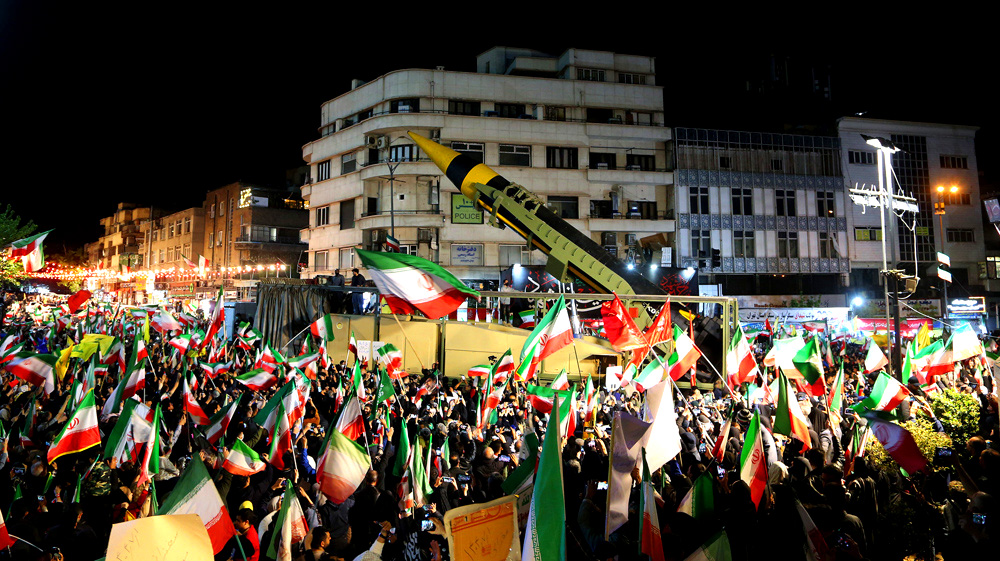
The rallies have drawn millions of people across the country – from Tehran to Birjand to Tabriz – who gather in major squares each night, waving Iranian flags and chanting against the United States and Israel.
Parliament Speaker Mohammad Bagher Ghalibaf on Tuesday hailed the Iranian nation for the popular show of force.
‘100 days have passed since the jihad of a nation that rose up to preserve dear Iran. God’s blessings be upon you who had Iran’s back, disappointed the enemy, and pulled the country out of the jaws of ravenous wolves that had sharpened their teeth to force Islamic Iran into submission,’ he wrote.
First Vice President Mohammad Reza Aref said this week that the 100 days since the Leader’s martyrdom have demonstrated that ‘the enemy has plotted, but the people have persevered’.
‘The message of these 100 days is clear, both for friends and enemies of Iran,’ Aref said. ‘Iran was in mourning, but did not sink into despair. The enemy conspired, but the people persevered.’
The Islamic Revolution Guards Corps (IRGC) also praised religious eulogists, poets and artists for their role during the rallies, describing them as a ‘divine mission that astonished the world and compelled arrogant bullies to submit to the will of a perceptive and resilient nation’.
In Tehran, crowds gather nightly at Enghelab-e-Eslami Roundabout and other major squares, with participants vowing not to leave the streets until they ensure that enemies will not repeat the terrorist assassinations.
Abdollahi said in his message that the rallies will be recorded in Iran’s history as a symbol of the ‘nation’s resurrection, revolutionary renewal and the display of the Iranian people’s invincible will.’
‘Peace and blessings of God be upon the great nation of Iran, upon the honourable families of martyrs, veterans and the self-sacrificing, and upon the brave warriors of the armed forces and the wise leader of the Islamic Revolution,’ the general said.
- The shattered walls and damaged laboratories of the Laser and Plasma Research Institute at Tehran’s Shahid Beheshti University bear the scars of an unprovoked and illegal military aggression carried out by the US-Israeli war machine against the Islamic Republic of Iran.
Windows were fully blown out, and some of the institute’s most advanced scientific equipment, optical systems, and critical research infrastructure were completely destroyed or severely damaged, while one of the main buildings directly hit in the April 3 US-Israeli attacks on the university, remains out of operation.
Yet despite the massive scale of the destruction, scientific activity inside the institute resumed with remarkable speed only days after the attack and continues.
Only days after the attack, faculty members, researchers, university staff, and volunteer forces returned to clear debris, restore laboratories, and restart research operations. Several neighbouring buildings that had also sustained damage also saw rapid repair work.
‘We will return with a deeper vision, with greater power, and with greater speed,’ Seyed Hassan Tavassoli, head of the institute and a PhD in physics, said.
For decades, the Laser and Plasma Research Institute has stood at the forefront of Iran’s work in photonics, optics, plasma engineering, laser applications, and advanced imaging technologies.
From developing plasma medicine for diabetic wounds and rare skin diseases to designing sophisticated optical brain-imaging systems, the institute has long represented one of the country’s most advanced scientific hubs.
Now, after enduring damage in an imposed war and losing part of its critical infrastructure, researchers say the institute is not merely rebuilding, but it is reimagining itself for a new phase of scientific growth and technological advancement.
The institute began its work in 1993 under the Faculty of Sciences at Shahid Beheshti University in northern Tehran.
It received official approval from Iran’s Ministry of Science, Research and Technology in the mid-1990s and later expanded into plasma sciences. In 2004, it officially became the Laser and Plasma Research Institute.
Over the years, the institute evolved into one of Iran’s leading centres for photonics and plasma research. Today, it houses 22 active laboratories and 17 faculty members, while training graduate students in photonics and plasma engineering at both master’s and doctoral levels.
Its mission extends far beyond academic research. The institute focuses on three core pillars, including training highly specialised researchers, producing scientific knowledge, and transferring technology into society and industry.
According to Tavassoli, the institute’s work has always been closely tied to national needs.
‘Projects were defined based on the country’s demands,’ he said. ‘Different organisations would communicate their needs to the university, and the university would pass them on to us. Many student projects at the master’s and PhD levels were designed around solving real national problems.
- Iran has emerged as the leading scientific producer in microelectronics among Islamic countries, securing first place across most major branches of the field while climbing into the ranks of the world’s top scientific powers in the sector.
According to the latest data released by the Islamic World Science Citation and Monitoring Institute (ISC), Iran ranks first among 57 Islamic countries in five out of six major subfields of microelectronics technology.
Globally, the country currently holds a position between 12th and 16th place in scientific production in the field, the report said.
Microelectronics technology encompasses a wide range of specialised areas, including integrated circuits, semiconductor devices, superconducting components, polymer-based components, emerging devices, and microsystems.
Iran has shown particularly strong performance in advanced and emerging technologies, according to the report.
In the field of emerging electronic components alone – considered one of the most sophisticated and rapidly evolving branches of microelectronics – Iranian researchers have produced around 5,000 scientific papers over the past two decades, it added.
ISC President Mohammad Mehdi Alavian-Mehr said Iran’s rapid scientific growth in microelectronics reflects decades of sustained research investment and academic development.
He also noted that Iran’s indexed scientific publications have witnessed dramatic growth over the past four decades.
‘In 1980, Iran had only around 300 papers indexed in international scientific databases, but that figure has now reached nearly 80,000,’ he said.
The announcement also comes amid broader evidence of Iran’s expanding scientific influence on the global stage.
According to newly published ISC figures, Iran currently ranks first among the world’s 20 leading scientific producers in publication efficiency, generating more internationally indexed scientific papers per research dollar than any other major scientific nation.