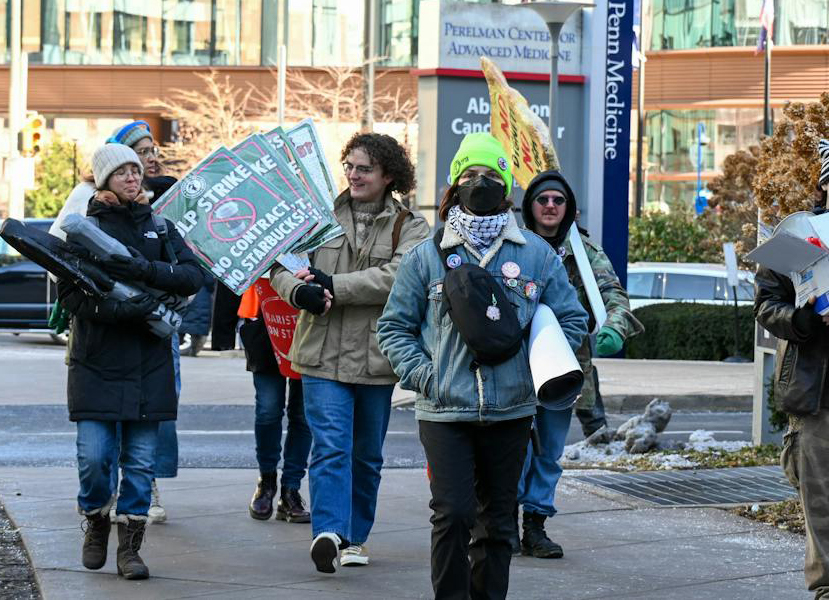
STARBUCKS baristas and students held rallies at over 40 college campuses across the United States last Thursday to support the Starbucks Workers United boycott campaign as the union nears five years of deadlock with the company over contract negotiations.
Starbucks Workers United is seeking better pay and stronger staffing levels, including a $17 an hour minimum wage for baristas and a minimum staffing of three workers per store. It has called on the public to boycott Starbucks until its first contract is reached.
More than 700 Starbucks stores have voted to unionise, representing more than 12,000 baristas.
It typically takes over 450 days for a new labour union to negotiate and reach its first contract, but it has been nearly five years since the first Starbucks store in Buffalo, New York, voted to unionise in December 2021.
Starbucks Workers United began to focus on college campuses in 2023, calling on campuses to cancel their contracts with Starbucks in protest against the company’s response to union-organising efforts. In response, Cornell University and Pomona College did not renew their contracts with the company, while UCLA stopped offering Starbucks products in their cafes.
Rallies and events took place at universities including the University of Pennsylvania, Northwestern and the University of Washington.
The union push came ahead of Starbucks’ Red Cup Day today (Tuesday 17th November) when customers receive a reusable holiday cup.
Andrew Trinklein, a barista who participated in an event at the University of Texas at Austin said: ‘Starbucks has been fuelling the working class for decades, but they’re failing the workers that fuel their profits
‘We’re really trying to push and get support from college campus students… in joining the boycott.’
His store recently unionised, and he expressed shock at how the company hired pricey union avoidance consultants in attempts to deter workers from unionising. Trinklein added: ‘Right now it’s just a toss-up whether we have a job tomorrow or not. Say they don’t like something that we’re doing – say we don’t write on a cup. We could be fired for it tomorrow.’
Efforts to pressure Starbucks to negotiate were temporarily paused when the union and Starbucks reached an agreement on a path forward in February 2024. But negotiations broke down shortly after Brian Niccol took over as Starbucks CEO.
In recent years, Starbucks has been found to have violated federal labour law by the National Labour Relations Board (NLRB) in several cases regarding its responses to union-organising efforts. Starbucks has challenged these rulings.
Speaking at a rally at the University of Pennsylvania, president of Workers United Lynne Fox said: ‘We’re calling on Penn to cut its ties with Starbucks. We’re saying that they shouldn’t give Starbucks access until baristas get a fair contract.’
Matthew Valenzuela, a barista at the 16th and Walnut Streets Starbucks in Philadelphia, who went on strike, said: ‘After a three-month-long strike, we still don’t have a contract.’
Meanwhile, the Portland city workers strike continues.
Leaders with the City of Portland Professionals Workers (CPPW) union gave an update to picketers at Portland City Hall on Sunday. They told the crowd they remain in mediation with the city.
CPPW represents about 800 city employees who work across most of the city’s departments, including parks and recreation, emergency management and infrastructure.
The city offered a three per cent cost of living increase. However, the union’s asking for an additional 3.5 per cent increase for employees on the lower end of the pay scale.
CPPW President Kari Koch said that if both sides aren’t able to come to an agreement, they plan to continue striking.
- A major US labour union is publicly urging Senator. Chuck Schumer from New York to step aside and make way for a new Democratic leader following the party’s takeover of Congress in last week’s midterm elections.
The International Association of Machinists and Aerospace Workers, which has 550,000 members at Boeing, Lockheed Martin, United Airlines and other companies, sent a letter to Schumer on Sunday calling for a ‘new generation’ of leadership in the Senate.
In an interview, IAM International President Brian Bryant said the election results made clear that voters are expecting change — not just from Republican to Democratic control in Washington, but within the Democratic Party itself.
Bryant said: ‘There comes a time when people need to step aside for the betterment of the country.
‘Our members are saying that they want a new leader in the Senate.’
Senator Bernie Sanders, an independent from Vermont who votes with the Democrats, said last Tuesday that he won’t support Schumer for Senate leader.
Trade unionists have complained for years, that their backing of Democrats in elections has produced few tangible gains
But the Democratic Party’s platform and rhetoric have been moving in labour’s direction in recent years, thanks in large part to the ascendancy of Sanders, and Alexandria Ocasio-Cortez from New York.
150 waste workers at CR&R Environmental Services have voted to join Teamsters Local 396. The new Teamsters provide vital sanitation services across Southern California from facilities in Santa Fe Springs, Phelan, and Blythe. They are seeking fair wages, affordable health care, retirement security, enhanced workplace protections, and real rights on the job.
CR&R workers overcame an aggressive anti-union campaign in their fight to become Teamsters. Management hired shameless outside union busters, who are paid hundreds of dollars an hour, to try and coerce workers out of unionising. This effort failed and only increased the group’s militancy.
Miguel Peña, a driver at CR&R in Santa Fe Springs said: ‘This victory is about standing together and fighting for better lives for ourselves and our families.
‘We organised because we deserve respect, fair wages, better benefits, and a voice on the job.’
Victor Mineros, Secretary-Treasurer of Teamsters Local 396 and Director of the Teamsters Solid Waste and Recycling Division said: ‘The hardworking men and women of CR&R should be proud of themselves for refusing to be intimidated and standing united in their fight for a better future.
‘These workers have sent a powerful message that no amount of corporate aggression or union busting can stop workers who are determined to organise and demand the respect, dignity, and economic security they deserve.
‘This victory represents a major milestone in the union’s fight to raise the industry standard for essential waste workers who keep streets safe and communities clean.’
- In Seattle Washington, SIFF Cinema Workers Union (SCWU) has filed an unfair labour practice (ULP) with the National Labour Relations Board – their second this year – over these issues and say they are now ‘actively discussing next steps.’
In a statement, the union said SIFF ‘unilaterally suspended the bargaining process’ and ‘no progress has been made since the summer.’
Back then, members expressed cautious optimism that SIFF was bargaining fairly after union members walked out before sold-out 70mm screenings of The Odyssey at SIFF Cinema Downtown.
After providing management with a proposal in late August on the remaining issues in their contract and giving SIFF ‘extra time’ to return to the union with a counterproposal, SIFF hasn’t been forthcoming at the subsequent meetings.
They now say that SIFF abruptly cancelled a meeting scheduled earlier last month ‘just hours before it was meant to start’ and haven’t scheduled any additional bargaining meetings since.
Nico Hall, a SCWU member and member of the bargaining team said: ‘They gave this individual a ‘final warning’ within one disciplinary meeting, which violates the disciplinary rules set up in the contract.
‘The contract requires SIFF to gradually move an employee up several stages of discipline.
‘Instead, SIFF has skipped through this process and placed this employee’s livelihood at risk.’