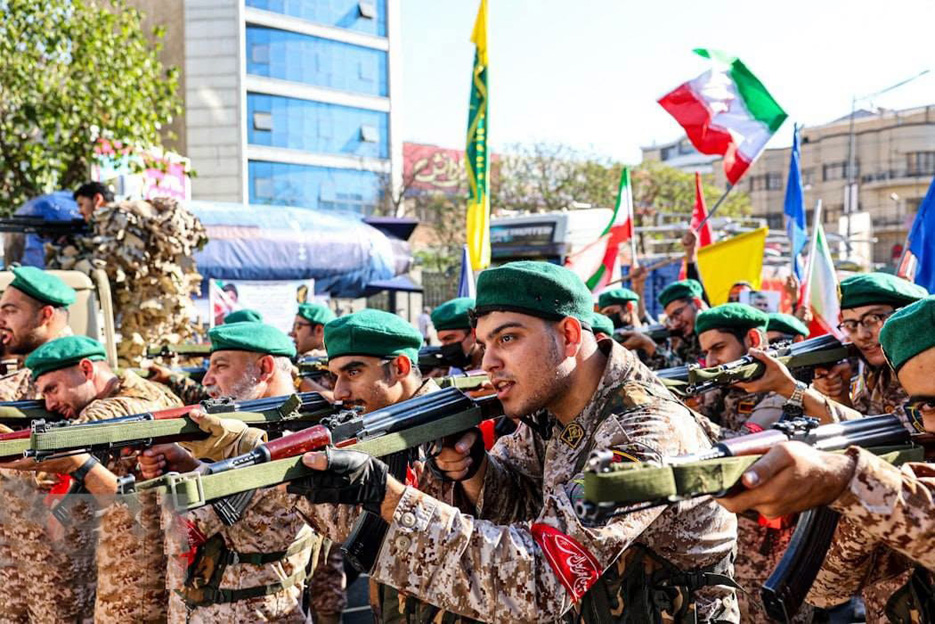
Iran’s military headquarters has warned Middle East nations they’ll be ‘considered complicit’ if the United States resumes major strikes on the country from American bases.
‘We warn that if the countries of the region – by continuing their dual policy toward the Islamic Republic of Iran – align with the Great Satan’s aggression against a powerful and sovereign Iran they will all be considered complicit in this evil and can no longer expect restraint or decency from Iran’s powerful armed forces,’ the Khatam al-Anbiya headquarters said in a statement.
Iran’s joint operational military command has repeatedly warned the US and regional countries that any aggression against Iran will trigger sustained and ‘painful’ retaliatory attacks on US positions and interests across the region.
In a statement on Sunday, the Khatam al-Anbiya Central Headquarters said that if the US ‘commits any mistake’ against Iran, ‘all its bases and interests in the region, without any limitation or consideration, will be targeted by sustained, effective and painful attacks.
‘Based on the information received, the criminal America, in pursuit of covering up its defeats and achieving false gains in a war that began relying on the lies and staging of the Zionists and has continued through deception and trickery, has once again decided, with the green light of some regional countries, at a joint meeting in one of the European countries, to resume actions against the Islamic Republic of Iran,’ the statement read.
It also warned regional countries against aligning with any US aggression against Iran, saying they would be considered partners in the ‘mischief’ and ‘could no longer expect restraint from the powerful Iranian Armed Forces.’
Earlier, Secretary of Iran’s Supreme National Security Council (SNSC) Mohsen Rezaei, warned that the Islamic Republic understands another US aggression is ‘very much on the cards’ based on its military assessments, and Tehran is prepared for a ‘decisive war’.
The US and the Israeli regime waged their first criminal war against Iran, which lasted 12 days, in June 2025.
Their second aggression began on February 28, 2026, and came to a halt in early April after 40 days.
In both wars, Iran’s resistance and successful retaliatory operations forced the aggressors to accept a ceasefire.
Iran has also maintained a tight grip on the Strait of Hormuz since the early days of the second imposed war.
In July, the US conducted waves of deadly air raids on Iran and imposed a naval blockade of the country in violation of the Islamabad Memorandum of Understanding (MoU) with the Islamic Republic, signed on June 17, to end the war.
In response, the Iranian Armed Forces launched devastating strikes against strategic American targets across West Asia and declared the Strait of Hormuz closed to all traffic.
Iran’s armed forces spokesman has rejected the latest ‘false and ridiculous’ US claims about the Strait of Hormuz, saying the initiative in the strategic waterway is firmly in Iran’s hands.
Brigadier General Abolfazl Shekarchi said on Saturday that the recent claims by the United States Central Command (CENTCOM) commander regarding the escort of one billion barrels of oil out of the Strait of Hormuz over the past two months were ‘false’ and ‘ridiculous’.
The CENTCOM commander’s claims were more ‘a failed psychological operation than a reflection of reality’ he said, and such remarks were aimed more at boosting the morale of the ‘exhausted and worn-out” personnel of the ‘terrorist’ US military in the region and justifying Washington’s heavy financial and human costs there.
Shekarchi said such claims would fail to change the reality of the expulsion of the ‘aggressor’ US military from the region.
‘The initiative in the Strait of Hormuz remains in the hands of Iran’s powerful armed forces,’ he pointed out.
In a statement shared on X, CENTCOM commander Admiral Brad Cooper claimed US forces had facilitated the transport of over one billion barrels of oil through the waterway in the last two months alone, providing protection for more than 2,000 commercial vessels.
He also claimed that the Strait’s primary transit lanes had been cleared of mines, allowing thousands of ships to pass through the waterway.
Iran restricted transit through the Strait of Hormuz in response to the illegal US-Israeli aggression that began on February 28.
On June 17, Tehran and Washington signed the Pakistan-brokered Memorandum of Understanding (MoU), whose Article 5 places responsibility for reopening and managing the Strait squarely in Iran’s hands.
However, Washington attempted to undermine Iran’s sovereignty over the vital global energy chokepoint by establishing an unsafe corridor near the Omani shores.
The United States also resumed its airstrikes on Iran and imposed a naval blockade in violation of the war-ending deal.
The unlawful US measures prompted Iran to declare the Strait of Hormuz closed to all traffic.
Now, shipping traffic through the Strait has reached its lowest level in months, sending oil prices rocketing.
Iran says the reopening of the critical waterway depends on US compliance with its obligations under the MoU.
Meanwhile, its Intelligence Ministry says security forces have dismantled three operational cells linked to terrorist groups in three provinces, preventing planned attacks against a security commander and critical infrastructure.
In a statement issued on Sunday, the Ministry said its forces killed one suspected operative and arrested several others during separate operations in West Azarbaijan, Alborz and Kerman provinces.
The first operation took place in Piranshahr, West Azarbaijan, where an operative affiliated with a separatist group was killed in an armed confrontation with security forces.
According to the statement, the suspect had been preparing to assassinate a local security commander.
In Alborz province, intelligence officers arrested a man identified only as ‘Amirali N, whom the ministry said had been working under instructions from a monarchist group linked to Israel’s intelligence services.
The ministry said the suspect had received training and instructions from the group and had transmitted information about several intended targets as well as the locations of military sites belonging to the Islamic Revolution Guards Corps (IRGC) and Basij forces.
It also noted that he had been tasked with carrying out a series of attacks, including damaging a Basij base, abducting or harassing individuals and setting vehicles on fire. These planned actions were prevented before they could be carried out.
In the third operation, intelligence forces in Kerman province arrested two members of an organised terrorist cell before they could carry out an attack.
The ministry said the two-member cell had been instructed to blow up a key infrastructure facility in the city of Bam and had also been ordered to prepare for further armed and terrorist operations.
The statement did not provide details about the identities of those arrested or the specific infrastructure facility targeted in Bam.
The Intelligence Ministry urged members of the public to report suspicious activities through its official channels and hotline.
Iranian lawmakers have submitted an urgent bill to Parliament’s Presiding Board seeking the country’s withdrawal from the Nuclear Non-Proliferation Treaty (NPT).
Addressing an open parliamentary session on Sunday, Iranian lawmaker Hossein-Ali Haji Deligani said the bill had already been submitted to the Presiding Board.
He added that the plan is ready to be presented before an open session and requires approval from Parliament Speaker Mohammad Baqer Qalibaf to be put to debate.
‘Given the circumstances facing the country and the aggression that the enemy has launched against us on two occasions, remaining in the NPT brings us nothing but losses,’ Haji Deligani emphasised.
The lawmaker also pointed to the recent referral of Iran’s case by the IAEA’s Board of Governors to the United Nations Security Council, and stressed the need for Tehran to avoid incurring further costs.
‘It seems that we may need to withdraw from the NPT so that we can manage our own affairs ourselves,’ he insisted.
The remarks came after the US and allied European countries forced through a resolution by the 35-member Board of Governors to refer Iran’s case to the UN Security Council over alleged non-compliance with the IAEA’s inspection regime.
That comes as Russia and China have opposed any action against Iran concerning IAEA claims, saying the US-Israeli aggression on the country has made it impossible for the IAEA to continue its routine inspections of Iran’s nuclear sites.
Secretary of Iran’s Supreme National Security Council (SNSC) Major General Mohsen Rezaei said on Saturday that the country remains committed to its policy of non-weaponisation of its nuclear programme.
However, he warned that withdrawal from the NPT is in response to military and political threats from the United States and the Israeli regime.
- Iranian authorities have closed down a French-language centre affiliated with the French embassy in Tehran following a judicial order.
The facility operated for years under the cover of foreign-language teaching despite repeated warnings to obtain a licence, authorities said, accusing it of activities ‘against Iranian culture and national security, including identifying and building networks, as well as facilitating the departure of skilled Iranians from the country’.
Paris expelled Iranian diplomats after Tehran’s similar move last month over accusations of ‘interference’ in Iran’s internal affairs.