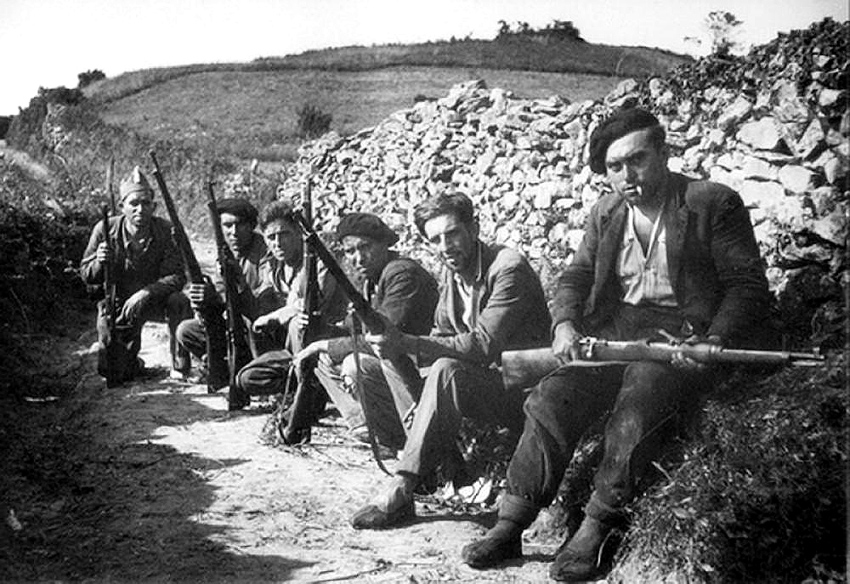
This month marks the 90th anniversary of the outbreak of the Spanish Revolution that erupted on July 18 1936 between Spanish workers, youth and rural workers and the fascist forces commanded by General Franco.
The background to the Spanish revolution and the civil war that followed lay in the catastrophic crisis of world capitalism that dominated in the early decades of the 20th century.
This was a crisis that had led to the first imperialist world war of 1914-1918, and had led to the first successful overthrow of capitalism and the establishment of a workers state in Russia in 1917.
This crisis had led to revolutionary confrontations and revolutions throughout Europe and the world notably in Germany in the early 1920s, the British general strike in 1926 and the Chinese revolution of the same year.
Apart from the revolution in Russia, led by Lenin, Trotsky and the Bolshevik party, these other revolutionary struggles had been defeated because they lacked the revolutionary leadership required to take the working class to power.
Spain, therefore, was not an exceptional set of circumstances, it came out of the development of a world revolutionary movement driven by the collapse of capitalism internationally.
Spain in the 1920s was dominated by a monarchy that openly reflected the interests of the large landowning nobility.
The Spanish monarchy oversaw a government that relied on the army to crush trade unions and working class organisations.
But all this repression failed to intimidate the working class who continued to organise in powerful trade unions especially in the large industrial regions in the north and east of the country, the Basque regions and Catalonia where the city of Barcelona became a working-class stronghold.
 Increasingly weakened and unable to cope with the demand of capitalism to force the working class to pick up the bill for the economic crisis, the monarchy lost the support of the ‘liberal’ bourgeoisie who favoured a turn to a more liberal democracy.
At municipal elections held in 1930 right-wing monarchist parties were decisively defeated and left parties, like the socialists, won an overwhelming victory.
The King abdicated and wildly enthusiastic crowds of workers declared Spain a republic.
This republican government, which contained parties of the left and openly pro-capitalist parties of the liberal bourgeoisie, promised great reforms but delivered virtually nothing to the working class.
But even vague promises of reforms was enough to terrify the capitalist class.
An important section of the bourgeois liberals broke away from the republican government and formed an alliance with the large landowners, representatives of big business, leading army officers, monarchists and those who admired the fascist leader of Italy, Mussolini, forming a new party called CEDA.
They saw fascism – which had triumphed over the working class in Germany and Italy – as the solution to the capitalist crisis in Spain through the complete defeat of workers and the institution of a naked fascist dictatorship.
The CEDA, following national elections in 1934, entered into the Spanish government triggering an uprising of miners in the Asturias region in the north of Spain.
Armed with dynamite they took control of the region and declared it an independent commune.
But throughout the country the official leadership of the working class refused to lead any real struggle.
The anarchists – who uniquely in Spain had a very large following amongst workers and controlled a powerful trade union – refused to take part in any national uprising because as anarchists they mistrusted and opposed any central action.
The Socialist Party – which also controlled an important union – although it talked very ‘left’ was completely reformist and restricted its members to a protest, a short general strike in Madrid.
The new government sent troops into Asturias to brutally put down the miners, using troops from the Spanish colony of Morocco under the command of General Franco.
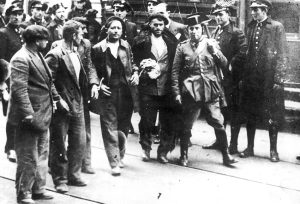
Despite the brutal suppression of the Asturias miners and the jailing of Socialist Party leaders throughout Spain, the CEDA government was unable to inflict a real defeat on the working class, which remained powerful and rebellious, and the CEDA government swiftly fell apart.
In 1936, another election was called under conditions of a class war between the working class and the capitalist class.
This election was won overwhelmingly by the Popular Front (PF), a coalition of Socialist Party, members of the small Spanish Communist Party and bourgeois republicans.
The Anarchists also supported the Popular Front.
Despite its left facade, it was a government determined to keep capitalism afloat and avoid revolutionary confrontation.
But its election unleashed a revolutionary spirit amongst workers and especially amongst the youth who exerted enormous pressure on the PF government, horrifying the landowners and the industrial capitalists who lived in fear of revolution.
These forces now deserted the CEDA and moved to an even more openly fascist organisation, the Falange.
The Falange opened up a wave of terror aimed at workers and their organisations – in just four months after the elections fascist thugs launched attacks that saw 269 people killed and 1,287 injured in street fights while 381 buildings were attacked, 43 left wing newspapers attacked and ransacked and 146 attempts made to bomb workers’ organisations.
At the same time, army officers were planning a coup which they believed would deliver Spain to their control in a matter of hours.
The coup was launched on the 17-18 July with the army attempting to seize control of every city in Spain and its colony, Morocco.
The republican government was paralysed with fear and attempted to reach some agreement with the army revolt.
The workers, however, were not cowed or frightened at all by this counter-revolutionary coup attempt.
While the unions restricted themselves to a call for a general strike, the workers moved decisively.
In almost every city they stormed the army barracks, seized weapons and disarmed the army.
In cities like Barcelona whole sections of the army deserted their right-wing officers and went over to the side of the workers, proving that when decisive action is taken, the working class is more than capable of winning the day.
Franco’s fascist forces were only able to win control of less than half of Spain, despite their military strength.
The republican government was also losing power as workers throughout the country began to organise in their local communities, replacing state institutions with revolutionary committees working for their interests.
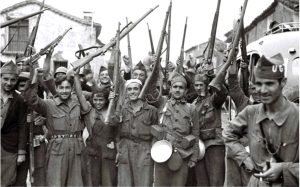
Factories were taken over, armed workers militias were set up to protect these seizures and to arrest local representatives of the capitalist class, while in the country, peasants seized land and distributed it amongst themselves.
In over half the country the capitalist class and its state had effectively been deposed and a situation of dual power existed in Spain.
But the working class faced two great problems.
One was purely technical in that they were untrained, with very little in the way of weapons apart from those they seized from the barracks, against them was ranged a professional army that was being equipped by its allies in fascist Germany and Italy.
Against this the Spanish workers had mainly small and obsolete arms, and while the working class internationally flocked to support their struggle, with young workers in their thousands coming from all over Europe and America to fight against fascism in the International Brigades.
But it was not the lack of arms or training, or the superiority of Franco’s army that led to the defeat of the Spanish revolution.
The treachery of their leadership betrayed them to defeat.
The Socialist Party opposed the revolutionary struggle to overthrow capitalism and continually sought to appease the fascists and world imperialism.
While honest anarchist workers and youth fought heroically, their leaders played a treacherously reactionary role, refusing to fight any kind of national struggle.
In Spain, anarchist leaders ended up not just supporting the republican government but having ministers in it.
The treacherous role played by Stalin and the Spanish Communist Party was decisive in the defeat of the Spanish revolution.
At the outbreak of the revolution the Communist Party had been very small and had no influence amongst the masses.
This changed when the Soviet Union under Stalin began to provide a limited amount of weaponry to the republicans – weapons that the republican government more than paid for when Stalin had the entire gold reserves of Spain seized and taken back to Russia.
By selectively holding back these weapons and ensuring that they only ended up in the hands of those who supported Stalin’s policies the CP, who had been the prime movers of the Popular Front, became very large and powerful.
Stalin, who had come to power in the Soviet Union after the death of Lenin and the exile of Trotsky, had developed the anti-Marxist theory of building socialism in one country.
Along with this went the position of peaceful co-existence with imperialism.
It was vital for Stalin to prove to the imperialists that the Soviet Union was not a supporter of world revolution, that it was a ‘safe pair of hands’.
All the policies followed by Stalin and the Spanish CP were designed to avoid a successful revolution at all costs.
Stalin’s secret police – who flooded into Spain – arranged the arrest and execution of leaders of those parties who opposed any compromise with the bourgeoisie, in a reign of terror that saw them attacking striking workers, and murdering their opponents.
No army, no matter how strong and determined, can win when it has a leadership determined to lead it to defeat.
The Spanish workers and youth fought heroically for two years against the full might of the fascist armies, with a leadership determined that they would not win.
That is the main lesson of the Spanish revolution, one that has to be learned by every worker and young person today, not just in Spain but throughout the world.
Only by building a revolutionary party to take the leadership of the working class can capitalism be overthrown and humanity advance to socialism.