WORLD Refugee Day was commemorated on Saturday amidst the continuation of the war in the Gaza Strip and escalating displacement operations in the West Bank.
Israel’s continued targeting of the United Nations Relief and Works Agency for Palestine Refugees (UNRWA) is the most prominent international witness to one of the longest refugee crises in modern history.
Palestinian data confirms that the refugee issue still represents the core of the Palestinian-Israeli conflict, in light of the continuous suffering of millions of refugees inside the homeland and in the diaspora, 78 years after the Nakba (Catastrophe – the forced establishment of the State of Israel).
In this context, Member of the Executive Committee of the Palestine Liberation Organisation (PLO) and Head of the Refugee Affairs Department, Ahmed Abu Houli, said that Palestinian refugees constitute about 42% of the total population of the State of Palestine, while the number of refugees registered with UNRWA is approximately 6.2 million, distributed among 58 official camps.
Abu Houli explained that the number of Palestinians around the world has reached about 15.5 million people, pointing out that more than 171,000 Palestinians have been martyred since the 1948 Nakba, including 74,176 martyrs since the seventh of October 2023, in addition to about 11,000 missing people who remain under the rubble.
He stressed that the issue of Palestinian refugees represents ‘the longest and deepest humanitarian and rights issue in modern history,’ in light of the continuation of what he described as the historical injustice inflicted on the Palestinian people.
Abu Houli spoke about a tragic situation experienced by refugee camps in the Gaza Strip and the northern West Bank, where they face unprecedented destruction and targeting.
About 1.9 million Palestinians have been subjected to repeated forced displacement inside the Gaza Strip, while the camps of Jenin, Tulkarem, Nur Shams, and Balata in the northern West Bank have witnessed continuous Israeli military operations that have led to widespread destruction of infrastructure, homes, and water networks, and has resulted in the displacement of more than 40,000 refugees.
He said that these policies deliberately aim to undermine the symbolism of the Palestinian refugee camp as a living witness to the right of return.
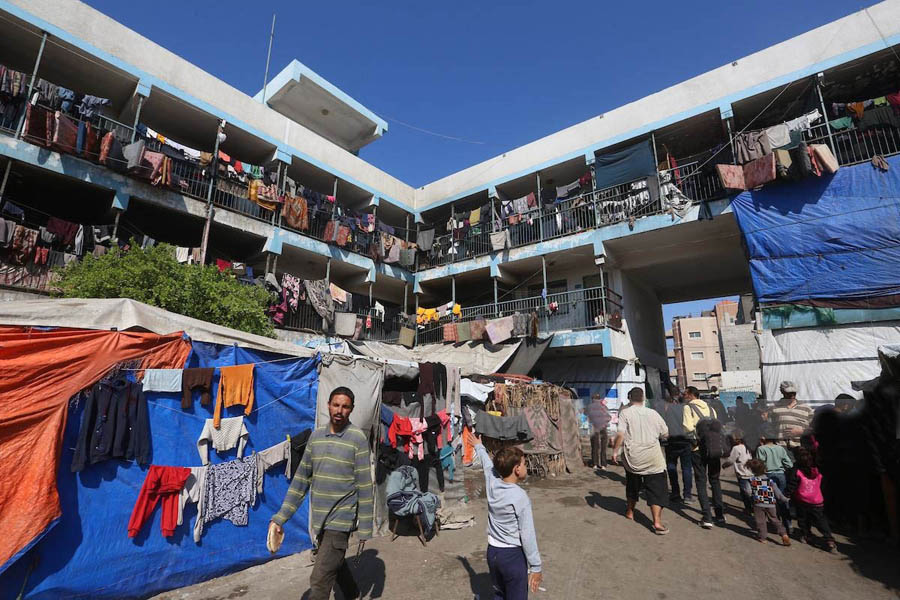
According to the data presented by Abu Houli, about one million displaced people are currently concentrated in 862 displacement sites inside the Gaza Strip, the largest bulk of whom are distributed in the Khan Younis governorate, followed by the Central Governorate, while thousands of families live in destroyed facilities and temporary shelter centres in the Gaza and North governorates.
He stressed that the living environment inside the camps and displacement sites has become a direct threat to the lives of the population, as most water and sanitation networks have been destroyed and the spread of diseases and epidemics, coinciding with the worsening starvation and the reliance of the majority of displaced people on humanitarian aid continue.
Abu Houli warned of the existential challenges facing UNRWA, pointing to continuous Israeli attempts to undermine the agency’s work and end its international mandate by targeting its facilities and working to dry up its funding sources.
He stressed that the targeting of the agency is not limited to its humanitarian services, but also targets its legal and political status as an international witness to the issue of Palestinian refugees and their rights.
For its part, the Ministry of Foreign Affairs of the Palestinian Authority called on the international community to assume its legal and moral responsibilities towards the Palestinian people, and to take practical steps to prevent forced displacement and ensure respect for international legitimacy resolutions.
The Ministry renewed its full support for UNRWA, stressing that any attempts to compromise its mandate or replace it will not change the legal status of Palestinian refugees or detract from their inalienable rights.
It also stressed that the right of return is an inherent and inalienable individual and collective right, and that achieving a just and comprehensive peace can only be achieved by ending the occupation and endorsing the independent Palestinian state with East Jerusalem as its capital.
At the international level, United Nations Secretary-General António Guterres called for strengthening solidarity with refugees around the world and working to protect them, stressing that millions of people are still forced to leave their homes due to conflict and persecution.
In a message on the occasion of World Refugee Day, Guterres stressed the importance of respecting international refugee law, protecting the right to seek asylum, and working to find solutions that guarantee refugees a safe and dignified life and real opportunities for self-reliance.
In a related context, the Head of the Communications Directorate of the Turkish Presidency, Burhanettin Duran, described what is happening in the Gaza Strip as one of the clearest contemporary examples of forced displacement, stressing that the cries of children, women, and civilians who lost their homes and loved ones represent a call to the global human conscience.
Duran stressed that Turkey will continue its support for just causes and defend the rights of the oppressed, foremost among them the Palestinian people.
In a reading of the Palestinian situation on World Refugee Day, content creator and researcher Dr Assem Al-Jaradat said that Palestinians have never given up their right of return, but the continuation of occupation, settlement, and the decline in the effectiveness of the international system made this right seem to entire generations as if it were a ‘Palestinian utopia’.
He added that the real question is not why the Palestinian clings to his right of return, but why the world failed to end the longest refugee issue in modern history despite more than seven decades since its inception.
He stressed that the right of return will remain an inherent part of the Palestinian national consciousness as long as injustice exists and justice is absent.
Coinciding with World Refugee Day, several countries witnessed solidarity events in support of Palestinian refugees and in rejection of displacement policies.
In the Moroccan capital, Rabat, activists and human rights associations organised a sit-in in front of the Moroccan Parliament, during which participants raised slogans supporting the right of return and condemning Israeli violations in Gaza and the West Bank.
South Korea also witnessed a massive popular march in support of Palestinians in the Gaza Strip and confirming the right of Palestinian refugees to return to their homes, in a scene that reflects the continued presence of the Palestinian cause in the global human consciousness despite the passage of decades since the Nakba.
- In a scene reflecting years of war, displacement, and disrupted education, thousands of high school students across the Gaza Strip began their final secondary school exams this year under unprecedented conditions, facing challenges unseen by previous generations.
Between overcrowded displacement tents, destroyed homes, and chronic shortages of electricity and internet access, Gaza’s students are fighting a double battle: the struggle to survive and the struggle to hold on to their right to education.
The Palestinian Ministry of Education said high school exams for Gaza students began on Saturday June 20, 2026, through an electronic examination system, an exceptional measure imposed by the ongoing circumstances and the destruction affecting the education sector.
Around 37,700 students from Gaza are taking part in this year’s exams out of nearly 91,000 students across Palestine and abroad.
For many students, preparing for exams was far from normal.
Many lost their homes, were displaced multiple times, or studied in conditions where schools had been damaged or turned into shelters.
With no stable classrooms or learning environments, students relied on limited educational initiatives, intermittent online classes, and individual study sessions inside tents, temporary shelters, or even cafés where electricity and internet access were available for only a few hours.
The hardships extended beyond academics. Many students took on responsibilities at home, helping their families secure basic necessities or caring for younger siblings, leaving them with less time and energy to study.
Educators say Gaza’s high school students are facing unprecedented psychological and social pressures, including fear, loss of family members, displacement, and uncertainty about their future.
Student Ahmad Hani from Jabalia said the biggest challenge was finding a quiet place to study, explaining that he and his family were living in a tent west of Gaza City.
He said nighttime was often his only opportunity to review lessons, relying on his phone’s light or a battery-powered lamp due to electricity shortages.
‘I felt I was studying in circumstances completely different from any other student in the world, but I tried to hold on to hope because high school represents the gateway to my future,’ he said.
Student Maha Fathi said she’d been displaced several times and constantly feared losing her books.
She added that throughout the year she struggled to find regular study time because of household responsibilities and the harsh realities of life in displacement.
‘Despite everything, I tried to use every quiet hour to review. Reaching exam day itself is an achievement after everything we have been through,’ she said.
Educational specialists say this year’s high school exams represent more than an academic milestone; they are an attempt to preserve the continuity of education and prevent the loss of an entire generation affected by war and displacement.
Despite the importance of completing high school, questions remain over students’ university futures amid economic hardship, damage to higher education institutions, and challenges related to travel, scholarships, and opportunities to continue their studies.
Yet for thousands of Gaza students, these exams remain a symbol of determination, a step toward reclaiming their educational journey after years of hardship.
Amid books, generators, and crowded tents, they are writing the story of a generation determined not to let war take away their right to dream.