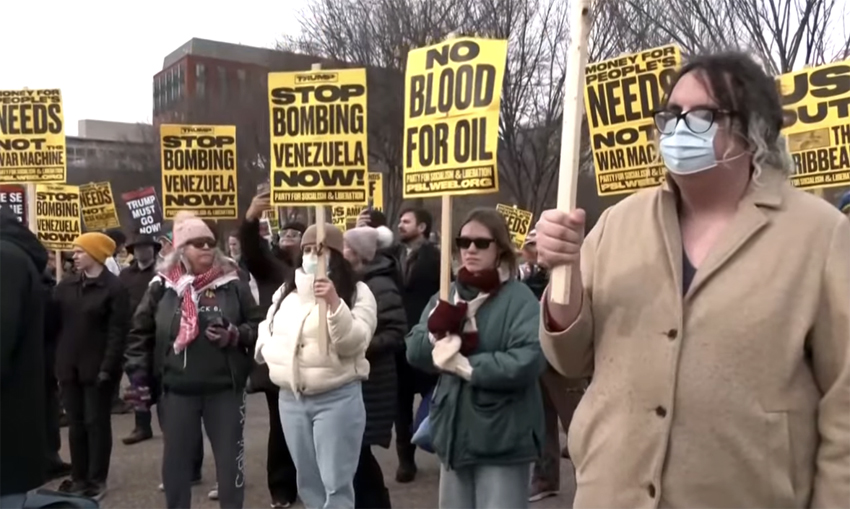
THE American National Nurses United union (NNU) has strongly condemned US President Trump and his administration’s illegal invasion of and regime change operation in Venezuela.
The NNU stated: ‘Nurses across the country are outraged that the Trump administration has ignored the Constitution and committed an imperialist act of war without approval from Congress and without backing from our patients, working class people across the United States who are already struggling to afford basic necessities such as healthcare, food, and housing.
‘Trump and the Republicans have spent the past year openly waging war on working class people here at home, gutting Medicaid, refusing to extend Affordable Care Act subsidies that keep our patients’ premiums from skyrocketing, and proving that they “run” the United States to benefit only billionaires and corporations, all while they have prioritised spending on war abroad.
‘Now, they want to run Venezuela. It couldn’t be more clear that, regardless of how one feels about Nicolás Maduro, this mission is an extension of Trump’s fascist allegiance to the billionaire class, as he brazenly declares that US oil companies will now go in and control Venezuelan oil.
‘The US has a long history of interventions in Latin America, but voters have been clear that they do not want to continue on in the direction of imperialism and forever wars.
‘After illegally invading Venezuela, the Trump administration has also threatened to go after Columbia, Cuba, Mexico, and Greenland.
‘Our patients demand investment in building a healthy society here at home, so people do not have to choose between paying for medication or keeping a roof over their family’s heads, not investment in sending troops to invade other countries.
‘In any military conflict, nurses are deeply aware that working-class people suffer the most.
‘That’s true for the working people of Venezuela, who now may have to endure imperialist rule.
‘It’s also true for workers and families in the United States, who are already stretched thin, as we are on the brink of a possible government shutdown at the end of this month.
‘Nurses call for international solidarity among working people and demand the following:
‘An immediate end to the war in Venezuela and an end to all US military violence;
‘Prioritisation from the US government on domestic policy and improving the lives of millions of working-class people here at home, who are suffering from lack of healthcare, inability to afford food, and housing insecurity;
‘Restoration and extension of Affordable Care Act subsidies;
‘A complete reversal of the over $1 trillion (£746 billion) in cuts to Medicaid and other critical public programmes;
‘Medicare for All not wars on behalf of billionaires and oil companies.’
The Communications Workers of America (CWA) union also condemned the attack.
In a statement released last Thursday they said: ‘The Communications Workers of America stand in solidarity with the international labour community to condemn the unconstitutional military action in Venezuela.
‘The attack ordered by the Trump administration was not simply an attack on a foreign country – it was an attack on our constitutional order.
‘To keep our democracy free of would-be kings, only Congress holds the power to wage war.
‘But with this unauthorised attack, the Trump administration has usurped the constitutional power of Congress and undermined the democratic voice of the American people.
‘While President Trump and his cabinet wreak chaos and confusion, working people suffer the fallout.
‘Our union stands in solidarity with the people of Venezuela and supports international efforts to ensure that the Venezuelan people can determine their own future.’
Meanwhile in New York City, 16,000 nurses in the New York State Nurses Association (NYSNA) are set to strike today amid a battle over safe staffing, healthcare benefits, pay and workplace safety during contract negotiations.
The union highlighted that Management pay and bonuses at three hospitals – Montefiore, Mount Sinai, and New York Presbyterian – is nearly 12,000 times more than that of the average nurse.
Nancy Hagans, president of NYSNA said: ‘We’re not taking this lightly. We’re not asking to strike. Management is the one who’s telling us that we need to strike. They are the ones putting us on the picket line.’
She cited safety issues that stem from a drastic increase of assaults on healthcare workers since the Covid-19 pandemic, and an active shooter incident at Mount Sinai last November, where three nurses were reportedly disciplined for speaking out afterwards.
‘The large, wealthy hospitals are much better off financially than they were three years ago, but yet they’re asking for takeaways.
‘They told us to choose between our wages or keeping our healthcare and safe staffing, because “we cannot have it all”.
‘The safety of a patient should never be a bargaining chip. Nurses will not cut corners on patients and their safety.
‘Nurses are just demanding that New York City private hospitals put patients over profit.’
Meanwhile, graduate student workers across the University of California system are seeking the creation of a dedicated legal fund to assist international employees with visa-related challenges.
The proposal comes from United Auto Workers Local 4811, the union representing roughly 48,000 teaching assistants, postdoctoral scholars, and researchers across UC campuses, including about 15,000 at University of California Berkeley.
Union leaders say there is growing anxiety among international scholars as the Trump administration tightens immigration and visa policies affecting students and researchers.
According to the union, nearly two in five of its members are foreign nationals, which makes immigration stability a central workplace issue rather than a peripheral concern.
Tanzil Chowdhury, a UC Berkeley doctoral student in materials science and engineering who leads the union’s bargaining committee for teaching assistants and graduate researchers said: ‘One of the things that has allowed the University of California to be a world leader in education and research is the fact that we welcome people from all over the world.
Rahoul Banerjee Ghosh, a graduate student researcher at Lawrence Berkeley National Laboratory said: I have lived in the US for about four years now, and I’ve never felt at risk until this year.’
Originally from India, Banerjee Ghosh said coming to Berkeley felt like entering ‘the bastion of scientific enterprise,’ where their work centres on developing materials for energy storage, transport, and generation.
He added ‘It’s an ever-present thought: Will I be able to continue my degree, continue the life I’ve built here?’
- The US jobs market ended 2025 with job creation in December falling short of expectations and the unemployment rate ticking down to 4.4 per cent, according to data released by the US Bureau of Labour Statistics last Friday.
Total nonfarm payrolls in the United States (agriculture does not feature in US unemployment figures) increased by a seasonally adjusted 50,000 in December, missing the market estimate of 73,000.
The sluggish performance was compounded by negative adjustments to prior data.
More notably, the job loss in October was steeper than initially reported, now standing at 173,000 compared to the prior estimate of 105,000.
The slowdown is evident in the broader annual trend. For the full year of 2025, payroll gains averaged just 49,000 a month, marking a sharp deceleration from the 168,000 monthly average recorded in 2024.
The bureau added that the federal government shutdown did not impact the collection of household survey data and addressed technical adjustments regarding the calculation of these figures.