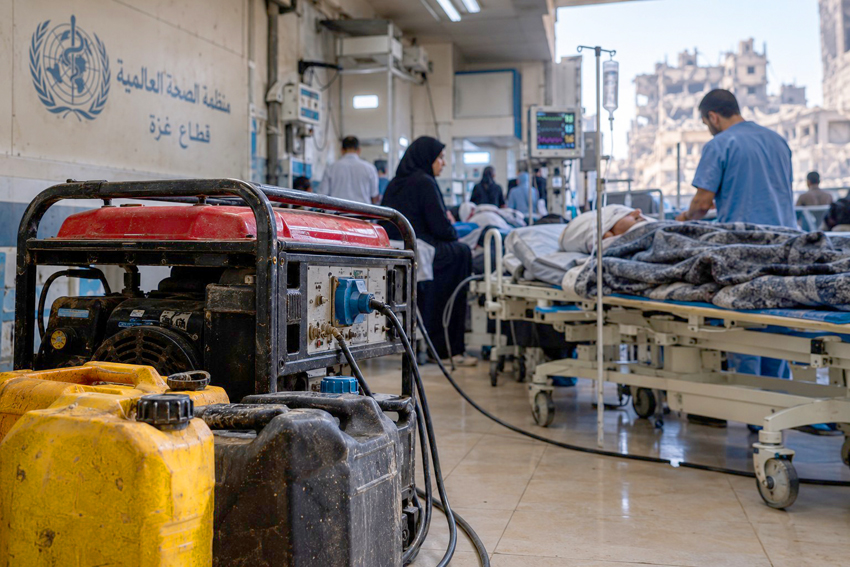
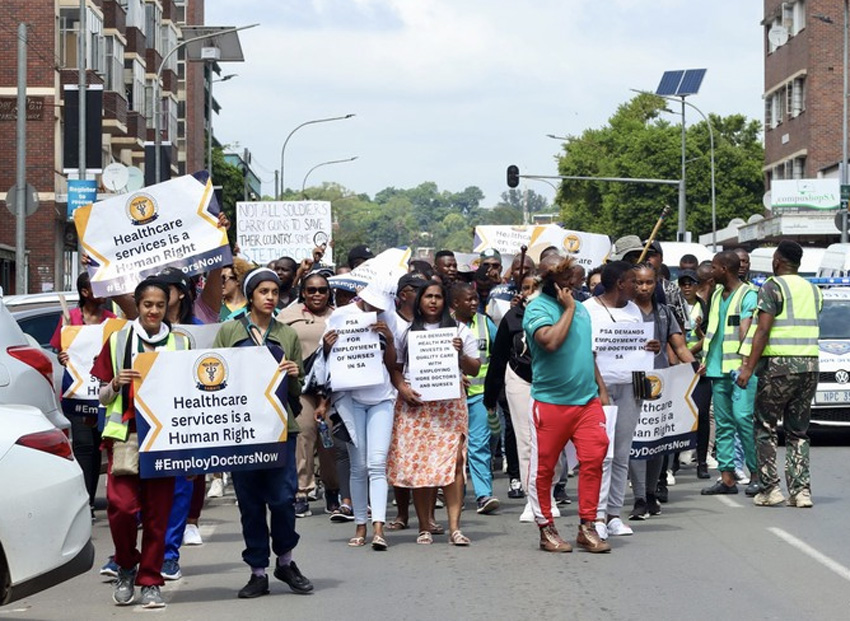
A new curriculum promising to ‘fast-track medical students into the workforce’, which has been launched by the World Health Organisation (WHO) Regional Office for Africa, was rejected by the South African Medical Association (SAMA) on Thursday.
SAMA has warned against adopting it as ‘a shortcut to produce doctors faster without ensuring safe clinical readiness’.
The WHO said the model, which integrates theory and clinical practice from day one, will allow countries to produce work-ready health professionals more efficiently, but SAMA believes it will undermine patient safety, worsen clinical risks and ignore the realities of practising medicine in one of the world’s most demanding health systems.
SAMA spokesperson Vezi Silwanyana said a curriculum alone, without supervised postgraduate rotations, ‘cannot fast-track graduates directly into independent practice’.
Sama added that it ‘is not realistic’ for South Africa.
SAMA stated: ‘Our graduates contend with some of the world’s highest burdens of trauma, infectious disease, maternal morbidity and chronic conditions.
‘No credible global system has eliminated supervised postgraduate clinical training entirely.
‘The root of the unemployment crisis is not educational but systemic.
‘Doctors remain unemployed because funded posts are not being created at the rate required to meet national healthcare needs.
‘This is a workforce planning and resource allocation failure.’
‘These supervised years are essential for building clinical competence, especially in a country with high disease burden, trauma load and resource constraints.
‘Without them, newly-graduated doctors would face high-stakes clinical decisions without the graded responsibility, mentorship and oversight required to ensure patient safety.’
‘On the job training exposes trainees to emergency medicine, obstetrics, anaesthetics, paediatrics, surgery, internal medicine and psychiatry, providing experience that cannot be replaced by classroom teaching or simulation-based assessments, it readies them to work in rural and underserved areas and ensures equitable distribution of clinical skills.’
At the same time, the Democratic Nursing Organisation of South Africa (DENOSA) said elements of competency-based training ‘already exist in this country’.
General-secretary Kwena Manamela said nursing programmes have long required students to complete mandatory practical hours across specialised clinical areas and that any move against that practice is wrong.
Manamela stated: ‘Not all African nurses can practise in Europe, whereas ours can.
‘The training of doctors is also not uniform across Africa.
‘Maybe minor adjustments have been made now, but we have been doing this all along.’
Elsewhere, the Department of Employment and Labour has approved the registration of the South African Domestic Service and Allied Workers Union (SADSAWU), officially recognising a trade union dedicated to domestic
workers.
While domestic workers have gathered under worker groups and unions, or registered under wider umbrella unions like COSATU, the largely informal nature of the job has made it difficult for workers to operate as a collective.
Domestic worker unions that had formed in the past had struggled to attain formal recognition and lacked the power to enter into collective bargaining and official conciliation processes.
Others that succeeded in overcoming the regulatory hurdles struggled to sustain themselves and were ultimately deregistered or dissolved.
However, the DEL has now officially registered SADSAWU as a trade union, making it one of the only nationally recognised bodies for domestic workers.
SADSAWU was launched in KwaZulu-Natal in 2000, with the aim of mobilising, educating and ensuring that labour laws were extended to include domestic workers.
Over the years, the union has been campaigning for domestic worker rights and working alongside other representative bodies and worker groups, like United Domestic Workers of South Africa, to help protect one of the most vulnerable classes of workers in the country.
Domestic workers have always been exposed to some of the worst ills of informal employment in South Africa, with the industry as a whole being under severe strain over the last five years.
Surveys and analyses of domestic workers in the country often point to underpayment, excessive responsibility (cleaning, cooking, child care, etc), and mental and physical abuse at the hands of employers.
The victory comes after the ANC government was forced to include domestic workers as formal employees, bringing them in line with national regulations around the Unemployment Insurance Fund (UIF) and Compensation Fund (CF) – and all the admin that comes with it.
Fuel price rises will add extra pressure – UASA
ABIGAIL Moyo, spokesperson for the trade union United Association of South Africa (UASA), warned on Thursday that the latest fuel price rises in the country will place additional pressure on workers already stretched by year-end expenses.
Moyo said: ‘Illuminating paraffin (wholesale) will increase by 74 cents per litre, and LP gas in Gauteng will increase by 24 cents per kg.
‘LP gas prices will vary by magisterial district zone.
‘This throws a spanner in the works for workers who, after the November fuel savings, had already budgeted for their December and January expenses, including travel to spend time with family and loved ones.’
Moyo urged South Africans to prepare for a tighter start to 2026.
‘UASA urges its members and South Africans in general to tighten their belts to accommodate the higher prices, while keeping in mind the upcoming costs of school fees and uniforms in early January.’
The warning follows the announcement by the Minister of Mineral and Petroleum Resources, Gwede Mantashe, who confirmed that fuel prices began to rise from Thursday, reflecting both local and international market conditions.
The key drivers behind the latest rise includes:
- Crude oil price fluctuations;
- International petroleum product price changes;
- Rand/US dollar exchange rate movements;
- Implementation of the Slate Levy (variable fuel price adjustment);
- Adjustments to industry margins;
- Annual updates to LPG price structure elements;
- The Maximum Refinery Gate Price (MRGP) for LPG imported through the Port of Saldanha Bay.
Consumers who rely on paraffin and LP gas, especially low-income households, are expected to be hit the hardest.