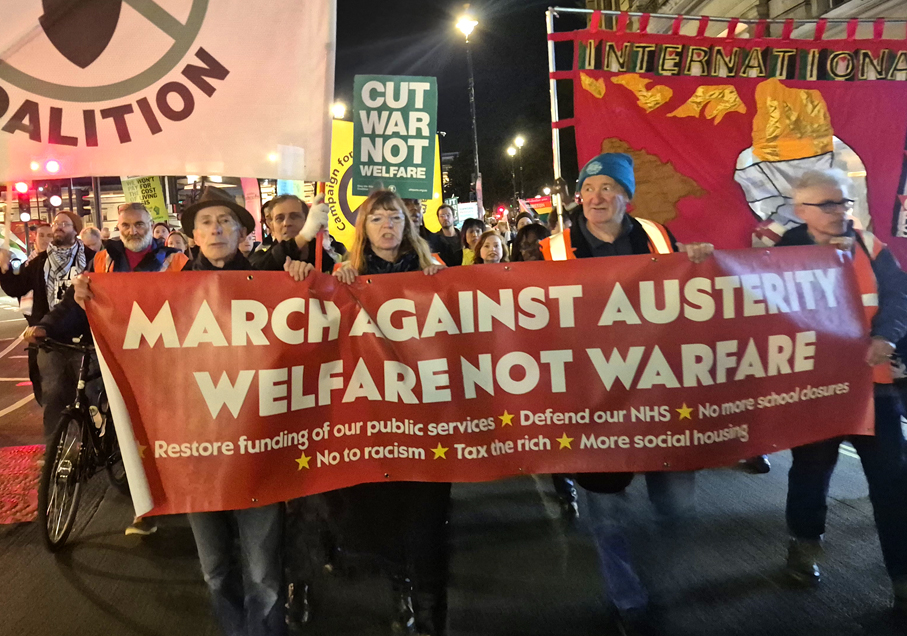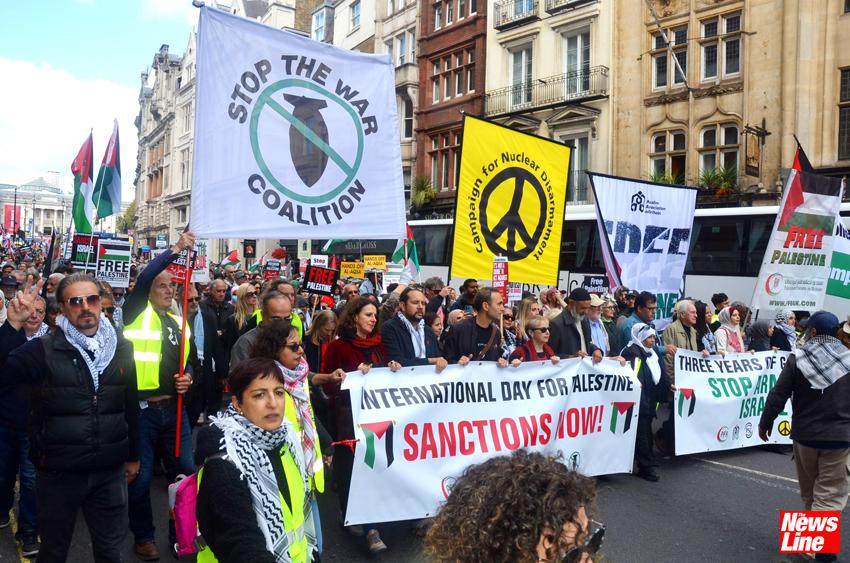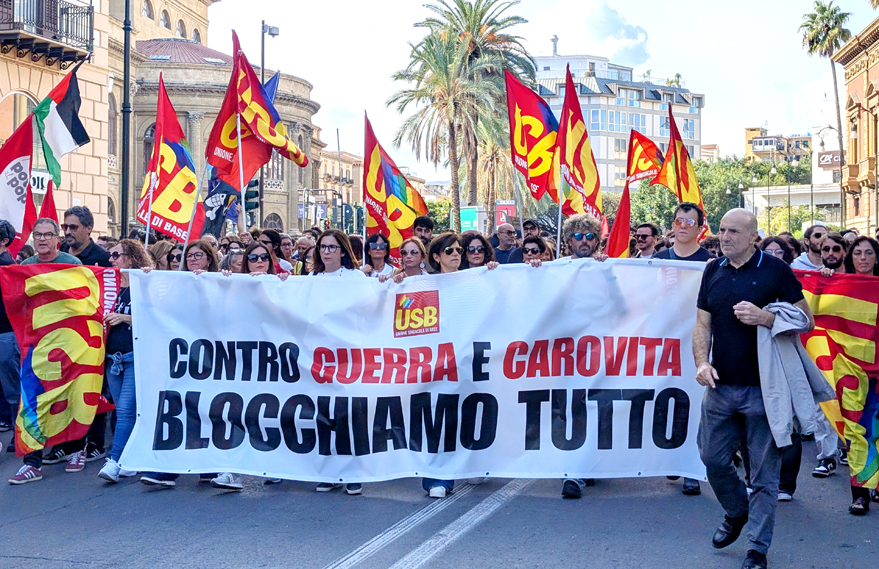
A GLOBAL dockworkers’ strike involving 113 ports began yesterday in protest against military supply chains supporting Israel’s genocidal war on Gaza.
Palestinians in the besieged territory have also rallied in support of the movement.
Organised by the dockworkers’ union coalition ‘Dockworkers Don’t Work for War’, the action is the largest ever coordinated port mobilisation of its kind.
Organisers said more than 25 unions across five continents refused to handle weapons shipments to Israel, staging 24-hour strikes and other actions, including work stoppages and demonstrations of varying durations.
Their demands include an end to the transportation of weapons and military equipment through civilian ports to conflict zones.
Local unions in France, Italy, Greece, Spain, Turkey and Morocco issued a joint call for an end to wars in the Middle East, including the war on Gaza, and ‘an end to the militarisation of ports’.
According to data published by No Harbour for Genocide (NHG), a pro-Palestine organisation campaigning to halt maritime transfers that sustain Israel’s military, 315 consignments of components for Israel’s Elbit Systems passed through 56 commercial ports across 29 countries between August 2025 and September 2026.
NHG said many of the ports identified in its research are among those whose workers took part in yesterday’s strike.
In Greece, the ENEDEP dockworkers’ union called a strike at Piraeus, the country’s largest port, as part of the International Day of Action.
Additionally, protesters in Turkey’s Istanbul gathered outside Haydarpafla port beneath a banner reading: ‘No to war, no to armament!’
In France, the CGT ports and docks federation called a one-day strike at major ports, including Le Havre, Marseille, Dunkirk and Rouen, in opposition to ‘the militarisation of port facilities’ under European policies.
The pro-Palestine maritime campaign Global Sumud Flotilla (GSF) also announced its participation, saying it would join land-based mobilisations across four continents as part of the global shutdown for Palestine.
The group said a flotilla of five vessels would operate in international waters between Sicily and Malta.
GSF added that around 20 of its activists had launched a 24-hour campaign of non-violent direct action to obstruct and challenge three major commercial vessels bound for, or servicing, Israeli infrastructure.
The international mobilisation has drawn support from Palestinians, particularly in Gaza, where residents and the Palestinian General Federation of Trade Unions have voiced solidarity with the movement.
On Thursday, Palestinians gathered at the fishermen’s port near Gaza City ahead of Friday’s strike, hoping to draw attention to the plight of fishermen who have faced killings, injuries and arrests during Israel’s assault on the territory.
Shaher Saad, secretary-general of the Palestinian General Federation of Trade Unions, said that yesterday’s international action reflected growing opposition to Israel’s war on Gaza.
Saad also highlighted the situation facing Palestinian fishermen, who have endured destruction and been prevented from accessing the sea since Israel launched its assault.
He said his organisation firmly supported the international mobilisation, describing it as ‘one form of solidarity with the Palestinian people.
Saad said ‘When we learned about this trade union initiative, which involved calling for strikes and protests at workplaces, we formally supported it.’
The union leader stressed the importance of the action in calling for governments to intervene and impose a full arms embargo on Israel.
‘This is an important form of solidarity because these weapons are being used to kill Palestinian children, women, elderly people, medical staff and journalists,’ Saad said.
‘All of this is happening while weapons are being transported through ports around the world to Israel, where they are used to kill the Palestinian people.’
Saad confirmed that the federation was coordinating with Palestinian workers and fishermen in Gaza, while expressing hope that yesterday’s mobilisation would lead to sustained international cooperation rather than remain a one-day show of solidarity.
‘The workers who took part in the strike have performed a heroic act of solidarity. They have raised their voices in support of the Palestinian people and stood alongside them,’ he said.
‘The Palestinian people have been deprived of their freedom. They seek to establish an independent and democratic Palestinian state, with East Jerusalem as its capital.’
He added: ‘The Palestinian people want peace, but peace must be based on their rights and dignity, and above all on the establishment of an independent Palestinian state. It cannot simply mean concessions granted by the Israeli occupation to those it chooses.’
‘We do not want this occupation on our land, and there can be no lasting solution while it continues to remain on our homeland.’