
PALESTINIAN Prime Minister Mohammad Mustafa said yesterday that security, stability, and peace in the region can only be achieved through ending the Israeli occupation and establishing an independent, contiguous, and viable Palestinian state in accordance with international law and relevant United Nations resolutions.
He made these remarks during a joint briefing session and meeting held at the Prime Minister’s Office with European Commissioner for the Mediterranean Dubravka Suica, attended by the European Union Special Representative for the Middle East Peace Process Christophe Bigot, the European Union Representative to Palestine Alexandre Stutzmann, and Minister of Finance and Planning Dr Stephan Salameh.
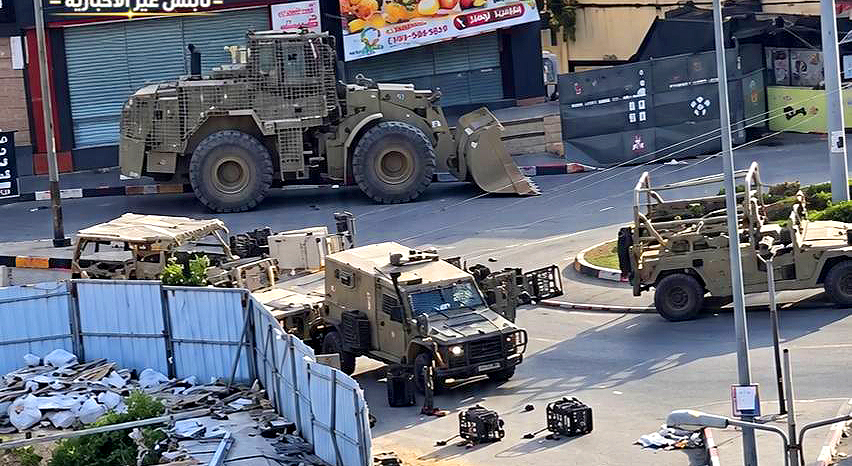
Addressing Israeli policies, the Prime Minister stated: ‘What Israel is carrying out on the ground, whether in the Gaza Strip or in the West Bank, including Jerusalem, is not merely a series of isolated actions. Rather, it is a deliberate and systematic policy aimed at dismantling the Palestinian existence, undermining the Two-State solution, and closing the horizon for an independent Palestinian state.
‘At the forefront of these policies is the ongoing war on the Gaza Strip and the unprecedented humanitarian catastrophe it has caused.’
Mustafa further highlighted policies of settlement expansion and de facto annexation of Palestinian land, as well as systematic settler attacks that enjoy official Israeli protection, support, and impunity.
He also pointed to escalating Israeli restrictions on freedom of movement and attacks targeting religious and cultural heritage sites, all aimed at creating irreversible facts on the ground.
Mustafa stressed that ‘the financial and economic blockade poses a serious threat to the sustainability of Palestinian institutions. Israel continues to unlawfully withhold Palestinian clearance revenues, which have now accumulated to approximately $6 billion. In addition, nearly $5 billion belonging to Palestinian banks remains frozen after the Bank of Israel refused to receive these funds, resulting in annual losses to the Palestinian economy estimated at $11 billion.’
He added: ‘Despite these exceptional circumstances, the Government has continued implementing its reform agenda and strengthening the performance of public institutions based on Palestinian national priorities and interests, in coordination with the European Union and international partners.’
Mustafa called on international partners, foremost among them the EU, to continue playing their role in safeguarding the two-State solution, supporting institutional and financial stability, and taking effective and decisive steps to halt Israeli policies and practices that violate international law and to ensure accountability, thereby contributing to justice for the Palestinian people.
Mustafa also reaffirmed that the Gaza Strip is an integral part of the State of Palestine.
He further commended the resilience and steadfastness of the Palestinian people, stressing that supporting their resilience and enhancing the capacity of Palestinian institutions to carry out their responsibilities and recovery efforts represents an investment in peace and stability across the region.
European Commissioner for the Mediterranean Dubravka Suica reaffirmed the EU’s continued support for Palestine, noting that strong and well-governed Palestinian institutions are essential to advancing this path. She also stressed that settlement expansion and the escalating attacks by Israeli settlers are undermining the reform efforts.
Commissioner Suica further stated that the ongoing humanitarian suffering in the Gaza Strip remains unacceptable and that the EU is working extensively to help bring an end to this suffering. She underscored the urgent need to facilitate the entry of humanitarian and relief assistance into Gaza, leading ultimately to full recovery and reconstruction.