
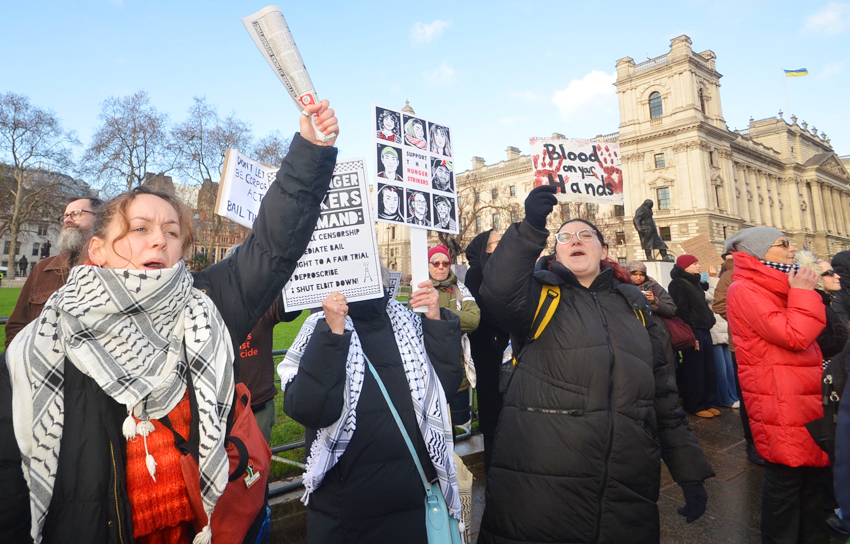
Authors Naomi Klein, Sally Rooney and China Mieville, philosopher Judith Butler, and activist Angela Davis, have joined global scholars in a declaration of solidarity with hunger striking prisoners for Palestine and Greta Thunberg.
The declaration reads: ‘Dozens of distinguished scholars and authors from around the world have made a declaration in solidarity with prisoners in the UK whose long detention on remand on charges relating to activism for Palestine has sparked criticism from human rights organisations and UN experts.
‘Among those who have added their names, including Richard Falk, Queen Mary University of London and former UN Special Rapporteur for human rights in the Occupied Palestinian Territories, Lynn Welchman, Professor of Law, SOAS University of London, Penny Green, Professor of Law and Globalisation, Queen Mary University of London, Emilios Christodoulidis, Chair of Jurisprudence, University of Glasgow, and Neve Gordon, Professor of International Law, Queen Mary University of London.
‘Three of the prisoners, Heba Muraisi, Kamran Ahmed and Lewie Chiaramello are facing imminent danger of death.
‘Heba reached 70 days without food on 11th January, while Kamran reached day 63 and Lewie, day 49. A fourth prisoner, Umer Khalid also announced on January 11th that he has restarted his hunger strike.
The statement wording also highlights the signatories’ condemnation of the arrest of Greta Thunberg on terrorism charges while protesting in solidarity with the prisoners before Christmas.
The statement, which is published on the Protest Not Terrorism website echoes the slogan which Greta Thunberg wrote on the placard she was carrying when she was arrested on 23 December.
“We oppose genocide, we support the Palestine Action prisoners”
A spokesperson for Protest not Terrorism open letter collective said:
‘This statement is a declaration of support for the campaign by prisoners for the respect of their fundamental rights to a fair trial, to prompt and appropriate medical treatment, to uncensored communications with their legal representatives and the removal of punitive and draconian conditions imposed by the Prison Service triggered by the widely-condemned proscription of Palestine Action.
‘The signatories also affirm their solidarity with Greta Thunberg after her shocking arrest on terrorism charges for expressing solidarity with the prisoners.
‘Professor Peter Hallward, one of the signatories to the statement, said: “The UK is now perilously close to full descent into authoritarian rule.
“Ministers won’t even meet with hunger-strikers who are now at death’s door. Starmer, Lammy, Cooper and Mahmood seem perfectly ready to let this country’s most committed and courageous opponents of an ongoing genocide waste away and die.
“Now the police have begun arresting people just for using the standard Arabic word for uprising, marking yet another draconian step in the elimination of what’s left of our freedoms of expression and of academic inquiry.”’
- An open letter by healthcare professionals has also been sent to prison governors, prison healthcare providers, and commissioners at HMP Pentonville, Wormwood Scrubs, Bronzefield, Peterborough, Bristol and New Hall, NHS England Health Justice, CQC, GMC, RCGP, RCP, and hospitals providing care for the hunger strikers has been sent demanding that they call for the hunger strikers release from prison and their admittance to hospital.
The letter states: ‘We write to you, once again, as healthcare professionals who are shocked at this government’s continued neglect of the health and rights of eight individuals who are currently – or have recently been – on hunger strike: Qesser Zuhrah, Amu Gib and Jon Cink (HMP Bronzefield); Heba Muraisi (HMP New Hall); Teuta Hoxha (HMP Peterborough); Kamran Ahmed (HMP Pentonville); Muhammad Umer Khalid (HMP Wormwood Scrubs); and Lewie Chiaramello (HMP Bristol).
‘It is our view that the hunger strikers must be admitted and kept in hospital for continuous monitoring and specialist investigations, not merely transferred to A&E and discharged after a number of hours.
‘Lewie Chiaramello, the third active hunger striker, requires 24/7 access to life-sustaining medication for his diabetes, which is recognised as a disability under the Equalities Act 2010.
‘It is our understanding that his diabetes reader and insulin have been withheld during visits, and during movements to and from his cell. We are particularly concerned about reports of sub-standard treatment in hospital.
‘That certain conditions should be worse in hospital than in prison is an indictment of the care provided to the hunger strikers in such settings.
‘While recognising that Qesser Zuhrah, Amu Gib, Jon Cink and Teuta Hoxha have paused their hunger strike, we emphasise that death is not the only tragic and devastating outcome of a hunger strike.
‘The long-term harm and permanent complications may not become apparent for many years or decades. Deficiencies in vital vitamins and electrolytes can lead to long term irreversible neuro-cognitive impairments and damage.
‘Severe muscle loss may take months or years to reverse, leading to sustained physical weakness and joint problems that may never fully resolve.
‘We note that the survivors of the 1981 Irish republican hunger strike experienced significant health problems later in life, such as digestive, visual and neurological complications.
‘We also wish to emphasise the psychological harm that can result from prolonged remand (pre-trial detention).
‘After release there may also be enduring functional impairment, and increased long-term psychological morbidity.
‘As several of the hunger strikers have entered into the late stage of acute starvation, they are at extreme risk of refeeding syndrome and as such, any prisoners who end or pause their hunger strike must be taken to hospital without delay to manage the refeeding process.
‘Since Teuta Hoxha paused her hunger strike on 3rd January, it took several days before she was transferred to hospital.’
- Former hunger strikers from Ireland, Palestine and Guantanamo Bay have called on the government to take immediate action.
They wrote: ‘We are a collective of former hunger strikers from Palestine, Ireland and Guantanamo Bay.
‘Hunger strikes end only when power intervenes, or when people die.
‘We learned, through pain, permanent damage, and watching our comrades fall, how states behave when prisoners have no choice but to refuse the only right afforded to them: food.
‘We write in uncompromising solidarity with the hunger strikers.
‘We cannot forget what the hunger strikers today stand for.
‘They stand for Palestine. They stand for dismantling the infrastructure of weapons that kills Palestinians.
‘They stand for the end of the apartheid regime implemented by the Israeli government. They stand in solidarity with the Palestinian prisoners.
‘They stand for the complete liberation of Palestine, from the river to the sea.
The UK government, through its unwavering support for the Israeli state continues to choose to be complicit in its actions.
‘It chooses to continue to arm Israel and shield Israeli officials from accountability while Palestinian bodies – men, women and children – are violated and destroyed in their streets, in their homes, and behind bars.
‘The proscription of Palestine Action was not about safety. It was about control.
‘No trial held under an atmosphere of state-manufactured fear can be deemed as fair, and no jury exposed to decades of terrorism rhetoric can operate free of bias.
‘These prisoners were smeared the moment the announcement of their arrest made mention of a ‘terrorism connection’, despite those proceedings not having taken place.
‘We therefore demand the following:
‘1. An urgent ministerial meeting with families and legal representatives to agree on actions that will preserve the lives of the hunger strikers. Immediate bail for the Palestine Action prisoners (known as the Filton 24) and all hunger strikers.
‘2. Dropping of terror charges designed to criminalise dissent.
‘3. Fair trial conditions free from fear-driven narrative and political interference.
‘4. Immediate access to independent medical care chosen by the prisoners.
‘5. An end to censorship and restrictions on family visits.
‘In 1981, Britain chose to let the Irish hunger strikers die in the Long Kesh prison. In the 2000s, Britain chose silence over the plight of the detainees at Guantanamo Bay.
‘For decades, Britain – along with other governments – continued to choose inaction in Palestine. Each time, British officials claimed responsibility rested elsewhere. Each time, history recorded the truth.
‘The Suffragettes, despite being force-fed and labelled as terrorists, are today celebrated as heroes and freedom fighters.
‘The Long Kesh prisoners, despite the smears they faced, are now seen as a vital part of the peace achieved under the Good Friday Agreement.
‘The Guantánamo Bay prisoners, despite their inhumane treatment and public consent for torture, remained untried and were largely released without conviction.
‘We are not merely observers, but witnesses to the injustice currently being dispensed by the hands of the state against people who history will no doubt vindicate, as it has done those hunger strikers who have gone before.’