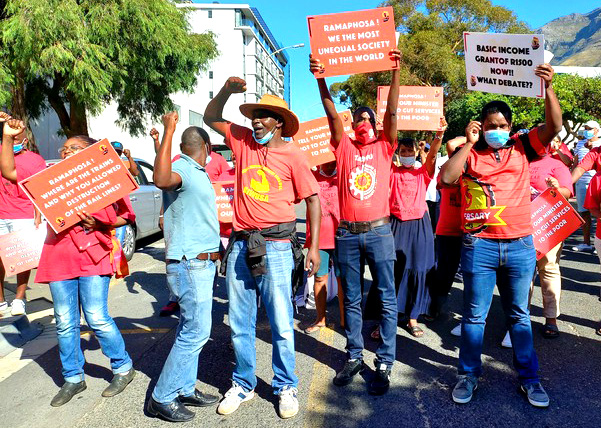
The South African Federation of Trade Unions (SAFTU) has condemned President Cyril Ramaphosa’s launch of Phase 3 of the Government-Business Partnership
In a statement on Monday Saftu said: ‘It is confirmation of what we have warned workers about for years: big business is no longer merely lobbying the state, it is increasingly being invited to help run it.
‘When Cyril Ramaphosa – himself a multi-billionaire with deep roots in corporate South Africa – became President, SAFTU warned against illusions that his administration would place the interests of workers above those of big business.
‘When the so-called Government of National Unity (GNU) was formed, we warned again that worse days were coming for the working class.
‘Phase 3 of the Government-Business Partnership confirms our worst fears.
‘What is unfolding is a full-blown nightmare and an intensification of the class assault on workers and the poor.
‘SAFTU is not opposed to government meeting business. But this has gone far beyond consultation.
‘Corporate South Africa now enjoys structured access to the Presidency, Ministers and senior state officials, and participates directly in programmes covering electricity, rail, ports, water, infrastructure, mining, agriculture and other strategic sectors.
‘Yet organised labour is not a party to this bilateral. Workers are expected to accept the consequences of economic decisions negotiated between government and business while their organisations remain outside the room.
‘It is certainly not the social compact envisaged through NEDLAC. It is the increasing capture of economic policy making by big business.
‘The contradiction could not be more obscene.
‘Corporate executives sit around tables with the President discussing the future of the economy, while workers demanding insourcing in Johannesburg have marched and even slept outside the Mayor’s office, only to be ignored.
‘Business gets a partnership. Workers get barricades and closed doors.
‘The programme is unmistakable: complete Eskom’s privatisation, deepen the electricity market, expand private train operations, increase private participation in infrastructure and increasingly turn public services and strategic state assets into fields for private accumulation.
‘This is a fundamental transfer of economic power from the democratic state towards private capital.
‘Eskom and Transnet were built as national strategic assets.
‘Electricity, rail, ports and water are not commodities whose development should depend upon where private investors can extract the highest returns.
‘The greatest indictment of this economic model is the unemployment catastrophe it has already produced. South Africa’s expanded unemployment rate is 43.8 per cent.
‘President Ramaphosa tells the country that this same economic direction will now deliver one million additional jobs by 2030. For decades we have been told that fiscal discipline, inflation targeting, investor confidence, liberalisation and structural reforms would produce investment and jobs.
‘Instead, factories have closed. Manufacturing has declined. Communities have been deindustrialised. Poverty wages have spread. Inequality remains obscene and millions have been condemned to unemployment.
‘The missing centrepiece of the President’s programme is a serious industrialisation strategy. South Africa cannot mine, consume and tourist itself into prosperity.
‘We need manufacturing. We need massive public investment and a capable developmental state.
‘Instead of rebuilding that state, the GNU increasingly outsources its responsibilities and then celebrates private capital for performing functions the state has deliberately weakened its own capacity to perform.
‘Public-private partnerships cannot substitute for state capacity.
‘Wage subsidies cannot substitute for industrialisation. Investor confidence cannot substitute for decent jobs. And privatisation cannot substitute for development.
‘SAFTU therefore rejects Phase 3 of the Government-Business Partnership as a substitute for genuine democratic social dialogue and economic transformation.
‘We demand a radically different path: state-led industrialisation, public ownership of strategic infrastructure, benefication and localisation, massive public investment, an end to austerity, decent work and the rebuilding of Eskom, Transnet and other SOEs as powerful developmental instruments.’
- The Federation of Unions of South Africa (FEDUSA) has called for an urgent investigation after the Eastern Cape Department of Health (ECDOH) revealed that only 139 of its 350 ambulances are currently operational.
‘FEDUSA said on Monday: ‘The high number of non-operational ambulances in the province is a serious injustice to the public, particularly vulnerable communities that depend on Emergency Medical Services (EMS).
‘It deprives them of access to quality public healthcare and raises serious questions about how public resources are managed.
‘The shortage of operational ambulances results in severe delays in emergency response times, potentially leading to poorer health outcomes, permanent disabilities, and preventable deaths.
‘How many people must suffer or die before the department recognises the seriousness of this crisis and takes decisive action?
‘The shortage of ambulances delays emergency responses, which can put EMS workers at risk, as frustrated and desperate members of the public may lash out when ambulances fail to arrive on time.
‘EMS workers should not be placed in harm’s way because of failures within the public healthcare system.
‘FEDUSA will engage with its affiliates organising in the public health sector to seek a meaningful engagement with the ECDOH.
‘The purpose is to ensure that the concerns of both healthcare workers and the communities they serve are addressed, and that urgent measures are taken to restore the province’s ambulance fleet to full operational capacity.’
FEDUSA affiliate, HOSPERSA, also raised the alarm over a critical and potentially life-threatening crisis affecting EMS in the Nelson Mandela Metro – also in the Eastern Cape.
HOSPERSA says members have repeatedly raised concerns about the shortage of ambulances and essential equipment, declining operational capacity, and ongoing human-resource challenges.
The union will also be lodging an official complaint with the Health Professions Council of South Africa (HPCSA), calling for an investigation into the reported conditions within EMS and the extent to which the Metro’s EMS operations comply with applicable national standards, norms and professional requirements governing emergency medical services.
FEDUSA said it ‘calls on the ECDOH to treat this matter with the urgency it deserves and to account for the resources allocated to the provision, maintenance and operation of ambulances.’
- The Congress of South African Trade Unions (COSATU) has demanded action by the African National Congress-led government, industry, labour and consumers to protect local jobs and value chains in the sugar industry.
The Federation stated on Monday that it ‘welcomes the Department of Trade, Industry and Competition (DTIC) and the International Trade Administration Commission (ITAC)’s gazetting tariff relief for the sugar sector through raising the Dollar-Based Reference Price from US $680 to US $785 per tonne and the import duty from R4.83 to R6.97 per kilogramme.
‘This is a critical intervention by the ANC-led government to save the local sugar industry, value chains and jobs.
‘We appreciate that the raised reference price seeks to protect jobs, businesses and value chains in the sugar as well as the food and beverages industries in addition to cushioning consumers from high food prices
‘We simply cannot afford to lose this industry in an economy that has barely grown over the past decade.
‘The sugar industry employs over 70 000 workers directly, and more indirectly. It provides livelihoods for more than 11,000 emerging and small-scale farmers and is an economic anchor for KwaZulu-Natal and Mpumalanga.
‘We need to protect jobs not only in primary agriculture and milling, but across the broader value chain including food and beverages.’