Israeli forces, settlers, and municipal authorities carried out a series of violent actions across the occupied West Bank and Jerusalem on Wednesday and Thursday.
28-year-old Alaa Sobeih was shot and killed by settler gunfire on Wednesday evening during clashes near the village of Tayasir in eastern Tubas.
The violence erupted after a group of settlers attempted to storm the village from an illegal outpost nearby.
The Palestinian Red Crescent said Israeli forces blocked its ambulance crew from reaching Sobeih as he lay bleeding, confiscated the paramedics’ mobile phones and identity cards, and later withheld his body after he died of his wounds.
That same evening, settlers carried out a spree of attacks across multiple areas of the West Bank.
In southern Nablus, a group kidnapped 14-year-old Osaid Mahmoud from the village of Qabalan and took him to the illegal settlement of Itamar.
In the village of Einabus, also south of Nablus, settlers seized two young men, drove them to an area near the illegal settlement of Yitzhar, stripped them of their clothes, and released them.
A young man was assaulted while working on his farm in the village of Aqaba, east of Tubas, and several Palestinian youths were attacked between Aqaba and the village of Yanun, with one transferred to hospital.
In the town of Burin, south of Nablus, a woman suffered suffocation after settlers broke into her home and sprayed her with pepper spray.
Israeli forces also kidnapped a young man in Tubas after settlers attacked residents there.
Earlier on Wednesday evening, Israeli police announced the reopening of al-Aqsa Mosque and the Church of the Holy Sepulchre in Jerusalem, attributing the decision to what it called ‘updated instructions from the Israeli home front command’.
The Islamic Awqaf Administration in occupied Jerusalem, the Jordanian-affiliated religious authority legally responsible for managing the Mosque, confirmed the reopening but gave no further details.
At dawn on Thursday, Palestinian worshippers streamed joyfully through the Mosque’s gates for the first time in forty days. Social media footage showed volunteers and caretakers preparing prayer areas to receive the faithful.
About 3,000 worshippers were able to observe dawn prayers, though under tight police restrictions on access.
Within hours, officers arrested a female worshipper identified as Muntaha Amara at one of the Mosque’s gates, after having already detained a young man inside its courtyards.
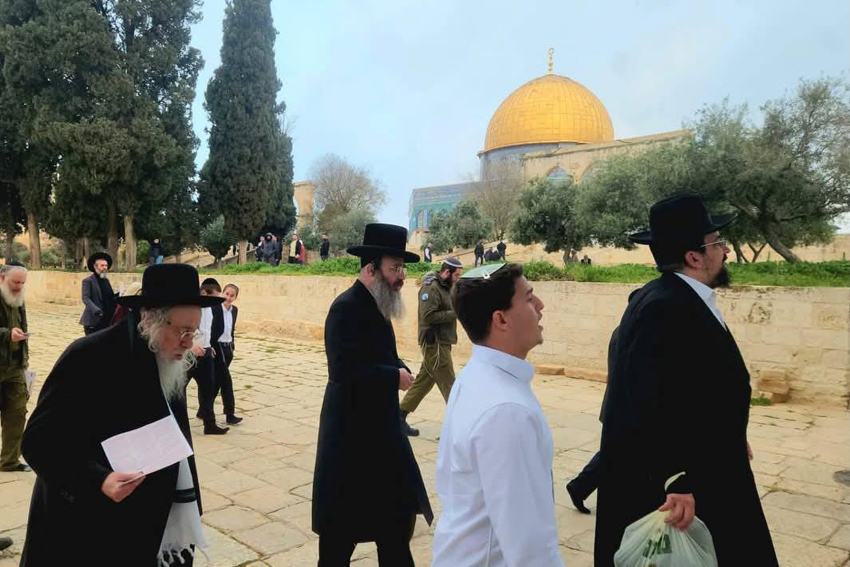
The relief was short-lived. By 6:30am, groups of extremist settlers began entering the Mosque’s courtyards under police escort, half an hour earlier than the previous schedule.
Jewish temple groups and Israeli police had announced the extension in advance. Settler tours now run from 6:30 to 11:30am and again from 1:30 to 3:00pm, totalling six and a half hours each day.
Ziad Ibhais, a researcher specialising in Jerusalem affairs, warned that the reopening was immediately accompanied by steps designed to deepen the division within al-Aqsa.
He explained that settler incursions into the Mosque began in 2003 and were formalised in 2008 with a schedule initially limited to three morning hours, from 7:00 to 10:00am
Since then, the allocated time has been extended year after year until reaching its current ceiling.
Ibhais said the temple organisations ‘explicitly seek to reach what they call “equal division”, so that the times allocated for intruders are equal to the times of the presence of Muslim worshippers’, describing this as ‘a dangerous transition in the path of Judaising al-Aqsa and imposing the occupation’s sovereignty over it’.
He added that the home front command’s announcement permitting activities from six o’clock in the morning ‘reflects an actual withdrawal of the Mosque management powers from the Islamic Waqf Department, despite it being the only party legally authorised to manage al-Aqsa affairs’.
He noted that this new reality placed the Waqf before a direct challenge, particularly after it announced the Mosque would reopen ‘without limiting numbers’ from the dawn prayer, while Israeli measures sought to control entry, exit, and the timings of presence inside the compound.
Ibhais concluded that what was happening ‘is not limited to reopening the Mosque after a long closure, but rather represents a new stage of imposing field facts that target changing the identity of al-Aqsa gradually’, and called for keeping the Mosque at the forefront of concern and working to prevent the establishment of any form of division.
In the town of Teqoa, southeast of Bethlehem, Israeli bulldozers escorted by soldiers uprooted dozens of olive trees in the al-Baq’ah area at the western entrance of the town.
Teqoa mayor Mohamed al-Badan said the targeted groves surrounded a military watchtower and belonged to Palestinian citizens from the town of Sa’ir in northern al-Khalil.
The destruction of olive trees, a cornerstone of Palestinian agricultural life and cultural identity, has long served as a tool of dispossession across the occupied territories.
In occupied Jerusalem’s Silwan neighbourhood, just south of al-Aqsa, the Israeli municipality forced Ahmad Quwaider to demolish his own home in al-Bustan under the pretext of building without a permit.
The Wadi Hilweh Information Centre reported that Quwaider, who lived in the house with his wife and child and had built it in 2010, tore it down under municipal order to avoid further fines after the family had already been penalised around 100,000 shekels. Jerusalemite homeowners are routinely compelled to demolish their own homes at their own expense to escape the even greater costs of municipal demolition crews and escalating penalties.
Human rights groups and monitoring organisations say the rate of demolitions of Palestinian homes and structures in east Jerusalem has nearly doubled since the start of the Israeli genocidal war on Gaza.
The Israeli municipality claims the demolished properties were built illegally, yet Palestinian families in east Jerusalem say all their applications for planning permission are systematically rejected, leaving growing households with no option but to build without permits and face the consequences.