HUMAN Rights organisations, marking 50 years since the 1976 coup, condemned President Milei’s government for justifying Argentina’s civil-military dictatorship and echoing its economic policies, demanding memory, truth, and justice for the 30,000 disappeared people.
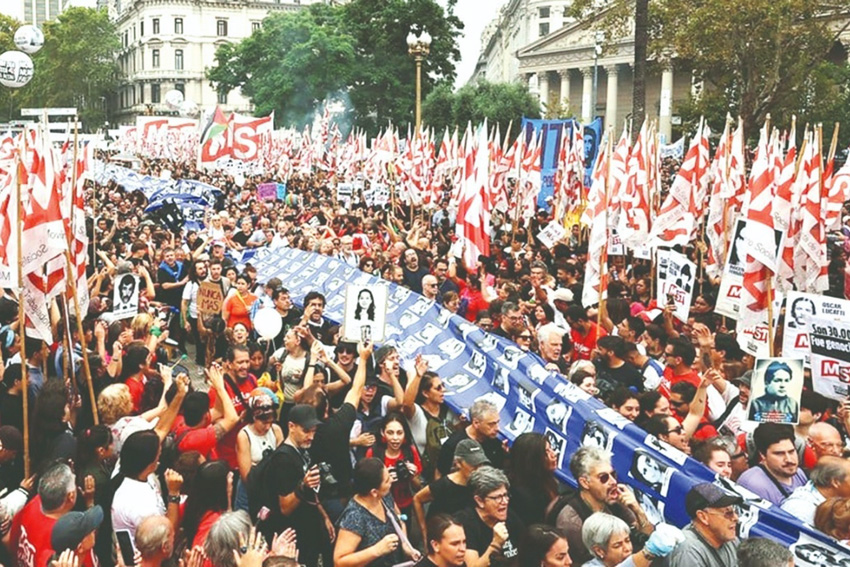
In a day filled with militant spirit and profound historical significance, hundreds of thousands of Argentinians marched in major cities on March 24, condemning the 1976 civil-military dictatorship.
The crowds expressed profound discontent with President Javier Milei’s far-right government, highlighting the enduring memory of past atrocities amidst severe economic hardship and eroded rights.
Half a century later, the Argentinian people remain mobilised in defence of their sovereignty and fundamental rights.
For the first time in years, the Human Rights organisations converged in a unified mobilisation, which called to amplify the demand for justice in a climate marked by the denialist rhetoric of President Milei and his government.
Under the powerful slogan ‘Tell us where they are’ Argentinians marched with different photographs of the dictatorship’s victims, remaining an unresolved crime for thousands of families across Argentina.
Columns of Human Rights organisations, labour unions, student movements, and left-wing and progressive parties and social organisations converged at the historic Plaza de Mayo in Buenos Aires City.
The slogan was clear and unanimous: ‘They are 30,000 and it was genocide’, which resonated with particular force given the attempts by far-right sectors to reintroduce denialist discourses and ‘war theories’ to justify state terrorism.
Historical Memory Endures
The mobilisation not only recalled the institutional breakdown but also the initiation of a systematic extermination plan, designed to dismantle the social context and impose a neoliberal economic model through violence.
During the Argentinian last civil-military dictatorship, forced disappearance, the theft of babies, and clandestine detention and torture centres were tools used to impose an asphyxiating external debt and destroy national industry under the so-called Operation Condor.
These actions sought to eliminate political opposition and silence any form of dissent, creating a climate of fear and control that permeated all aspects of Argentinian society.
The day’s focal point was marked by the presence of the Mothers and Grandmothers of Plaza de Mayo, whose white scarves continue to lead the demand for the identity of the more than 300 grandchildren.
White silhouettes, representing the forcibly detained-disappeared, once again bordered the perimeter of the Plaza de Mayo’s pyramid.
Simultaneously, on giant screens, the faces of the martyrs of popular militancy from the 1970s were projected.
During the mobilisation, a joint document marking half a century since the beginning of the last civic-military dictatorship and the consequent fight for Memory, Truth and Justice was read by Estela de Carlotto, President of Grandmothers of Plaza de Mayo; Taty Almeida, from Mothers of Plaza de Mayo Founding Line, and Adolfo Pérez Esquivel, Nobel Peace Prize laureate.
The Human Rights organisations explicitly reclaim the 30,000 forcibly detained-disappeared, over 10,000 political prisoners, and thousands of exiles struggles, which embodied militancy as a tool for transforming reality, against imperialist interference.
The organisations emphasised that these historical lessons are crucial in the ongoing fight against the current far-right administration, which they described as the ‘fascist government of Milei and Villarruel’.
Milei’s government further fuelled public outrage by disseminating on the Day of Memory for Truth and Justice a video attempting to justify the civil-military dictatorship and its actions.
This video, weak in arguments, inadvertently highlighted one of the most atrocious crimes of the dictatorship: The appropriation of children from those who were kidnapped, disappeared and murdered.
The woman in that video maintains the surname of her illegal appropriators, who severed her ties to her biological family. This act, intended to soften the image of the dictatorship, instead underscored its horrific legacy.
The protests are not merely about historical memory but about a living struggle against perceived repetitions of past injustices.
The 1976 coup in Argentina was one of the final pieces of Operation Condor, a repressive coordination among the dictatorships of the Southern Cone, in an operation that was orchestrated and financed from Washington by the United States Department of State.
The US facilitated the exchange of intelligence and the clandestine elimination of political opponents across borders, representing a dark chapter of imperialist intervention in Latin American internal affairs.
A half-century after the beginning of the most bloody stage in recent Argentine history, the popular and massive mobilisation sent a forceful message to the region.
- Meanwhile, on Tuesday, the tuna fishing vessel Maguro, dubbed ‘Granma 2.0’, arrived in Havana with more than 30 tons of humanitarian aid on board for the people of the Caribbean island, amid a crisis worsened by economic restrictions imposed by the United States.
The shipment also includes 73 solar panels intended for health centres, as well as basic foods such as rice, beans and cereals, along with medicines and hygiene products, all donated by various countries.
On this occasion, the vessel is carrying 32 people from 11 countries, according to its organisers, who have joined efforts to support the Cuban people amid the difficult situation they are facing.
‘The humanitarian mission was received by the president of the Cuban Institute of Friendship with the Peoples (ICAP), other Cuban authorities, and hundreds of Cubans who gathered to welcome the members of the flotilla,’ reported Siempre con Cuba outlet.
‘Members of the mission and the Cuban people united in a single cry against the blockade under the slogan “Cuba Yes! Blockade No!” Once again, the international solidarity demonstrated that Cuba is not alone,’ it added.
The Maguro, renamed Granma 2.0 by its international crew, docked at the Sierra Maestra terminal.
For many Cubans, this moment marked a break in the naval and economic wall that has long surrounded the island.
On board were thirty-two activists from ten nations, including members of the Progressive International and The People’s Forum.
They flew the flags of Cuba and Palestine, linking the struggles for sovereignty in both the Caribbean and the Middle East.
The arrival of the Granma 2.0 was more than just a humanitarian act; it was also a political message.
By using the name of the original Granma, the yacht that carried Fidel Castro and his comrades to Cuba in 1956, the organisers showed that the Cuban fight for independence has entered a new stage.
While the first Granma launched a revolution against a domestic dictatorship, the Granma 2.0 challenges an external siege that has reached its highest intensity in early 2026.
As the gangplank was lowered, the crew unloaded a different kind of aid.
Rather than providing short-term relief, the cargo focused on long-term energy independence.
In the face of a blockade designed to plunge Cuba into darkness, the ship delivered technology to generate solar light.
The Caribbean Community (Caricom) on March 24 initiated extensive preparations for a significant humanitarian aid shipment destined for Cuba, reaffirming the enduring bonds of solidarity that unite the Caribbean nations with the country.
The formal announcement was made by Dr Terrance Drew, Prime Minister of Saint Kitts and Nevis and current chairman of Caricom, during the 50th Ordinary Meeting of the Conference of Heads of Government, convened in his nation.
The decision reflects a strong regional consensus on the necessity of providing tangible support to Cuba in the face of the US reinforced pressures, amidst the 6-decades of economic, commercial and financial blockade.
The initiative underscores Caricom’s unwavering commitment to regional cohesion and mutual support, embodying the principle that ‘Our North is the South’.
The comprehensive cargo is slated to include a wide array of essential items, carefully selected to strengthen various sectors within Cuba.
Among the critical provisions, are basic foodstuffs, crucial for household sustenance and nutritional security. These include substantial quantities of powdered milk, vital infant formulas, beans, wheat flour, rice, and diverse canned goods.
In addition to food supplies, the shipment will also encompass essential health inputs.
These basic medical supplies are designed to reinforce the island’s robust public health system, which, despite external challenges, continues to serve its population and extend medical cooperation across the world.
Furthermore, the aid package recognises Cuba’s commitment to sustainable development, incorporating vital resources for energy transition and infrastructure resilience.
These include solar panels, batteries for energy storage, and water tanks, all critical components for enhancing the island’s self-sufficiency and mitigating the effects of climate change and infrastructure strain.