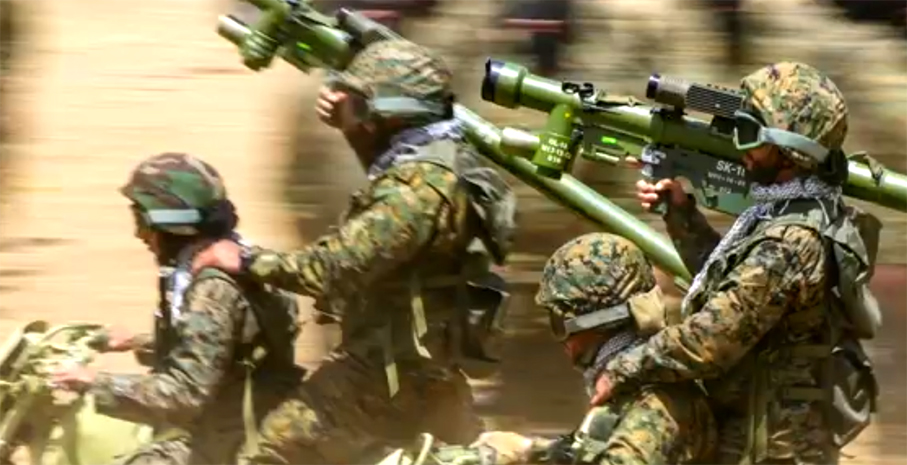
Sheikh Naim Qassem, the Hezbollah Secretary-General, says Lebanon is facing a ‘historic turning point,’ where it must choose between yielding to ‘US-Israeli domination’ or preserving its sovereignty through resistance.
Speaking at a ceremony marking the second anniversary of the assassination of senior resistance commander Hajj Muhammad Hassan Yaghi, also known as Abou Salim, in the city of Baalbek on Sunday, Qassem warned the United States and Israel are pursuing a project of ‘full guardianship’ over Lebanon.
He also pointed out that the calls for Hezbollah’s disarmament, now being presented as a ‘weapons monopoly,’ are part of broader US-Israeli efforts to weaken Lebanon and serve Israeli interests.
Qassem said: ‘Requesting a weapons monopoly while the Zionist regime continues to invade Lebanon means this demand is not in the best interest of Lebanon, but rather serves Israel’.
He accused the US of supporting corruption and undermining Lebanon’s economy since 2019, while noting that Israeli aggression has persisted despite a 2024 agreement intended to halt hostilities.
Qassem said that Hezbollah, in collaboration with other groups, the Lebanese army, and the public, has played a pivotal role in defending and ‘liberating’ the country.
He described the cooperation between the army and the resistance as a ‘key pillar’ of national security, adding that this coordination has greatly unsettled Hezbollah’s adversaries.
The Hezbollah chief criticised Israel for its failure to fulfil its commitments under the ceasefire framework, including ending violations and withdrawing from occupied Lebanese territory.
Qassem said: ‘No new action is expected from Lebanon unless the Israeli side first fulfils its commitments.
‘The era of unilateral demands from Lebanon is over.’
Qassem rejected any involvement of Lebanon as a ‘police force’ for Israel, asserting the country’s rights to its land, dignity, and sovereignty.
He also emphasised that Israel’s withdrawal from occupied areas is ‘a necessity, not a privilege,’ and called for a complete cessation of air, land, and sea attacks, the release of prisoners, and the initiation of reconstruction in southern Lebanon.
Qassem reaffirmed Hezbollah’s strong alliance with the Amal Movement, describing it as ‘deep, stable, and unbreakable.’
He also cautioned that the loss of southern Lebanon would pose a risk to the entire country.
Qassem stressed that discussions regarding Lebanon’s national security strategy can only commence after Israel complies with its obligations, affirming that Hezbollah and the resistance will persist in their path ‘with dignity, strength, and courage,’ despite the sacrifices.
Meanwhile on Monday, Member of Resistance, Lebanese Parliament MP Ali Fayyad, said all Lebanon has to remember is that Hezbollah is the most popular political party in the country.
In a memorial service in the southern town of Majdal Selm on Monday, Fayyad said the ‘stage we are going through today requires patience and wisdom, and at the same time steadfastness and courage.
‘The risks to which Lebanon is exposed, the extent of the targeting, and what is being planned by the Israelis and Americans, are great and dangerous,’ he warned.
‘The issue goes beyond the issue of weapons to a political, security and economic path that takes the country to another position that changes its political identity, disrupts its internal balances, subjects it to foreign guardianship.’
He added: ‘Everyone must remember that Hezbollah is the largest and most popular political party in Lebanon, and that its weight and role cannot be ignored.
‘Lebanon is at a crossroads, and we call on everyone to cooperate in order to save sovereignty, launch the path of recovery, protect stability, and build the state.’
- The Israelis went ahead with attacks in south Lebanon on Sunday, in violation of the ceasefire which ended the brutal 66-day Zionist war on Lebanon between September and November in 2024.
The border town of Kfar Shouba came under heavy machine gun fire from Israeli positions at Roueisset Al-Alam and Al-Samaqah, damaging several homes.
One family narrowly escaped harm as the gunfire struck the centre of their house, shattering windows.
Also on Sunday, Israeli occupation forces, stationed in the occupied post of Al-Hamames Hill, opened fire on shepherds near Al-Wazzani, and an Israeli glider also dropped a bomb on the area.
Israel continues to bomb Lebanon, mainly the country’s south, almost daily, and maintains occupation over five posts along the southern border, in violation of a ceasefire deal reached following the 2024 Israeli war.
At least 340 people have been killed by Israeli attacks since November 2024, according to figures released by Lebanon’s Health Ministry.
- The largest global journalists’ union has confirmed that it is actively reaching out to Jordanian authorities concerning the release of pro-Palestine journalist Mohammad Faraj, who was detained earlier this month without being provided with any explanation for the reasons for his arrest.
Dominique Pradalié, the president of the International Federation of Journalists (IFJ), on Saturday characterised Faraj’s arrest, carried out without formal charges or justification, as shocking and expressed complete solidarity with the journalist and his family.
She also demanded the immediate release of the journalist, who works for the Lebanese al-Mayadeen television news channel, voicing optimism that diplomatic measures would soon bring about a resolution.
Pradalié emphasised the ongoing initiatives undertaken by the IFJ to create a binding international agreement dedicated to safeguarding journalists globally.
She highlighted that the draft convention is still under development, and underscored the need for United Nations support to establish it as an international standard.
‘The detention of journalists without clear cause is unacceptable,’ Pradalié stated, reiterating the IFJ’s dedication to safeguarding press freedom and ensuring the safety of media professionals worldwide.
The family of Faraj released a statement voicing deep concern about his health condition after detention. They called on relevant authorities to promptly provide clarity regarding his legal status and to guarantee his safety.
Faraj’s family visited him last Thursday, marking their first opportunity to see him since his arrest on December 12. They noted that he seemed to be in poor mental and physical condition, which has sparked serious concerns about his overall well-being.
The family acknowledged the significant public attention that Faraj’s case has received, noting the considerable support from those closely following updates on his detention.
Since Faraj’s detention, the family has approached the situation calmly and with restraint, showing respect for Jordanian state institutions.
This approach, they said, was partly based on assurances obtained through various sources that the conditions of his detention were deemed acceptable.
Faraj still does not know his location of detention and has not been made aware of any formal charges against him.
He has firmly denied engaging in any actions that would justify his detention, stressing that voicing political opinions and backing resistance against Israeli occupation should not be considered a criminal act.
The family expressed concern that Faraj’s ongoing detention, without a transparent legal justification or formal notification of the reasons behind it, casts significant doubt on the legitimacy of the action.
They urged the relevant authorities to promptly address Faraj’s legal status, ensure his physical and mental well-being, and uphold his rights as guaranteed by the constitution and law.
Faraj was arrested after returning to Jordan on vacation with his wife, fellow journalist Rana Abi Jumaa. He was subjected to a thorough search and interrogation and then taken to an undisclosed location.
The detention comes as Jordan continues its official diplomatic and security cooperation with Israel, even as Tel Aviv intensifies its grip on the occupied West Bank. The regime continues to violate the November 2024 ceasefire agreement frequently and persists in occupying five locations in southern Lebanon.