
The Israeli occupation army continued, for the 60th consecutive day yesterday, to violate the ceasefire agreement in the Gaza Strip, targeting residential buildings and different areas.
The latest violations included blowing up homes and buildings and launching intensive air and artillery attacks on areas east of Gaza City and Rafah.
Israeli gunboats opened fire on the shores and beach of Khan Younis.
The Israeli army also detonated a remote-controlled vehicle packed with explosives in Gaza City’s al-Shuja’iya neighbourhood, while Israeli warplanes carried out raids on the neighbourhoods of Tuffah and al-Zeitoun.
Military vehicles also opened fire on the northeastern areas of al-Bureij refugee camp in central Gaza.
A similar shooting attack was reported in the Muraj area of northern Rafah, south of Gaza.
A video published by Israeli activists on the platform ‘X’ on Monday shows Israeli National Security Minister Itamar Ben Gvir, along with several members of his far-right Otzma Yehudit party, provocatively wearing pins shaped like a noose during a session of the National Security Committee to discuss a draft law to execute Palestinian prisoners.
In the video, Ben Gvir said that the committee, headed by Zvika Fogel, is discussing the bill proposed by MK Limor Son Har-Melech of the same party.
He adds: ‘This law is about the death penalty for terrorists, it’s a very significant step in Israel.’
Referring to the noose pin on his clothes, he says: ‘We want either the noose, the guillotine, or the electric chair… death penalty for terrorists.’
Last November, the Israeli Knesset passed the bill in a preliminary reading.
The legislation proposes the death penalty for those Israel claims carried out attacks resulting in the death of Israeli settlers.
The bill was submitted by the extremist Otzma Yehudit party led by Ben Gvir.
At the time, Ben Gvir called on all coalition and opposition parties to vote unanimously for the bill, describing it as a ‘historic step.’
The proposal mandates the death sentence for anyone who intentionally or through gross negligence causes the death of an Israeli citizen based on racist motives or hatred of Israel.
It also prohibits rescinding any final death sentence issued under this law.
Meanwhile, Israeli military chief of staff Eyal Zamir openly described the so-called ‘yellow line’ – a north-south axis cutting through the Gaza Strip and marking the point of Israel’s pullback – as ‘a new border line’ with Gaza.
Addressing Israeli troops inside the besieged Strip on Sunday, Zamir said: ‘We have operational control over extensive parts of the Gaza Strip and we will remain on those defence lines. The yellow line is a new border line – serving as a forward defensive line for our communities and a line of operational activity.’
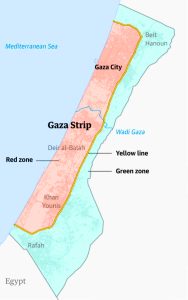
Israeli forces withdrew to the ‘yellow line’ in October as part of the first phase of US President Donald Trump’s 20-point Gaza ceasefire plan with the Palestinian-based resistance movement Hamas.
Zamir’s remarks came even as the ceasefire agreement explicitly requires a full withdrawal of Israeli forces.
A US official said on Monday that the US is preparing to announce a transition into the second phase of the truce plan in the coming weeks.
The announcement would include the unveiling of a new governing body in Gaza, led by the so-called Board of Peace, along with the launch of an ‘International Stabilisation Force’ in the Strip, according to US news reports.
It is anticipated that Trump will soon disclose the names of the individuals and countries participating in the mechanism as part of his announcement.
Israel’s Prime Minister Benjamin Netanyahu also confirmed that the second phase of the plan is ‘close’, as he is expected to discuss it during the upcoming meeting with Trump at the White House by the end of this month.
‘We’ll be having very important conversations at the end of the month on how to ensure that this second stage is achieved,’ Netanyahu said.
Tony Blair has reportedly been removed from consideration for the Trump-proposed so-called Gaza ‘Board of Peace,’ a development Hamas has welcomed as a ‘step in the right direction’.
Arab and Muslim nations had objected to Blair’s involvement in the purported ‘transitional authority’ that Trump has unveiled as part of his 20-point plan, which the US president claims is aimed at ending the Israeli regime’s war of genocide on the Gaza Strip.
The development came as the Hamas resistance movement confirmed it had urged mediators to exclude Blair over his ‘blatant bias towards the occupation.’
Blair, previously the only publicly identified candidate for the body, which Trump has said he would personally chair, was quietly dropped after opposition from the countries and organisations in the region, despite lobbying and behind-the-scenes efforts to secure a prominent role for him in the so-called board.
His involvement had been linked to proposals drafted partly by the self-described Tony Blair Institute for Global Change alongside Trump’s son-in-law, Jared Kushner.
Blair’s candidacy had drawn criticism across the world due to his legacy in the 2003 United States-led invasion of Iraq, which was later found to have simply conjured up accusations of harbouring ‘weapons of mass destruction’ by Iraq at the time in order to sell the invasion.
His record as a member of the Middle East Quartet had also amassed criticism in light of the UK’s widely-reported and verified strong favouritism benefiting the Israeli regime.
Even Trump, himself, acknowledged in October that Blair was a ‘controversial figure,’ whose acceptability to all sides remained uncertain.
Hamas’ official Taher al-Nunu said reports of Blair’s likely removal aligned with the movement’s repeated calls on mediators to keep him out of any Gaza-related body.
The media report, however, suggested Blair could still play a less central role. Blair’s office declined to comment.
Al-Nunu reiterated that the movement remains ‘ready for a long-term truce’ provided the Israeli regime upheld all terms of a full ceasefire, something that Tel Aviv has so far clearly avoided by repeatedly violating a ceasefire deal that was reached in early October.
The Hamas official also stressed that any plan involving an international force tasked with forcibly disarming Palestinian resistance groups was ‘rejected and has never been discussed.’
He noted that Hamas had not received clarity on the mandate of any potential international presence in Gaza, and the movement does not believe countries would agree to such a mission.
On the political front, al-Nunu said Hamas is prepared to ‘immediately’ transfer governance of Gaza to an independent national technocratic committee, something that the group agreed to help realise when signing the ceasefire deal.
He reiterated Hamas’s position that the resistance’s weapons remained part of the Palestinians’ national arsenal.
Al-Nunu, meanwhile, warned that Israeli Prime Minister Benjamin Netanyahu’s ambitions ‘extend beyond the borders of Palestine and threaten the countries of the region.’
- An Israeli official says the number of soldiers suffering from post-traumatic stress disorder and other mental health conditions, and receiving treatment in rehabilitation centres, has risen sharply since the start of the war on Gaza more than two years ago.
Tamar Shimoni, the deputy head of the Ministry of Foreign Affairs’ Rehabilitation Department, told Israeli Army Radio network that approximately 62,000 psychological cases were addressed by the ministry on the evening of October 7th, 2023. Since then, the number has surged to around 85,000 – an increase she characterised as extraordinary and without precedent.
She stated that approximately one-third of Israeli soldiers are experiencing psychological challenges associated with the events of the Gaza onslaught.
Shamoni explained that a single therapist is now responsible for managing up to 750 patients, and in certain regions, the number is even higher.
According to Hebrew-language media outlets, a reserve officer from the Givati Brigade took his own life on December 4th following intense psychological distress connected to his involvement in the Gaza war, writing shortly before the incident that he ‘could no longer live’.
By the end of last October, official Israeli reports disclosed 279 suicide attempts within the army over an 18-month span, during which 36 soldiers lost their lives to suicide.
The Israeli ministry of military affairs said in a statement on Monday that it has treated nearly 22,000 wounded soldiers since the Gaza war.
According to it, some 58 per cent of those treated by the rehab centres are suffering from mental health conditions.
The ministry also noted that nearly 1,500 new treatment requests are submitted by wounded soldiers each month.