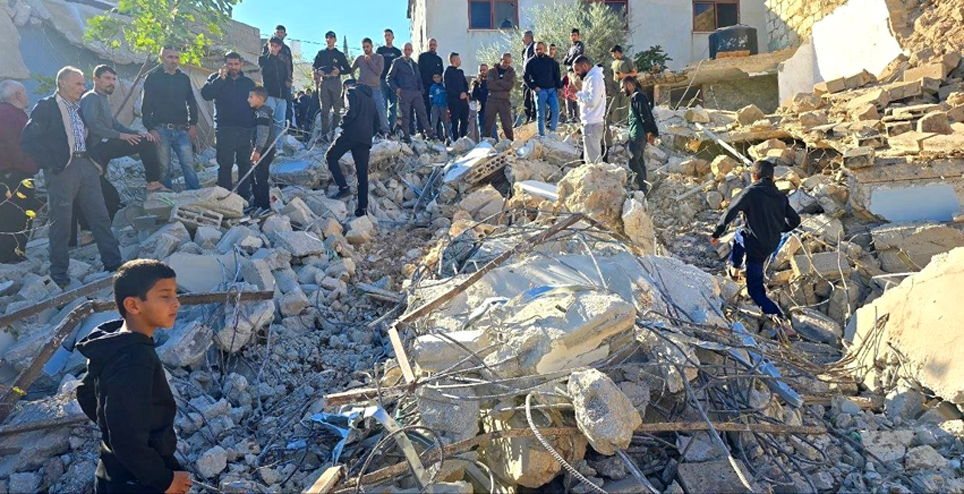
ISRAELI occupation forces (IOF) escalated their policy of collective punishment last Friday, issuing demolition orders in al-Khalil and forcing a Palestinian resident in occupied Jerusalem to self-demolish his home.
In al-Khalil, IOF troops raided the Wadi al-Hariya area overnight and delivered a demolition and confiscation notice to the family of Imran al-Atrash, an 18-year-old Palestinian killed by Israeli forces in November 2025.
The family was given 72 hours to file an objection before the demolition was carried out.
Al-Atrash was martyred alongside Walid Sabarna, 18, from Beit Ummar during a stabbing attack south of Bethlehem. Israeli authorities later issued a similar demolition notice, on December 23, to Sabarna’s family home in the town of Beit Ummar, also granting a 72-hour objection period.
Rights groups say the demolition of family homes under the pretext of ‘deterrence’ constitutes collective punishment, which is prohibited under international humanitarian law.
Separately in occupied Jerusalem, Israeli authorities forced Palestinian resident Saqr Qanbar to demolish his own home in the town of Jabal al-Mukabber, south of the city.
Qanbar carried out the demolition to avoid heavy fines imposed by the Israeli municipality if the house was demolished by its teams.
The move followed the demolition of two other Palestinian homes earlier this week in the same area, allegedly for lacking building permits, permits that Palestinians say are systematically denied.
According to the Jerusalem Governorate, Israeli occupation authorities carried out 27 demolition and land-clearing operations in the holy city in November alone, including five cases of forced self-demolition, 21 demolitions by municipal and security forces, and one land razing operation.
Palestinian officials warn that home demolitions are being used as a tool to reshape the city’s demographic reality, in violation of international law, which forbids the destruction of civilian property under occupation.
Meanwhile, activists on social media platforms have circulated a video documenting a large-scale demolition carried out by the Israeli occupation army in the city of Rafah, in the southern Gaza Strip, as part of ongoing destruction targeting residential neighbourhoods despite the ceasefire agreement being in effect.
The video was published by Palestinian journalist Younis Al-Tirawi, who specialises in monitoring Israeli soldiers’ social media accounts and documenting their violations. Commenting on the footage, he wrote, ‘Gaza on Christmas Eve; the Israeli army is blowing up the homes of displaced Palestinian families today. We remind that the ceasefire has been in force for more than two months.’
According to Al Jazeera Network’s digital verification team, the video’s location was precisely identified, showing that the demolition took place in the Al-Zuhur neighbourhood north of Rafah city, at the coordinates (31°18’9.14≤N 34°15’58.27≤E).
The verification revealed that the video was first published shortly after midnight Wednesday, although the footage itself does not definitively establish the exact timing of the explosion.
However, a review of satellite images of the site between December 13th and 24th showed a heavy presence of Israeli military vehicles carrying out extensive bulldozing and demolition operations in the area.
The bulldozing traces visible in the satellite imagery matched the landmarks shown in the explosion footage, strengthening the likelihood that the operation occurred within 24 hours.
This is further supported by field reports from journalists in Gaza who confirmed hearing massive explosions caused by demolition operations north of Rafah at around 11pm last Wednesday night, coinciding with similar operations in the city of Khan Younis and east of Gaza City.
In the same context, an Israeli journalist broadcast new video footage showing the massive destruction left by systematic demolition and bombardment operations in northern Gaza, particularly in the Tel al-Za’tar neighbourhood and the Jabalia refugee camp.
The footage documented a gathering of Israeli soldiers accompanied by a media delegation visiting the area, where the Israeli reporter said: ‘We are in the Jabalia neighbourhood in the Gaza Strip.
‘You can see the destruction behind me, almost everything here is completely destroyed.
‘This is what a neighbourhood looks like just seven kilometres from the city of Sderot; the hospital is the only building still standing.’
A digital geographic verification of the images concluded that the journalists and soldiers were positioned inside a newly established military outpost set up by the Israeli army on the Tel Al-Za’tar hill, overlooking the Indonesian Hospital in northern Gaza.
The analysis showed that the footage documents the Indonesian Hospital and what remains of Al-Awda Hospital as nearly the only landmarks still standing amid surroundings that have been entirely levelled by months of intensive demolition operations.
The extensive clearing and destruction also revealed the boundaries of the city of Beit Lahia, at the far north of the Strip, in a direct visual scene that had not been possible before the war due to the dense urban development that once separated the areas.
The Israeli occupation army continues to destroy large swathes of residential neighbourhoods in Gaza City, particularly in Al-Shuja’iya and Al-Tuffah, alongside ongoing demolition operations in eastern Jabalia in the north of the Strip, and in Khan Younis and Rafah in the south, despite the ceasefire agreement announced under the plan proposed by US President Donald Trump
- The Palestinian Ministry of Agriculture said Israeli occupation forces (IOF) and settlers uprooted and bulldozed more than 8,000 trees, most of them olive trees, in the West Bank within a single week, causing material losses estimated at $7 million, amid escalating attacks on the Palestinian agricultural sector.
In a statement issued last Thursday, the ministry said it documented what it described as a ‘dangerous and accelerating escalation’ in assaults by IOF and settlers directly targeting agricultural land and sources of food security.
It said the attacks amount to a systematic policy aimed at seizing land and displacing its indigenous Palestinian owners.
According to the ministry’s report, the attacks took place during the third week of December and were concentrated in the northern and central West Bank.
The IOF uprooted around 5,000 olive trees in the town of al-Sila al-Harithiya, west of Jenin, and an additional 3,000 olive trees in Turmus Ayya, east of Ramallah.
The ministry also recorded separate land-clearing operations that included the uprooting of 156 olive trees in Mikhmas, east of Jerusalem; 100 fig trees in the towns of Ramin and al-Nazla al-Sharqiya in Tulkarem district; 13 olive trees in the village of al-Funduq, east of Qalqilya; and 19 olive trees, including 10 mature trees, in Deir Istiya in Salfit district and the village of al-Minya, south of Bethlehem.
In parallel, the report documented widespread destruction of agricultural infrastructure in several areas, including the demolition of 13 water wells and farm structures, damage to irrigation networks, theft of water pumps, the destruction of 82 beehives, and the poisoning of sheep in multiple parts of the West Bank.
The West Bank has witnessed sustained attacks by the IOF and settlers, often intensifying during planting and harvest seasons, as part of policies aimed at pressuring Palestinian farmers to abandon their land in preparation for settlement expansion.
Data from the Palestinian Wall and Settlement Resistance Commission showed that settlers carried out 621 attacks across the West Bank in November alone, targeting Palestinians and their property.
Since the start of the Israeli genocide in Gaza, the IOF and settlers have killed more than 1,103 Palestinians in the West Bank and Jerusalem, wounded around 11,000, and detained more than 21,000 others.
The town of Deir Dibwan, east of Ramallah, witnessed yet another settler attack at dawn Friday.
The assault targeted Palestinian property and involved physical violence and the theft of dozens of sheep from a local farm.
Local sources reported that a group of settlers stormed the Khillet al-Louz area east of Deir Dibwan and attacked a sheep farm owned by citizen Hassan Mohammad Dawoud Ghannam. The settlers brutally beat two workers before stealing around 150 sheep.
The sources indicated that the attack occurred during the early morning hours while there was no protection for the farm owners, resulting in significant losses to the farm in addition to the injuries sustained by the workers.
Deir Dibwan, located east of Ramallah and al-Bireh Governorate, has been subjected to a continuous wave of settler violence, which in the past included the burning of Palestinian property and vehicles, as well as the bulldozing of agricultural lands, all as part of efforts to expand settlement activity in the area.
According to documented data, Israeli forces and settlers committed approximately 2,144 attacks in the West Bank in November.
Of these, 1,523 were carried out directly by Israeli soldiers against citizens and their property, while 621 attacks were perpetrated by settlers.