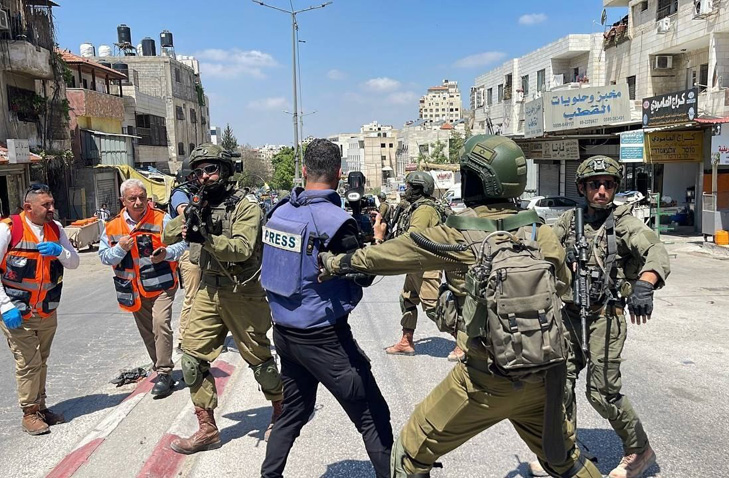
The Palestinian Journalists Syndicate confirmed on Thursday that in 2025, the Israeli occupation authorities continued their systematic targeting of Palestinian journalists through arbitrary detention, physical assault, expulsion, equipment confiscation, and forced interrogation, all aimed at silencing Palestinian press coverage and disrupting the national media
infrastructure.
The Syndicate’s Freedoms Committee reported 42 cases of Palestinian journalists being detained in 2025, with arrests occurring in the West Bank, occupied Jerusalem, inside Israel, at military checkpoints, crossing points, during field coverage, and during home raids.
The Committee noted that, despite a decline in the number of detentions compared to 2023 (64 cases) and 2024 (58 cases), this does not signal an improvement in Israeli conduct.
Instead, it reveals a dangerous shift from mass targeting to more focused attacks on the most influential journalists, including repeated arrests of the same individuals, expanded administrative detention without charge or trial, and the use of physical and psychological violence as a deterrent tool.
The Committee documented numerous cases of journalists being detained while performing their professional duties.
These including covering military incursions, settler attacks, and humanitarian work.
It underscored that detention has become a tool to empty the field of witnesses and prevent the truth from being reported.
The Committee stressed that the use of administrative detention against some journalists is one of the most dangerous forms of targeting.
It occurs without a clear charge, deprives journalists of the right to defend themselves, and turns them into prisoners of conscience with no set time frame for their release, violating the International Covenant on Civil and Political Rights.
The year also saw a disturbing rise in the targeting of Palestinian female journalists through arrests, interrogations, and expulsions, with some being re-arrested.
This trend points to a gendered form of systematic violence within the Israeli repression apparatus.
The Committee explained that these incidents are consistent with documented testimonies of foreign female journalists who faced severe violations inside Israeli prisons, suggesting that these actions could qualify as serious international crimes.
Numerous cases of journalists being beaten, threatened with weapons, dragged, humiliated, and having their cameras, phones, and journalistic equipment confiscated were also documented.
The Palestinian Journalists’ Syndicate called on the international community, human rights organisations, the United Nations, and special rapporteurs on freedom of expression to fulfil their legal and ethical responsibilities, urgently intervene, and hold Israeli leaders accountable for their crimes against Palestinian
journalism.
Doctors Without Borders reject baseless Israeli allegations
JERUSALEM – Doctors Without Borders (MSF) has rejected allegations by Israeli authorities that its staff are linked to Palestinian resistance groups, calling them baseless public accusations made without evidence.
The organisation said the Israeli claims appear aimed at forcing a re-registration process under new and unclear Israeli requirements.
In a statement released on Thursday, MSF warned that such accusations endanger medical teams and could deprive hundreds of thousands of Palestinians of life-saving healthcare, as the health system in Gaza collapses.
The organisation said it is still awaiting the renewal of its registration to operate in Gaza and the West Bank.
MSF noted that despite months of communication, it has not received clear criteria or assurances from Israeli authorities.
It added that on December 30, Israel issued public accusations alleging links between MSF staff and armed groups.
MSF emphasised that it takes such claims ‘extremely seriously’, affirming that it ‘would never knowingly hire anyone engaged in military activity’.
It criticised Israel’s actions, stating that ‘making public allegations without verified evidence puts humanitarian workers at risk and undermines life-saving medical work’.
The organisation pointed out that the Palestinian health system has been decimated, with key infrastructure destroyed, and families struggling to meet basic needs.
It stressed that ‘the need now is to scale up services, not reduce them’.
MSF warned that losing access, alongside other international NGOs, would leave hundreds of thousands of Palestinians without basic healthcare.
Currently, MSF supports 1 in every 5 hospital beds, covers one-third of all births in Gaza, and in 2025 alone provided around 800,000 outpatient consultations.
It treated over 100,000 critical injuries, performed 22,700 surgeries, assisted with more than 10,000 births, and distributed nearly 700 million litres of water.
The organisation also denied reports that it failed to comply with registration rules.
It insisted that it has ‘fully engaged since July 2025 and submitted most of the required information’.
This is while continuing to seek dialogue with Israel to ensure its ability to deliver essential services and support the decimated health system in Gaza.
In a previous statement on December 22, 2025, MSF warned that Israel’s new NGO registration rules could leave hundreds of thousands of people in Gaza without access to life-saving care by 2026.
The threat of revoking NGO registrations starting January 1 would block the continuation of essential services in both Gaza and the West Bank.