A senior Iranian military commander has warned that the Islamic Revolutionary Guards Corps (IRGC) will deal ‘more crushing’ blows to the United States and the Israeli regime following the martyrdom of the elite force’s Navy chief.
Major General Ali Abdollahi, the commander of Khatam al-Anbia Central Headquarters, made the remarks on Monday, after the IRGC announced the martyrdom of Rear Admiral Alireza Tangsiri due to injuries he sustained in US-Israeli strikes.
‘The American and Zionist enemies must know that the glorious flag that was in the hand of the brave, competent and prudent IRGC Navy commander would never remain on the ground,’ he said.
‘Helpless enemies will be dealt blows, more crushing and severe than before, at the hands of the valiant IRGC fighters.’
Abdollahi also extended condolences to Leader of the Islamic Revolution Ayatollah Seyyed Mojtaba Khamenei, IRGC forces and Tangsiri’s family on the commander’s martyrdom.
He said Admiral Tangsiri dedicated his life to the path of God and serving the Muslim Ummah.
The commander, he added, brought the enemies of Islam and Iran to their knees through his steadfastness, devotion, wisdom and bravery.
Tangsiri was ‘modest and reverent’ before the faithful and the Iranian nation while ‘steadfast and powerful’ against the enemies of the Islamic Revolution, notably the US and Zionist regime, and defended the country, Abdollahi stated.
The IRGC Navy chief was finally assassinated by the United States and the Zionist regime and ascended to martyrdom, his biggest dream, he said.
In a statement, the IRGC said Tangsiri was organising and reinforcing defensive positions on Iran’s islands and coastal areas at the time he received the fatal injuries, and that his martyrdom will not hinder ongoing operations.
Meanwhile, Commander in Chief of the Iranian Army Major General Amir Hatami hailed Tangsiri’s ‘significant role’ in the development of Iran’s maritime power in the Persian Gulf and the country’s predominance in the Strait of Hormuz.
‘Undoubtedly, this sacred path will continue stronger than before with the pure blood of the commander and the nation’s heroes,’ he said in a statement.
The criminal US-Israeli aggression on Iran began on February 28 with airstrikes that assassinated senior Iranian officials and commanders.
The Iranian armed forces have responded by launching daily missile and drone operations targeting locations in the Israeli-occupied territories as well as US military bases and assets across the region.
They have also blocked the Strait of Hormuz to oil and gas tankers affiliated with the adversaries and those cooperating with them to maintain security at the strategic waterway.
Meanwhile, on the evening of Friday 27 March, 2026, the Islamic Revolutionary Guards Corps (IRGC) Aerospace Force carried out one of the most devastating single strikes against American air power in decades.
The operation employed a coordinated barrage of ballistic missiles and drones, successfully breaching the multi-layered defences of Prince Sultan Air Base in Saudi Arabia.
The strike resulted in the complete destruction of a $700 million E-3 Sentry AWACS surveillance aircraft, a key asset for airborne command, control, and surveillance.
In addition, two EC-130H Compass Call electronic warfare planes were severely damaged, while multiple KC-135 Stratotanker refuelling aircraft were crippled, significantly reducing the operational capabilities of US occupation forces in the region.
Military analysts are describing the retaliatory strike as a strategic turning point in the ongoing US-Israeli aggression against Iran.
The precision and scale of the operation underscore the growing capabilities of the IRGC Aerospace Force and signal a marked shift in the balance of power in the region.
The operation, carried out from Iranian territory in direct retaliation for weeks of American-Israeli aerial bombardment, represents the culmination of a carefully calibrated Iranian military strategy.
It targeted not only frontline combat aircraft but also the critical infrastructure that enables US air superiority across the region.
Throughout March, American officials had boasted that Iranian air defences had been ‘flattened’ and claimed that Tehran’s military capabilities were on the verge of collapse.
The March 27 strike, however, revealed a starkly different reality.
Iran’s precision-guided munitions penetrated Patriot missile batteries and fighter intercepts to strike at the very core of American command-and-control capabilities.
The operation destroyed assets that cannot be quickly replaced, exposing vulnerabilities in forward bases Washington has long considered secure.
As the war imposed on Iran enters its fifth week, the loss of these high-value platforms, particularly the rare and irreplaceable E-3 Sentry, has fundamentally shifted US operational calculations.
Central Command is now forced to reassess the sustainability of its air campaign and revise base defence protocols across the Persian Gulf.
Prince Sultan Air Base, located approximately 80 kilometres southeast of Riyadh, has served since the early 1990s as a cornerstone of US military presence in the Persian Gulf.
Its runways, hardened aircraft shelters, and expansive aprons host a rotating contingent of US Air Force assets that provide intelligence, surveillance, reconnaissance, aerial refuelling, and electronic warfare support for operations throughout West Asia.
Under a longstanding defence cooperation agreement with Saudi Arabia, the base has functioned as a forward operating location for some of the most sensitive platforms in the American inventory.
In the context of so-called ‘Operation Epic Fury’ – the designation assigned by US Central Command to the ongoing war of aggression against Iran – Prince Sultan assumed even greater importance.
From this installation, E-3 Sentry AWACS aircraft tracked Iranian missile launches, coordinated strike packages targeting IRGC facilities, and maintained battlespace awareness across a theatre cluttered with drones, ballistic threats, and resistance forces.
KC-135 Stratotankers operating from the same base extended the loiter time of fighter and bomber aircraft, enabling deep penetration missions into Iranian territory without the need for frequent returns to distant airfields.
EC-130H Compass Call electronic warfare aircraft, deployed to the region in early March, jammed Iranian communications and degraded air defence networks, creating corridors for American strike aircraft.
This concentration of high-value, low-density assets made Prince Sultan an irresistible target for Iranian military planners.
Unlike attempting to engage these platforms in flight – where their speed, altitude, and defensive systems would complicate any engagement – striking them on the ground offered a higher probability of success.
The March 27 operation was not a spontaneous act of retaliation but a carefully planned act that exploited predictable patterns of aircraft parking, maintenance cycles, and crew rotations to deal a painful blow on the enemy.
Iranian intelligence had clearly identified the most valuable targets on the flight line and allocated specific munitions to each.
The attack unfolded on the evening of March 27, beginning with a coordinated salvo of at least six ballistic missiles and approximately 29 drones launched from Iranian territory.
This mixed salvo was designed to overwhelm the layered air defences protecting Prince Sultan, which included Patriot surface-to-air missile batteries operated by both American and Saudi crews, as well as fighter aircraft on combat air patrol duty.
The combination of high-speed ballistic missiles and slower, low-flying drones presented a complex targeting challenge, forcing defenders to prioritise threats while accepting the risk that some would penetrate the defensive umbrella.
According to official American and Saudi assessments, their interceptors neutralised the some of the missiles.
However, evidence shows ballistic missiles and at least one drone evaded interception, pounding the base’s main aircraft apron and logistical areas.
The missiles struck with sufficient precision to cause catastrophic damage to parked aircraft, igniting fires that burned for hours before emergency crews could contain them.
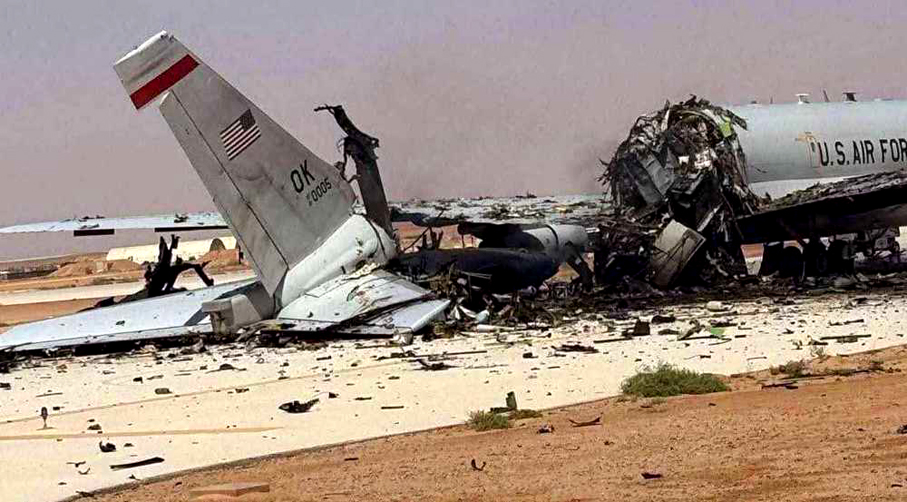
Ground-level photographs later circulating on social media showed the aftermath: the distinctive tail section of an E-3 Sentry, its rotating radar dome compromised and fuselage burned out, surrounded by debris and firefighting foam.
The success of the strike reflects a broader evolution in Iranian military capabilities.
The ballistic missiles employed in the operation demonstrated not only range and accuracy but also the ability to penetrate advanced air defence networks through trajectory shaping, decoys, and saturation tactics.
The drones, likely of the Shahed family, flew at low altitudes and followed unpredictable flight paths, complicating radar detection and interception.
Together, these systems created a synergistic effect that even Patriot batteries – designed to counter precisely such threats – could not fully defeat.
The most significant loss confirmed in the aftermath of the strike was a Boeing E-3 Sentry Airborne Warning and Control System aircraft, specifically serial number 81-0005 from the 552nd Air Control Wing based at Tinker Air Force Base in Oklahoma.
The IRGC Aerospace Force issued a statement on March 29 declaring that the aircraft had been ‘completely destroyed’, and photographic evidence supports this assessment.
Images show that an Iranian projectile struck the most important and sensitive section of the aircraft near its tail, where the AN/APY-2 surveillance radar is mounted.