International Field Hospitals have bolstered medical care in Venezuela in the wake of the June 24 earthquakes.
Medical teams from several countries are operating field hospitals across Venezuela, expanding emergency and specialised healthcare.
International field hospitals have been deployed across Caracas and La Guaira state to support medical care for people injured in the powerful earthquakes that struck Venezuela on June 24, strengthening the country’s emergency health response during the recovery process.
Medical units and healthcare personnel sent by the governments of Brazil, Colombia, the Dominican Republic, Japan, Spain, Barbados and India, alongside organisations including the US-based Samaritan’s Purse, are providing emergency treatment, surgical care, intensive care and psychological support in affected communities.
In Miranda state, the Spanish Agency for International Development Cooperation (Aecid) is operating a field hospital staffed by 50 volunteers with the capacity to treat up to 200 people per day. The facility provides trauma care, X-ray services and minor surgery. Since its deployment, it has treated 1,805 patients and carried out 2,194 medical consultations.
‘The first START team rotation returns after 12 days in Venezuela, having treated 1,805 patients and carried out 2,194 medical consultations. A second rotation has already taken over to keep the field hospital operational,’ the agency said on its X account.
Brazil has deployed 11 healthcare professionals to Camurí Chico, in La Guaira, where a field hospital equipped with an operating room and an intensive care unit can treat up to 150 patients daily.
Through the Japan International Cooperation Agency (JICA), Japan continues to operate a team of 40 physicians in Caraballeda conducting clinical testing and epidemiological surveillance, although its mission in La Rinconada has concluded.
Colombia’s Hospital Ship San Rafael Foundation has established a medical centre at the temporary shelter located at Gran Colombia School in Caracas, where it expects to treat up to 150 patients per day through to the end of July.
In La Guaira, Samaritan’s Purse has activated a Type 3 field hospital near Maiquetía International Airport, where 90 healthcare professionals are providing inpatient and surgical services.
The Dominican Republic is operating a medical facility at César Nieves Stadium with 40 specialists, offering capacity to treat more than 2,000 patients and perform up to 150 procedures each day.
Venezuela has also continued receiving humanitarian assistance from countries and public figures responding to the impact of the twin earthquakes.
The international deployments are intended to reinforce healthcare capacity in the areas most affected by the disaster by providing critical medical infrastructure.
Coordination between foreign medical teams and Venezuelan authorities has enabled a comprehensive response that includes general medicine, specialised treatment and mental health services as reconstruction efforts continue.
Venezuelan authorities have expanded emergency assistance to 128,324 families affected by the earthquakes that struck the country on June 24, while relief, rescue and recovery operations remain underway.
Jorge Rodríguez, head of the General Staff for Transitional Camps, reported that as of Monday, July 13, the official death toll stood at 4,561, with 16,740 people injured. Authorities also reported that 17,907 people were displaced by the seismic events.
According to the latest official update, 20,231 people are currently housed in 107 state-run transitional camps, where they are receiving comprehensive assistance, including food, shelter, medical care and other essential services.
Rodríguez said rescue teams have pulled 6,462 people alive from beneath collapsed structures since the earthquakes.
Since June 24, the Venezuelan state has distributed 10,063 tons of food and more than 19.6 million litres of drinking water to affected communities.
Emergency medical teams have treated 33,085 patients as part of the response. Operations have been supported by the deployment of 30,989 military personnel, 30,692 civilian volunteers and 2,471 international rescue workers providing humanitarian assistance.
Risk management authorities have also recorded 1,254 aftershocks since June 24. Official assessments indicate that 190 buildings collapsed and another 856 sustained severe structural damage.
Venezuela has restored 96% of its electricity demand after the June 24 earthquakes, according to the Ministry of People’s Power for Electric Energy, the National Electric Corporation (Corpoelec), and the Sectoral Vice Presidency for Public Works and Services.
Electric Energy Minister Rolando Alcalá said recovery operations have restored electricity to priority circuits serving hospitals and other healthcare facilities, as well as temporary camps and residential areas.
‘It is important to inform the country that on June 24 there was significant damage to the National Electric System, not only in La Guaira but throughout the country … Damage to 10 transmission towers on the Planta Centro-Yaracuy transmission line resulted in the loss of 600 MW from the National Electric System,’ Alcalá said.
He said authorities are continuing efforts to restore operations at Termocarabobo, Planta Centro and other components of the national electricity system to ensure stable and continuous service.
Alcalá also outlined three recovery targets for this month. ‘First, the incorporation of Termozulia 1, which would add 150 MW to the state; one unit at the San Agatón Hydroelectric Plant in Táchira, which would provide another 150 MW to the Andean region,’ he said.
He added that ‘the incorporation of one of the Termocarabobo units would also provide 15 MW to the central region, as part of efforts to recover the 600 MW that remain unavailable following the earthquakes.’
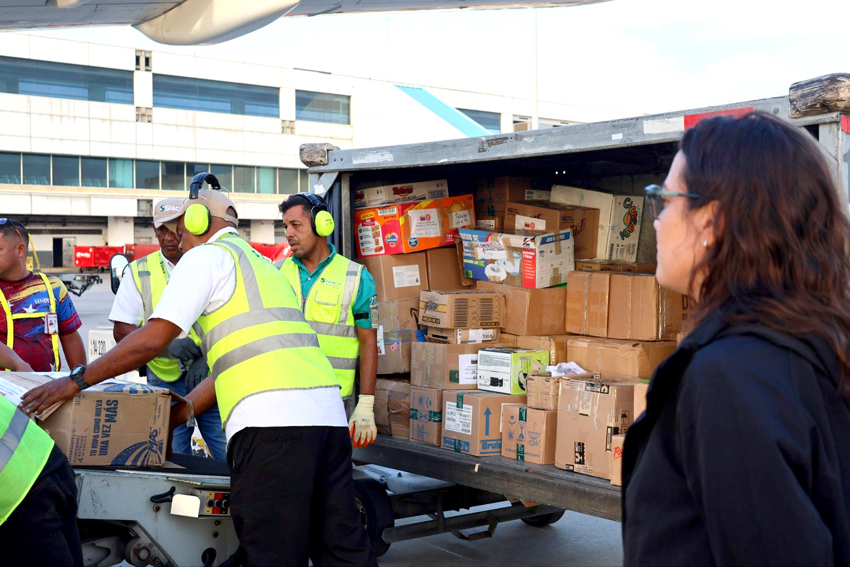
Venezuela received this Monday 341 tons of humanitarian aid from Mexico, the largest shipment ordered by President Sheinbaum following the 7.2 and 7.5 magnitude earthquakes of June 24.
The vessel ‘Isla Holbox’ transported 227 tons of supplies, while a second ship, ‘Huasteco’, completed the cargo with 114 additional tons including medical supplies, medicines, non-perishable food, and resources for housing reconstruction.
The cargo including four water purification plants and Mexican technical operators for their installation joins a sustained solidarity operation that deployed 250 rescue specialists and 18 canine units to search for survivors trapped under rubble, adding to a deployment that began just 48 hours after the disaster that claimed over 4,500 lives and left more than 16,700 injured.
Science and Technology Minister Yván Gil welcomed both vessels at La Guaira port and acknowledged Mexico’s swift response. The Mexican Ambassador to Venezuela, Leopoldo de Gyvés de la Cruz, ratified his country’s commitment and stated that the shipment responds to a direct instruction from President Sheinbaum following a request from the Venezuelan side.
The sustained Mexican humanitarian operation underscores the historic bonds between both nations, members of the Community of Latin American and Caribbean States and the Association of Caribbean States, and reflects the principle of South-South cooperation that has characterised bilateral relations since establishing diplomatic ties in 1831.
- A magnitude 5.0 earthquake struck the southern Mexican state of Chiapas on Monday, according to the National Seismological Service (SSN). The quake’s epicentre was located near the country’s border with Guatemala, triggering monitoring and assessment protocols by civil protection authorities.
The SSN said the earthquake’s epicentre was located 64 kilometres southwest of Ciudad Hidalgo, in the municipality of Suchiate. The event occurred at a depth of 44.2 kilometres.
Mexico’s National Civil Protection Coordination (CNPC) said there were no immediate reports of casualties or significant material damage following the earthquake. The agency also ruled out any tsunami threat, stating that no significant changes in sea level had been detected along the country’s Pacific coast.
‘Following the magnitude 5.0 earthquake recorded this morning, no significant variations in sea level have been reported, and there is no danger to port operations or the population.’
The CNPC added that it remains in permanent communication with state and municipal civil protection authorities to monitor the situation and respond to any developments.
Mexico is one of the world’s most seismically active countries due to the interaction of the Cocos, Rivera, Pacific, North American and Caribbean tectonic plates. Chiapas is particularly prone to earthquakes because it is located above the Cocos Plate, which is subducting beneath the North American Plate.