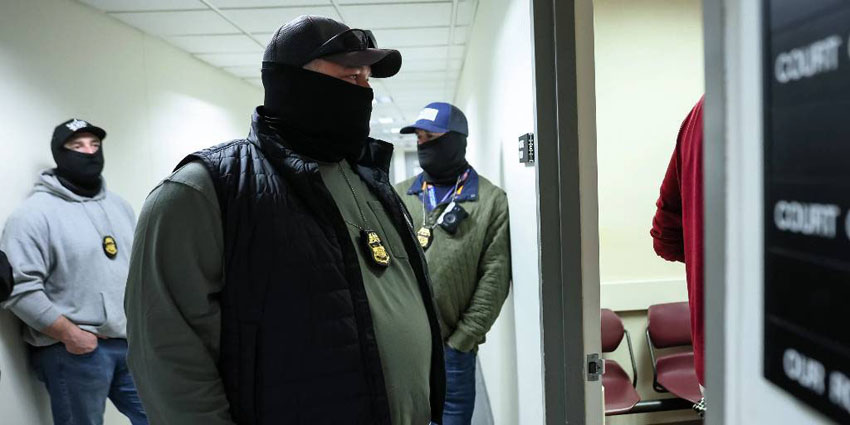
FEDERAL immigration agents arrested three men at New York City immigration courts over the past week, in the first serious breaches of two court orders that were meant to end such arrests.
On Thursday, Immigration and Customs Enforcement agents detained an Ecuadorian man at the court at 26 Federal Plaza and a Dominican man at another court at 290 Broadway, both in Lower Manhattan.
The arrests resumed on Monday, when agents took a third man, originally from Guatemala, into custody at 290 Broadway.
All three have since been moved to detention centres, according to ICE records.
The Dominican man is being held at ICE’s Delaney Hall facility in Newark, New Jersey, the Ecuadorian man at the D. Ray James processing centre in Folkston, Georgia, and the Guatemalan man at the Orange County Detention Facility in upstate New York.
In habeas corpus petitions challenging Thursday’s detentions, lawyers with the non-profit Make the Road New York accused the agency of violating both their clients’ right to due process and a federal court order, and demanded the men’s release so they could continue through the immigration process.
Two rulings should have stood in the way. On 18 May, US District Judge P. Kevin Castel barred ICE from arresting people at Manhattan’s immigration courts save in a narrow set of circumstances, requiring the agency to revert to a policy set in 2021 that permitted courthouse arrests only with prior authorisation and only in limited cases, such as when a person posed a threat to national security or public safety, agents were in direct pursuit, or an arrest could not be made elsewhere.
A second ruling, handed down on 24 June by a federal court in California, applies across the country.
By detaining the men on Thursday, ICE appears to be directly defying the New York order without offering any justification, said Representative Dan Goldman, a New York Democrat.
‘ICE continues to flagrantly violate the law by arresting immigrants who are attending their mandatory court hearings, despite a court order mandating an end to courthouse arrests,’ he said, adding that his office was working to secure the men’s release.
Murad Awawdeh, head of the New York Immigration Coalition, said the agency was operating outside the law.
‘We’re witnessing ICE, yet again, operate in a lawless and rogue fashion and not following court orders,’ he said.
‘We’re supposedly a nation under the rule of law, and our judicial branch has said that this agency must stop engaging in this lawless behaviour, and they continue to do so.’
A spokesperson for ICE denied that the agency had breached any order, but did not explain how the arrests fell within the exceptions Castel had set out.
The spokesperson pointed to a trespassing conviction against the Dominican man and a 2025 disorderly conduct conviction against the Ecuadorian man.
The Intercept, which first reported the arrests, is withholding the men’s names given the sensitivity of their cases.
The detentions broke a brief lull.
Between 18 May and last week, only two arrests took place at Manhattan’s immigration courts, and in both cases the detainees were quickly released after lawyers and rights groups invoked Castel’s order.
This time there has been no such reprieve, with all three men transferred out of the city.
The California ruling was the broader of the two. Judge P. Casey Pitts of the Northern District, in a 71-page opinion, found that ICE and the Executive Office for Immigration Review had violated the Administrative Procedure Act by scrapping earlier limits on courthouse arrests without adequate justification, calling the decision-making arbitrary and capricious.
He noted that the agency’s stated rationale bore no real connection to the sweeping expansion of arrests that followed, and rejected the government’s claim that immigrants with valid cases had nothing to fear, since ICE’s own policy carved out no exception for meritorious claims.
The same order struck down a June 2025 waiver that had allowed the agency to hold people in short-term cells for up to 72 hours, well beyond its traditional 12-hour limit.
The government has appealed, and the ruling drew swift condemnation from administration officials and Republican figures who cast it as judicial overreach into immigration enforcement.
Lawyers describe the courthouse arrests as part of a wider surge in detentions.
‘For whatever reason, that order is essentially being disregarded, and we’ve seen a pretty significant uptick in detentions,’ said Benjamin Remy, senior coordinating attorney at the New York Legal Assistance Group’s immigration protection unit.
In the roughly 18 months since President Trump returned to office and expanded the agency’s role in his mass deportation drive, ICE has repeatedly been found in violation of orders on immigrant detention, with advocates and court records pointing to an acceleration in recent months.
‘We’ve seen ICE have a fairly flexible and adaptive relationship when it comes to the truth and the facts,’ Remy said, ‘and to complying with court orders and frankly to rule of law as a fundamental concept.’
For close to a year from May 2025, arrests at 26 Federal Plaza, 290 Broadway and a third court at 201 Varick Street were routine, with hundreds seized by masked agents as they arrived for scheduled hearings.
By last August, more than half of all courthouse arrests nationwide were taking place in New York.
Like most of those detained over the past year, the three men were doing what the system demanded of them.
Each had fled persecution, entered the United States, been detained and then released while their cases proceeded, and each turned up when summoned.
Advocates say the arrests leave immigrants trapped, forced to choose between obeying the law by attending court and risking detention, or skipping a hearing and forfeiting any chance of remaining lawfully.
‘It is not uncommon for me to encounter folks walking into court in the morning already just sobbing,’ Remy said.
‘These arrests are discouraging the legal process. It’s discouraging people’s fundamental constitutional right to due process and to be able to have their day in court.’