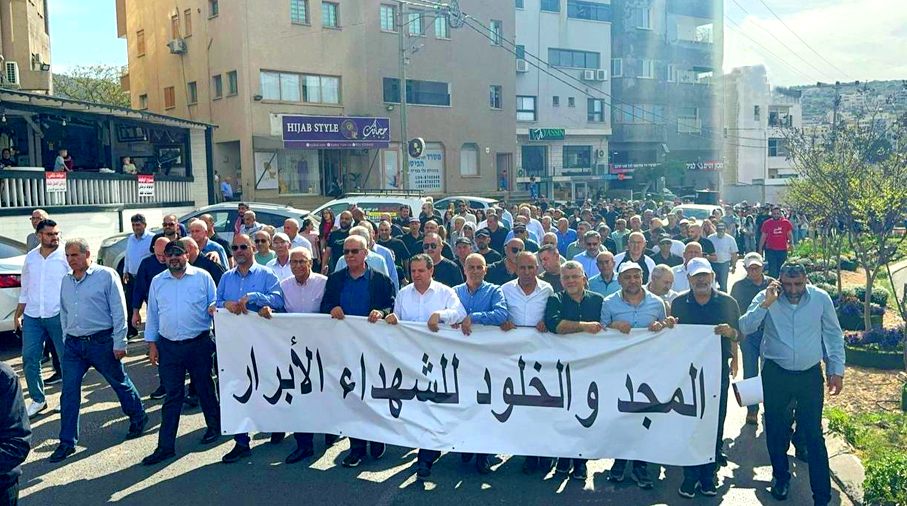
On the fiftieth anniversary of Land Day, Monday 30th March, Palestinians find themselves in one of the bloodiest and most complex phases in the history of their cause.
Land Day sees the ongoing assault and blockade on Gaza and the escalation of settlement and displacement policies in the West Bank, amid popular mobilisation and political positions that highlight the centrality of land as the essence of the struggle.
The events of Land Day erupted on March 30, 1976, when Palestinians inside 1948 occupied Palestine confronted sweeping land confiscations.
Six Palestinians were killed, and hundreds were injured and arrested.
This turning point became an annual symbol embodying the struggle over land and identity.
Since then, Land Day has remained a unifying occasion that reinforces national awareness and affirms that the conflict with the occupation continues to revolve around control of the land and the reshaping of Palestinian geography through settlement and annexation.
This year’s commemoration comes amid a devastating war on Gaza that has left massive destruction and unprecedented humanitarian crises, alongside accelerated settlement expansion in the West Bank.
Estimates suggest that effective Israeli control extends over more than 40% of its area through settlements, bypass roads, and military zones.
Officials and analysts see this as part of a historical trajectory based on land confiscation and the imposition of new demographic realities, with escalating displacement of Palestinian communities, especially in Area C, as part of a systematic reshaping of Palestinian geography.
In this context, Palestinian factions, including Hamas, affirmed that the Palestinian people are ‘rooted in their land and will remain steadfast, defending it by all means,’ considering the destruction and starvation in Gaza part of a plan aimed at displacing residents and imposing a new reality.
These positions stressed that Palestinians’ right to their land is inalienable, and that settlement and displacement policies will not succeed in changing historical facts, while emphasising the continuation of struggle until liberation and return.
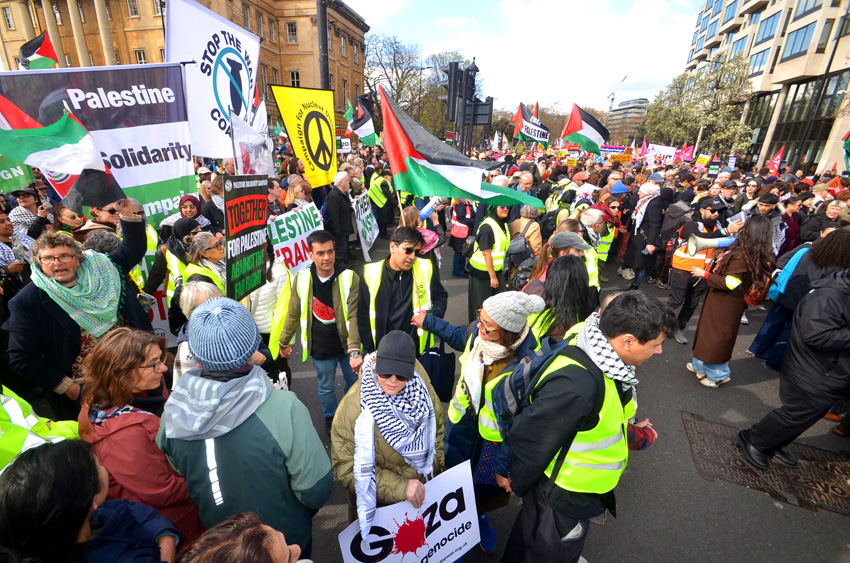
Internationally, several capitals saw solidarity movements.
In Tunisia, popular marches were held in support of Palestinians, raising slogans affirming the unity of the cause and rejecting displacement, while calling for stronger Arab and international support.
Observers note that such mobilisation reflects the continued presence of the Palestinian cause in Arab and global public consciousness, despite regional and international political shifts.
After fifty years since the eruption of Land Day, the struggle still revolves around the same theme: land and existence.
The tools may change, and the arenas of confrontation may expand, from direct confiscation to settlement projects and geographic re-engineering, but amid ongoing annihilation and mounting challenges, this year’s commemoration seems closer to a description of daily reality, affirming that the battle over land has never ceased and will remain the core of the Palestinian struggle until it is resolved.
On the 50th anniversary of Land Day, Palestinian officials warned of an unprecedented escalation in Israeli settlement activity and land control across the West Bank.
Moayyad Shaaban, head of the Wall and Settlement Resistance Commission, said current policies aim to reshape the geographic and demographic reality, undermining prospects for a viable Palestinian state.
He noted that Israel now exercises effective control over more than 42 per cent of the West Bank through settlements, outposts, bypass roads, and military zones, while about 61 per cent of the territory falls under full Israeli control.
The number of settlements and outposts has surpassed 542, housing over 780,000 settlers, alongside continued expansion through new housing units and infrastructure projects.
Shaaban underlined that since October 7th, settler attacks have contributed to the displacement of dozens of Bedouin communities, while hundreds of demolition orders and restrictions on Palestinian construction have intensified pressure on residents.
Shaaban called for stronger international action and renewed popular resistance, stressing that land remains at the core of the conflict and central to Palestinian identity.
On the 50th anniversary of Land Day, the Islamic Resistance Movement, Hamas, affirmed that ‘our people are deeply rooted in their land and will remain steadfast, defending it by all means, until they reclaim all their rights and achieve their aspirations of liberation and return.’
In a press statement issued on Monday, the Movement said: ‘This year’s fiftieth anniversary of the eternal Land Day comes after more than two years of genocide, starvation, ethnic cleansing, and attempts at forced displacement suffered by our people in the Gaza Strip.
‘Its grave consequences still affect every aspect of human life there. Meanwhile, the fascist occupation government escalates its crimes of settlement expansion, annexation, Judaization, and displacement in the West Bank and occupied Jerusalem, continues to close Al-Aqsa Mosque, and commits grave violations against prisoners, an aggression that exposes the true nature of this Zionist enemy, which violates all international norms, conventions, and divine laws, and poses a real threat to the security and stability of the region and the world.’
The statement recalled, ‘Our people commemorate this eternal day every year on March 30, remembering the spark ignited in 1976 by the masses in the Triangle, Galilee, and Negev in our lands occupied in 1948, in response to settlement expansion and in resistance to displacement policies.
‘This anniversary has become a unifying national symbol to strengthen unity, struggle, and resistance, inspiring generations with the spirit of sacrifice, defiance, and determination to hold fast to the land and confront aggression until the occupation is defeated and removed from our land.’
On this occasion, Hamas paid tribute to ‘the souls of our righteous martyrs, prayed for the recovery of our brave wounded, saluted our free prisoners, and honoured our steadfast people in Gaza, the West Bank, Jerusalem, 1948 occupied Palestine, and refugee camps in exile.
‘We send a message of pride to all those standing firm on the frontlines of the homeland, pledging to continue the path of holding to our constants and defending our land and holy sites until their liberation and the realisation of return.’
The Movement stressed: ‘The crimes of the Zionist enemy against our people, our land, and our Islamic and Christian holy sites will never lapse with time, nor establish any right or legitimacy for it.
‘At the same time, they will not break our people’s will or deter them from continuing the path of struggle, steadfastness, and adherence to rights and constants.’
It added: ‘Enabling our people to hold fast to their land, live in freedom and independence, and defend it by all means is not a favour from anyone, but a legitimate right affirmed by international conventions to rid the world of the most criminal, settler-colonial occupation still ongoing.’
Hamas declared: ‘The occupation’s schemes, land theft, settlement expansion, and displacement of our people will not succeed in changing the facts of history and reality or erasing the features of Palestinian land.’
It reaffirmed: ‘We will not relinquish or concede a single inch of Palestine. Our people will remain steadfast, defending it by all means, until they reclaim all their rights and achieve their aspirations of liberation and return.’
The statement emphasised: ‘Jerusalem and the blessed Al-Aqsa Mosque have always been and will remain the crown jewel of our blessed historic land.
‘The occupation will never have sovereignty or legitimacy over any part of them. We will protect and defend them, no matter the sacrifices.
‘The return of refugees to their land, from which they were forcibly displaced by the Zionist occupation, is both a right and a duty, individual and collective, that no one has the authority to relinquish. We renew our categorical rejection of all resettlement and alternative homeland projects.’
Finally, Hamas called on the Arab and Islamic nations to ‘unite and stand together to confront and thwart all colonial schemes and objectives of the Zionist entity, which go beyond Palestine and threaten the security, stability, and unity of our nation.’
It also urged ‘the free people of the world to strengthen all forms of solidarity and support for our just cause and legitimate struggle, to isolate the racist fascist Zionist entity, criminalise its terrorism, and prosecute its leaders, leading to the end of the occupation and enabling our people to achieve freedom, independence, self-determination, and the establishment of an independent Palestinian state with Jerusalem as its capital.’