The polar low-pressure system ‘Byron’ has intensified the unprecedented humanitarian catastrophe in the Gaza Strip after striking the area last Wednesday evening, bringing torrential rains and violent winds amid a near-total collapse of infrastructure and basic services destroyed by the ongoing Israeli war.
This has led to the flooding of vast areas with rainwater mixed with sewage, the collapse of partially destroyed homes on their occupants, the disruption of relief and emergency operations, and a rise in the death toll.
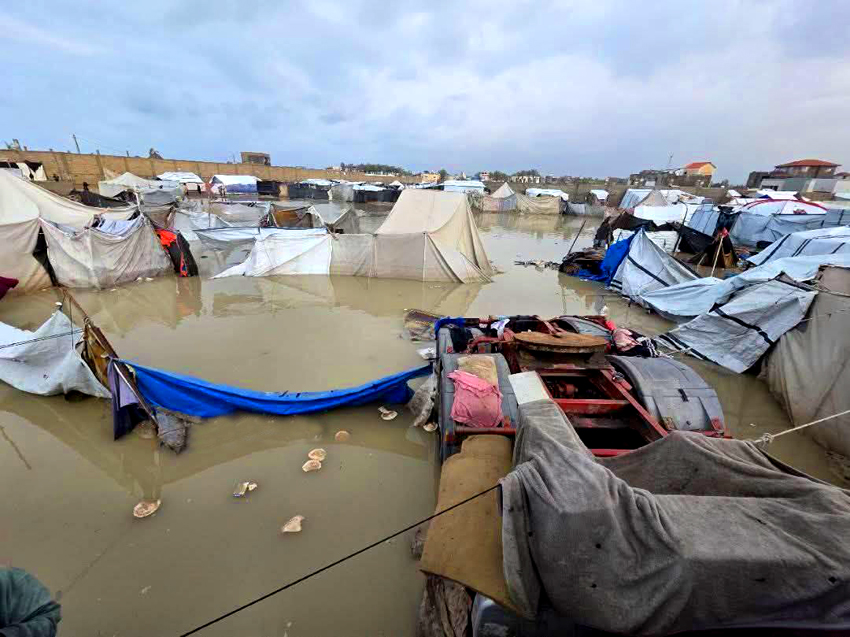
Flash floods inundated thousands of displacement tents, particularly in coastal and low-lying areas. Gaza’s residents, especially those forcibly displaced and living in camps, lack heating and insulating materials, amid deteriorating living and health conditions and unprecedented pressure on hospitals already suffering from severe shortages of medicines and medical supplies due to the ongoing blockade.
Record rainfall and
dangerous climate indicators
Engineer Ahmed Suhail Abu Abdu, an international climate change consultant, said the depression recorded ‘rainfall exceeding 100mm across the Gaza Strip, expected to reach 120mm, about a quarter of the annual average within a very short period,’ noting wind gusts exceeding 45km/h, a marked rise in sea waves, and severe cold that directly affected children, patients, and the elderly.
Abu Abdu explained that these weather conditions came about ten days before the official start of winter, reflecting ‘clear indicators of increasing intensity of climate phenomena linked to global climate change, which particularly harm fragile, conflict-affected areas such as the Gaza Strip.’
He warned of the severity of upcoming winter systems, calling for the provision of safe, cold- and rain-resistant shelters instead of tents, the urgent opening of humanitarian corridors, and engineering assessments of buildings and soil to reduce the risks of collapses and landslides.
Deaths from cold and acute medicine shortages
According to local data, the weather depression has so far caused the deaths of 14 citizens due to extreme cold, with expectations that the number will rise; children are the most affected.
The Ministry of Health reported the death of infant Rahaf Abu Jazar due to cold in Khan Younis, as well as the death of another infant in al-Shati refugee camp west of Gaza City.
The ministry confirmed that the health situation is alarming, with shortages reaching catastrophic levels: 52% of essential medicines, 71% of medical consumables, and 70% of laboratory supplies are currently out of stock.
Home collapses and
thousands of distress calls
The Palestinian Civil Defence reported that the depression caused the collapse of around 13 homes in various parts of the Strip. The latest incident occurred last Friday morning when a large wall fell onto displacement tents near the ‘Taj Mall’ west of Gaza City, killing one person and critically injuring another.
Several homes in Jabalia and the Sheikh Radwan neighbourhood were evacuated after partial collapses. The Civil Defence received more than 4,300 distress calls during the days of the storm, confirming that over a quarter of a million displaced people were directly affected by flooding and tent collapses.
Testimonies from the heart of the tragedy
Citizen Amjad Dawoud, a father of two, described his ordeal: ‘We live on the roof of my family’s house, which is at risk of collapse, after returning from the south of the Strip. As the rain and winds intensified, a wall fell on the tent where we sleep, tarps flew away, and stones fell on our heads. We narrowly escaped death. There is nowhere else to go.’
In Al-Mawasi, Khan Younis, a resident, identified as (J M) said that water flooded the tents despite precautions: ‘The rain didn’t stop. We woke up at dawn on Thursday to find large amounts of water inside the tent. I carried my children to my brother’s neighbouring tent, and four families slept together to protect the children from the cold. All the blankets and mattresses were soaked, and almost the entire camp was flooded.’
Thousands of damaged tents and municipal paralysis
Local sources estimate that around 27,000 tents were either flooded or swept away by flash floods and uprooted by strong winds, especially in the Al-Mawasi area of Khan Younis.
According to the Shelter Cluster, at least 259,000 Palestinian families – more than 1.45 million people – require urgent shelter.
Gaza’s municipalities face an almost complete inability to respond to the disaster due to lack of capacity, the ban on the entry of equipment and heavy machinery, and the destruction of sewerage networks and infrastructure. This hampers road access and water drainage and delays the arrival of relief and civil defence teams to affected areas.
International warnings and urgent calls
Angelita Caredda, Regional Director for the Middle East and North Africa at the Norwegian Refugee Council, said: ‘We have an extremely limited opportunity to protect families from winter rains and bitter cold. Large quantities of shelter materials were supposed to reach Gaza after the ceasefire, but what has arrived represents only a small fraction of actual needs.
‘The international community must act immediately to ensure the unhindered entry of these materials.’
Meanwhile, the Al-Mezan Centre for Human Rights warned of a worsening humanitarian catastrophe amid the continued war and the prevention of the entry of medicines, medical supplies, heavy equipment, and shelter materials.
It stressed that children, women, and the elderly face inhumane conditions that threaten their lives daily, especially with the intensification of weather depressions.
The Centre called on the international community to assume its legal and moral responsibilities toward Gaza’s population, urgently and permanently open the crossings, allow the entry of shelter materials, medical equipment, and heavy machinery, and accelerate the rehabilitation of essential infrastructure, steps that would help save lives and curb the worsening humanitarian catastrophe.
The medicine crisis in the Gaza Strip continues to escalate to unprecedented levels, threatening the lives of thousands of patients who stand in long queues at hospital doors, hoping medication will arrive before disease complications overtake them.
The picture is grim, as described by Alaa Adnan Helles, Director of the Hospital Pharmacy Department at Gaza’s Ministry of Health, who says that ‘the healthcare sector is living through one of its harshest moments.’
Shocking figures
Helles states: ‘We are facing an actual collapse. More than 55% of essential medicines are unavailable, and over 71% of medical supplies have reached zero. Ministry warehouses are nearly empty, and patients are paying the price every single day.’
Key services have come to a complete halt, most notably open-heart surgery, while orthopaedic and oncology services are ‘eroding day by day.’
The director of Al-Shifa Medical Complex previously confirmed that out of 170,000 wounded individuals, 42,000 are in urgent need of surgery, amid a severe shortage of supplies and medications.
Pain that waiting
cannot heal
In the oncology department at Al-Shifa Hospital, 47-year-old Sami Mohammad Qandil, a mathematics teacher from the Al-Tuffah neighbourhood, sits waiting for his fifth chemotherapy dose, but the dose has not arrived.
Speaking calmly, despite the anxiety on his face, Sami says: ‘I started treatment four months ago, and things were stable. Weeks ago, they told me the medicine wasn’t available. I’m not afraid of the disease itself; I’m afraid it will reach an uncontrollable stage because of the delay.’
His wife, Salwa Nasser, who accompanies him daily, adds: ‘We’re not asking for a miracle. We just want to complete a treatment we already began. Illness does not wait and time is not on our side.’