DESPITE the ceasefire agreement of October 10, 2025, the gas crisis deepens in Gaza, the Strip’s General Petroleum Authority warns.
Despite nearly three months having passed since the ceasefire and the resumption of limited supplies of household gas into the Gaza Strip, the gas crisis continues to cast a heavy shadow over residents’ lives.
What began as an emergency has turned into a daily hardship affecting the smallest details of living, further fuelling rising prices, poverty, and unemployment.
Gaza’s General Petroleum Authority says the number of gas trucks entering the Strip ranges between 15 and 23 per week at best, while actual needs are estimated at around 100 trucks weekly.
Each truck carries approximately 20,000 kilogrammes of gas, revealing a sharp gap between supply and demand, one that explains the persistence of long queues and citizens waiting for weeks or even months without obtaining a gas cylinder.
Distribution mechanisms under scrutiny
The Authority confirms that 93% of incoming gas quantities are directed straight to citizens through officially approved lists, while the share allocated to stations and distributors does not exceed 6%, after being recently reduced in favour of consumers.
There are about 14 gas filling stations operating in the Strip, four in northern Gaza (one of which is temporarily out of service) and ten in the south.
As for restaurants and bakeries, the Authority stresses that no official quantities are allocated to them.
These establishments are therefore forced to purchase gas from the local market, with the maximum allowed amount reduced from 100 cylinders to just 30, amid severe shortages.
Families’ suffering: waiting and harsh
alternatives
Fathi Manaa, a father from Deir Al-Balah, says the gas crisis has become part of the daily routine of suffering. He says: ‘We registered through the official link and have been waiting our turn for a long time, but to no avail.’
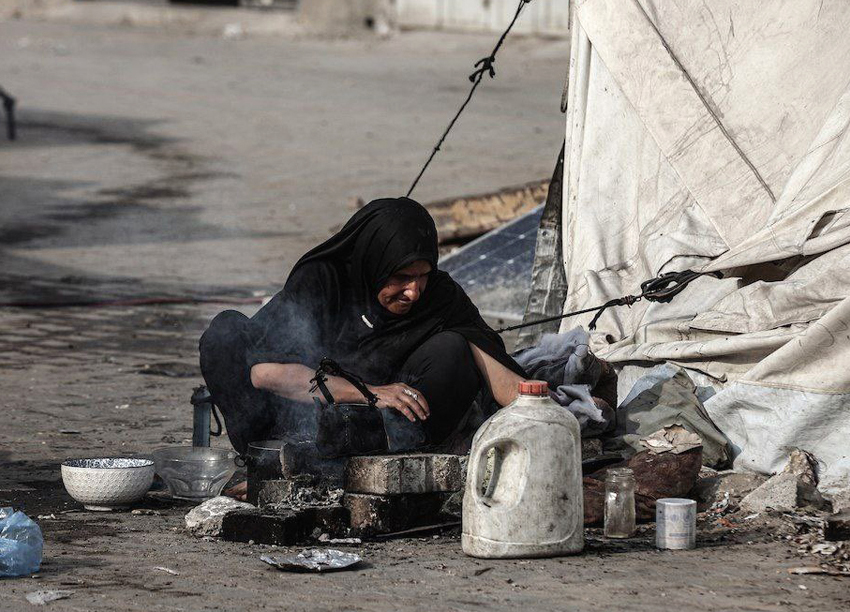
He told a Palestinian Information Centre correspondent that the entry of limited quantities under a ‘drip-feed’ policy has kept the crisis ongoing without fundamental solutions, forcing many families to resort to primitive cooking alternatives, such as collecting firewood or buying it at high prices that reach five shekels per kilogramme.
The black market adds fuel to the fire
With demand unmet, the black market has flourished, and the price of gas has surged to around 80 shekels per kilogramme, several times higher than the normal price.
This increase not only burdens households but also impacts commercial and service sectors.
Abu Nidal Al-Khalidi, the owner of a shawarma shop in central Gaza, explains that gas shortages and high prices threaten the survival of small businesses.
He says: ‘We buy gas from the black market without any allocated quantities, which raises costs and shrinks profit margins.’
He notes that the price of a sandwich has remained at 15 shekels, though it could have dropped to 12 shekels had gas been available at its normal price.
The gas crisis remains unresolved, with suffering intensifying further as winter sets in.
Meanwhile, the Civil Defence in the Gaza Strip announced on Monday morning that it has suspended its response to calls for removing hazards caused by buildings dangerously damaged by Israeli airstrikes, because there is no fuel or rescue equipment.
In an official statement, the agency explained that since the ceasefire agreement took effect in October, its teams have managed to remove dangerous concrete blocks and walls from approximately 3,445 damaged buildings and homes that posed direct threats to the lives of residents and displaced persons across the Strip.
However, around 1,560 emergency calls related to damaged buildings remain pending, as these structures continue to pose serious risks to public safety.
The Civil Defence expressed deep regret over its inability to meet ongoing emergency needs, citing the near-total depletion of gasoline supplies and widespread damage to equipment in multiple governorates.
It added that even under normal conditions, its resources were only sufficient to handle about 30% of all calls.
It warned that thousands of citizens living in or near these buildings, many of whom are displaced and residing in tents, now face life-threatening risks due to the halted response to urgent calls.
It urged the countries sponsoring the ceasefire agreement to take responsibility by ensuring the humanitarian response needs are met and by pressuring Israeli authorities to allow the entry of adequate fuel and rescue equipment to enable civil defence teams to fulfil their life-saving mission.
Previously, in late November, the Civil Defence reported that roughly 50% of its services had effectively ceased due to fuel shortages, severely hindering its ability to respond to thousands of dangerous and damaged buildings and threatening a full halt to search and rescue operations.
At that time, the agency also noted that its ability to respond to fires, explosions, and building collapses had been significantly disrupted, putting civilians at direct risk.
In a related statement, the Gaza Centre for Human Rights expressed grave concern over the continued Israeli obstruction of fuel and diesel shipments into the Strip, warning that it puts humanitarian response efforts in extreme jeopardy.
Last Thursday, the centre said that Israel’s strict restrictions on fuel entry have had a devastating effect on all aspects of life in Gaza, which is already grappling with catastrophic humanitarian conditions.
Similarly, the Union of Gaza Municipalities had previously warned of the consequences of continued fuel blockage, emphasising that it exacerbates the humanitarian crisis, threatens the collapse of essential services, and endangers civilian lives.
Despite nearly three months having passed since the ceasefire agreement was signed, Israel continues to evade its commitments, foremost among them allowing fuel and essential equipment into Gaza to enable humanitarian sectors to carry out their work.
- The United Nations Relief and Works Agency (UNRWA) has reported that over 12,000 Palestinian children are experiencing forced displacement in the occupied West Bank due to the ongoing Israeli assault on the northern governorates.
Since January 21, 2025, the Israeli army has been conducting a large-scale operation in the northern West Bank, dubbed ‘Operation Iron Wall,’ beginning in Jenin Refugee Camp and later expanding to the camps of Nur Shams and Tulkarm.
Israeli forces have imposed a strict siege on the three camps, destroying infrastructure, homes, and shops, resulting in the displacement of approximately 50,000 Palestinians, according to official data.
In a post on its X platform account, UNRWA stated that ‘over 12,000 children remain forcibly displaced in the West Bank.’
In February 2025, the UN agency launched an emergency education programme for displaced children in the north, ensuring continuity of learning through temporary learning spaces, remote education, and psychosocial support. UNRWA noted that nearly 48,000 Palestinian children attend its schools in the West Bank.
Since the start of Israel’s genocidal war on Gaza on October 7th, 2023, which has lasted for two years, Israeli forces and settlers have intensified their attacks in the West Bank, including killings, home demolitions, forced displacement, and settlement expansion.
These operations have extended into Occupied Jerusalem, leaving at least 1,105 Palestinians killed, around 11,000 injured, and more than 21,000 people arrested.